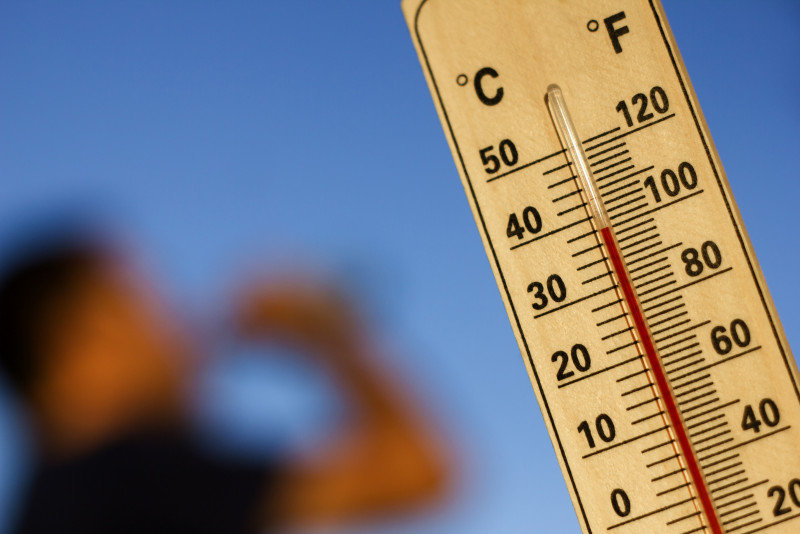
CURRENT policies to limit global warming will expose more than a fifth of humanity to extreme and potentially life-threatening heat by century's end, researchers warned Monday.
Earth's surface temperature is on track to rise 2.7 degrees Celsius above preindustrial levels by 2100, pushing more than two billion people – 22% of projected global population – well outside the climate comfort zone that has allowed our species to thrive for millennia, the scientists reported in Nature Sustainability.
The countries with the highest number of people facing deadly heat in this scenario are India (600 million), Nigeria (300 million), Indonesia (100 million), as well as the Philippines and Pakistan (80 million each).
"That's a profound reshaping of the habitability of the surface of the planet, and could lead potentially to the large-scale reorganisation of where people live," said lead author Tim Lenton, director of the Global Systems Institute at the University of Exeter.
Capping global warming at the 2015 Paris climate treaty target of 1.5C would sharply reduce the number of those at risk to less than half-a-billion, some 5% of the 9.5 billion people likely to inhabit the planet six or seven decades from now, according to the findings.
Just under 1.2C of warming to date has already amplified the intensity or duration of heatwaves, droughts and wildfires beyond what could have occurred absent the carbon pollution generated by burning fossil fuels and forests. The last eight years were the hottest on record.
"The costs of global warming are often expressed in financial terms, but our study highlights the phenomenal human cost of failing to tackle the climate emergency," said Lenton.
"For every 0.1C of warming above present levels, about 140 million more people will be exposed to dangerous heat."
Profoundly unjust
The threshold for 'dangerous heat' used in the new findings is a mean annual temperature (MAT) of 29C.
Across history, human communities have been densest around two distinct MATs – 13C (in temperate zones) and to a lesser extent 27C (in more tropical climes).
Global warming is pushing up the thermostat everywhere, but the risk of tipping into lethal heat is clearly higher in regions already close to the 29C red line.
Sustained high temperatures at or beyond that threshold, studies have shown, are strongly linked to greater mortality, reduced labour productivity and crop yields, along with more conflict and infectious disease.
As recently as 40 years ago, only 12 million people worldwide were exposed to such extremes.
That number has today increased five-fold, and will climb ever more steeply in coming decades, the study found.
The risk is accentuated in regions straddling the equator, where human populations are expanding most rapidly: tropical climes can become deadly even at lower temperatures when high humidity prevents the body from cooling itself through sweating.
Episodes of extreme humid heat have doubled since 1979.
Those most exposed to extreme heat live mostly in poorer countries with the smallest per capita carbon footprints, the authors say.
According to the World Bank, India emits on average about two tonnes of CO2 per person every year and Nigerians about half-a-tonne annually, compared to less than seven tonnes per person in the European Union and 15 in the United States.
Carbon-cutting pledges by governments and companies not yet translated into action would stop the rise in global temperatures at – or even below – 2C, allowing hundreds of millions to avoid catastrophic heat.
But scenarios even worse than the 2.7C world that would result from current policies cannot be excluded either, the authors warn.
If past and continuing emissions trigger the release of natural carbon stores, such as in permafrost, or warm the atmosphere more than anticipated, temperatures could climb nearly four degrees above mid-19th century levels, they said. – AFP, May 23, 2023