CHINA, Japan, and South Korea, which have formed informal alliances since the announcement of sweeping US tariffs, held their second trilateral meeting in just eight days in Kuala Lumpur.
This quick succession of meetings highlights the urgency prompted by the ripple effects of Washington’s tariffs on global markets.
Bernama reported today that the latest meeting, held on March 30, gained significant attention after the US President announced a baseline tariff of 10 per cent on all countries, with higher duties for some.
China now faces a 34 per cent tariff on imports, while Japan is hit with a 24 per cent duty. South Korea is attempting to reduce the 25 per cent tariff rate imposed on it.
The meeting raised concerns about the global economic outlook, as such tariff policies have a detrimental effect on trade, business, and consumer confidence, straining diplomatic relations.
The global markets took a severe hit on Monday, reportedly losing more than US$10 trillion, with Malaysia’s stock market alone shedding RM93.15 billion in market capitalisation.
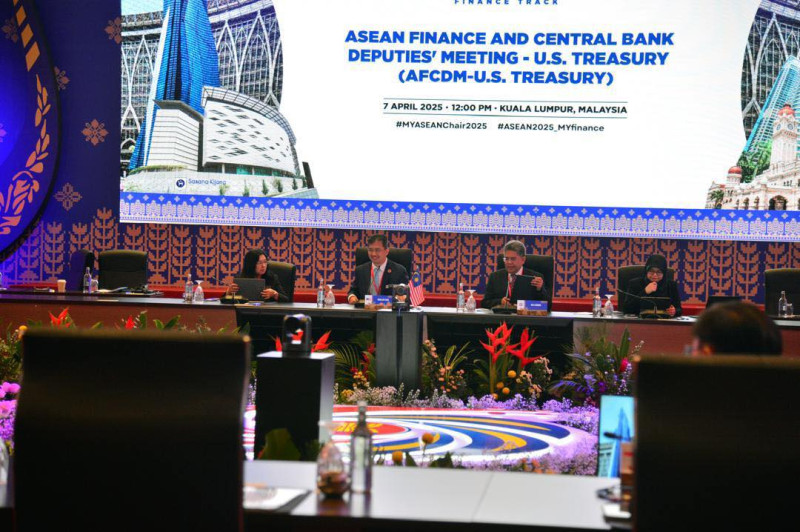
The trilateral discussions, held on the sidelines of the 12th ASEAN Finance Ministers’ and Central Bank Governors’ Meeting (AFMGM), were attended by China’s Vice Minister of Finance, Liao Min; Japan’s Vice Minister of Finance, Atsushi Mimura; and South Korea’s Deputy Minister for International Affairs, Ministry of Economy and Finance, Choi Jiyoung.
The three officials are also expected to attend two sessions of the ASEAN+3 Finance and Central Bank Deputies Meeting (AFCDM+3) today.
This latest US move is set to raise duties on Chinese goods to 54 per cent this year, while South Korea faces a 25 per cent tariff. In response, China has announced retaliatory tariffs of 34 per cent on all US imports, effective April 10, according to international media reports.
The trilateral economies had previously met in late March and signalled a joint response to the escalating tariff tensions. The March 30 meeting marked the first economic dialogue in five years between the three Asian export giants, who are keen to strengthen regional trade amid rising US protectionism.
At the Seoul meeting, China, Japan, and South Korea reaffirmed their commitment to trilateral economic and trade cooperation to address “emerging challenges”—a partnership that is increasingly seen as vital in light of the US measures that have sparked fears of a global trade war.
The three nations also agreed to accelerate negotiations on a trilateral free trade agreement, although tangible progress remains elusive. - April 8, 2025