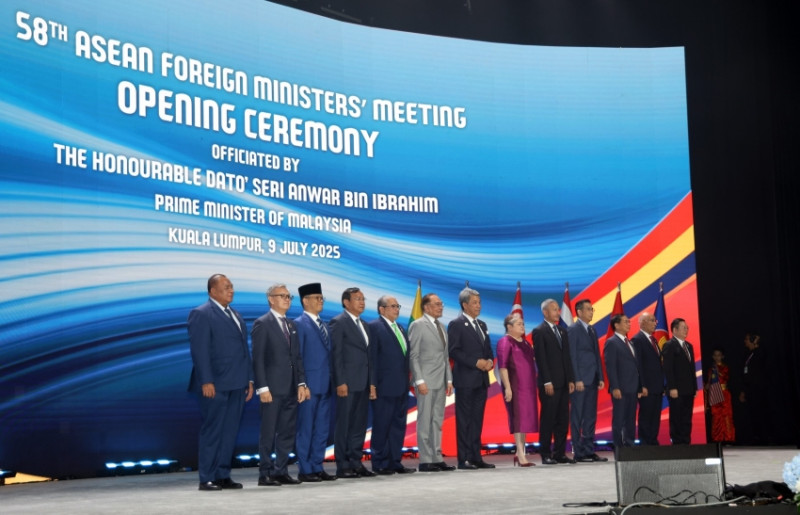
THE 58th ASEAN Foreign Ministers’ Meeting (AMM) and Related Meetings concluded in Kuala Lumpur on 11 July amid mounting concern over the United States’ latest round of sweeping tariff hikes, which became a central point of discussion among regional leaders.
Held under Malaysia’s 2025 ASEAN Chairmanship, the four-day summit saw foreign ministers and economic partners recalibrate regional diplomacy in response to global trade volatility—heightened by President Donald Trump’s announcement just a day before the meeting began, imposing tariffs of between 25 and 40 per cent on 14 countries, including several ASEAN members.
While revisions saw modest reductions for Vietnam, Cambodia, Laos and Myanmar, Malaysia was handed a marginally increased tariff rate of 25 per cent, effective 1 August, up from 24 per cent announced in April. Final decisions for the Philippines, Brunei and Singapore are still pending.
In his remarks following talks with US Secretary of State Marco Rubio, Malaysia’s Prime Minister Datuk Seri Anwar Ibrahim remained measured yet firm.
“Rubio stated that the letter was general, but Malaysia still has about one month to negotiate. He also acknowledged that Malaysia is a major trading partner of the US in this region, and will consider and present our views,” Anwar said.
He reiterated Malaysia’s commitment to neutrality and strategic autonomy: “No. While the US is an important trading partner, we will also strengthen our ties with China, ASEAN countries, and others to safeguard our people’s interests and the nation’s well-being.”
The tone was echoed by ASEAN Secretary-General Kao Kim Hourn, who announced that a joint meeting between ASEAN foreign and economic ministers would be held ahead of the 47th ASEAN Summit in October to coordinate a collective regional response.
“ASEAN continues to pursue constructive engagement and negotiation with the United States,” Kao said. He also highlighted ongoing diversification efforts, including a raft of free trade agreements with China, Japan, Korea, India, Australia and New Zealand.
Malaysia’s Foreign Minister Datuk Seri Mohamad Hasan stressed the urgency of internal reform.
“Before the summit of heads of state and government, the foreign ministers and ministers of economy and trade will convene in a single forum,” he said. “We need to be more efficient, as the world has changed dramatically. We cannot afford to wait for others. The best approach now is through collective ASEAN action.”
Despite external shocks, ASEAN’s trade outlook remains resilient. In 2024, intra-ASEAN trade totalled US\$800 billion, with the bloc’s overall trade reaching US\$3.8 trillion.
Kao confirmed legal finalisation is nearing completion for the upgraded ASEAN-China Free Trade Area (ACFTA 3.0), with signing targeted for October. Negotiations are also accelerating for the ASEAN Digital Economy Framework Agreement.
He added that ASEAN continues to eliminate non-tariff barriers and has established a Geoeconomic Strategy Task Force to guide collective responses to global headwinds.
As geopolitical currents intensify, ASEAN leaders made it clear that the bloc’s course will be determined from within. Prime Minister Anwar summed up the sentiment with a pointed reminder:
“We are a region that charts its course, deliberately, coherently and with purpose. ASEAN will not be spoken for in absentia.” - July 12. 2025