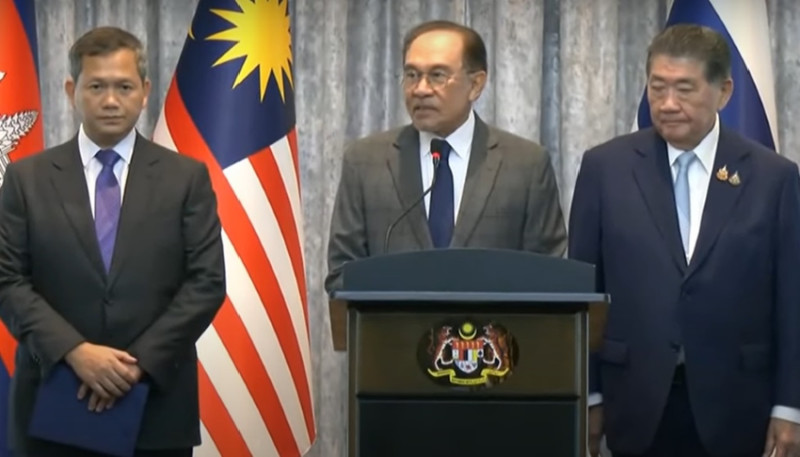
THAILAND and Cambodia have committed to an immediate and unconditional ceasefire following a high-level meeting hosted by Malaysia in Putrajaya, aimed at de-escalating the recent border conflict between the two Southeast Asian neighbours.
The talks were convened by Prime Minister Datuk Seri Anwar Ibrahim, in his capacity as Chair of ASEAN, and attended by Cambodian Prime Minister Samdech Moha Borvor Thipadei Hun Manet and Thailand’s Acting Prime Minister Phumtham Wechayachai.
The United States co-organised the session, while China participated as an observer.
In a joint statement issued after the meeting, both leaders expressed their “positions and willingness for immediate ceasefire and return to normalcy”.
The ceasefire took effect at midnight local time on 28 July 2025, marking a critical step towards ending weeks of skirmishes along the disputed border region near Preah Vihear.
The United States President Donald J. Trump had reportedly contacted both leaders prior to the meeting, urging a peaceful resolution, while the Chinese government had also been in active dialogue with all relevant parties, including Malaysia.
As part of the ceasefire agreement, regional military commanders from both sides are scheduled to meet at 07:00 on 29 July. This will be followed, subject to mutual agreement, by discussions involving defence attachés under ASEAN auspices.
The General Border Committee (GBC) will reconvene on 4 August in Cambodia to advance further negotiations and stabilisation efforts.
Malaysia, as ASEAN Chair, has committed to forming and coordinating a regional observer team to verify compliance with the ceasefire, with other ASEAN member states expected to participate in this monitoring initiative.
Cambodia and Thailand also agreed to resume direct communication between their respective Prime Ministers, Foreign Ministers and Defence Ministers, to maintain diplomatic momentum.
Foreign and Defence Ministries from the three countries have been instructed to develop a formal mechanism for the implementation, verification and reporting of the ceasefire — described as essential groundwork for lasting peace and accountability.
“The meeting reaffirms the shared resolve of Malaysia, Cambodia and Thailand to uphold the principles of international law, peaceful co-existence and multilateral cooperation in pursuit of a just and lasting resolution to the situation,” the statement concluded.
The special meeting between Thailand and Cambodia opened in Putrajaya on Monday in a bid to establish a ceasefire and halt hostilities along their disputed border, amid rising military tensions that have led to casualties.
The urgent dialogue was convened by Malaysian Prime Minister Datuk Seri Anwar Ibrahim, who is currently serving as ASEAN Chair. The initiative aims to de-escalate the growing conflict and restore stability to the affected region.
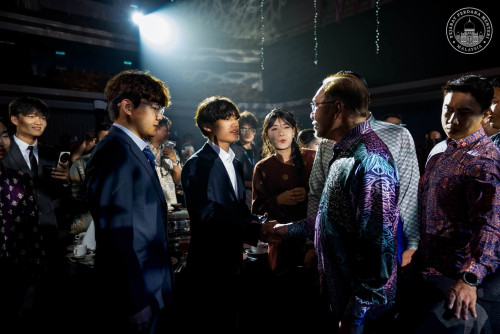
Thailand’s Acting Prime Minister Phumtham Wechayachai arrived at the Seri Perdana Complex at 2.51pm, followed shortly by Cambodian Prime Minister Hun Manet. Both leaders were received by Anwar ahead of the closed-door meeting.
Also present were US Ambassador to Malaysia Edgard Kagan, representing Washington as a co-facilitator of the dialogue, and Chinese Ambassador Ouyang Yujing, attending in an observer capacity.
Last Friday, Anwar held separate calls with both Phumtham and Manet to urge an immediate ceasefire and a return to negotiations. He had earlier stressed Malaysia’s readiness to assist and facilitate the process in line with ASEAN’s principles of unity and shared responsibility.
The two neighbours share a long and unsettled 817-kilometre border, which has been the source of recurring diplomatic and military disputes.
Tensions flared anew on 28 May following a fatal skirmish near the disputed Preah Vihear region, which claimed the life of a Cambodian soldier.
Clashes continued to escalate, culminating in a new round of armed exchanges on 24 July along Cambodia’s northern frontier. - July 28, 2025