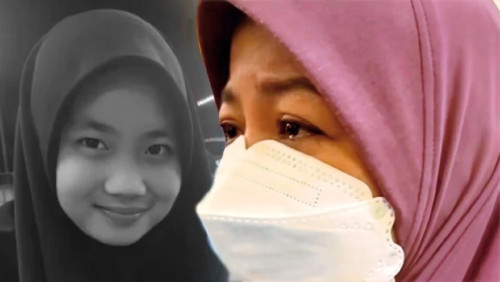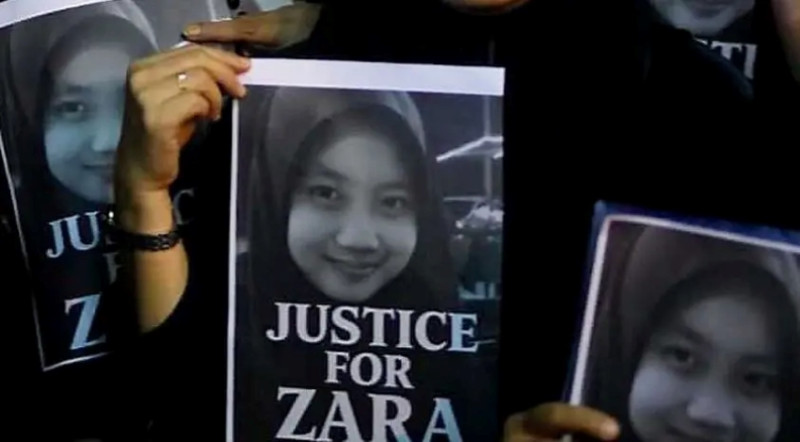
A TOTAL of 21 evidence bags containing handwritten documents and notebooks were submitted to the Chemistry Department of Malaysia in connection with the inquest into the death of Zara Qairina Mahathir, the Coroner’s Court was told today.
Nurul Atiqah Mohd Noh, a forensic document examiner from the Document Examination Division at the Forensic Science Analysis Centre, Chemistry Department of Malaysia in Petaling Jaya, testified as the second witness in the inquest proceedings.
“All documents marked W1 to W6, Y1 to Y7, and Y9 to Y15 bore the Royal Malaysia Police seal number 314. One Police Form 31 with report number Kinarut 1776/25 was also received at 8.37am on 20 August,” she told the court.
During the proceedings, Nurul Atiqah conducted a re-identification of the submitted materials, which consisted of handwritten sheets marked ‘Y’ as well as exercise books, workbooks, and notebooks belonging to the late Zara Qairina, marked ‘W’.
The inquest resumed at 9.20am before Coroner Amir Shah Amir Hassan, with Dana Arabi Wazani acting as the conducting officer.
Nurul Atiqah, 44, who has 21 years of experience as a forensic science officer, explained that her duties include receiving case materials, conducting forensic analyses, and producing chemical examination reports.
Her expertise spans various types of document examination including handwriting, signatures, typewriting, alterations, printing processes, paper, and ink.
“I have also provided court testimony when required. To the best of my knowledge, my expert opinion has been accepted by the courts,” she said during her statement.
She explained that the handwriting in question was analysed and compared against known samples to determine whether the writings belonged to the deceased.
“I examined all the disputed handwriting and compared it with known handwriting samples. I identified similarities and differences in the characteristics of the writing using a magnifying glass and a Video Spectral Comparator,” she said.
Nurul Atiqah told the court that part of the handwriting submitted, particularly from a book under examination, was believed not to have been written by Zara Qairina.
“After comparison, I found that the disputed handwriting on sheets Y1 to Y7 and Y9 to Y15 showed significant similarities with the sample handwriting marked ‘SA’. Therefore, I am of the opinion that it was written by the sample writer,” she stated.
The same conclusion was reached for sheet Y8, as well as two additional sheets marked W1 and W2, which also matched the sample handwriting.
Further analysis of a notebook marked W3 revealed writings by both Zara Qairina and another individual.
“For pages 3 to 6, 15 to 24, 38 to 45, 47 to 57, 65 to 72, and 90 to 103, the disputed handwriting also showed significant similarities with the sample writer. However, for pages 2, 7 to 14, 25 to 37, 46, 58 to 64, and 73 to 89, the handwriting displayed sufficient significant differences. Therefore, I am of the opinion that the handwriting on those sections was not written by the sample writer,” she clarified.
She concluded by informing the court that after completing the analysis, all exhibits were resealed in their original evidence bags and secured with the Chemistry Department’s safety labels.
Nurul Atiqah has analysed approximately 670 document examination cases throughout her career, around 120 of which involved handwriting analysis. - Sept 8, 2025