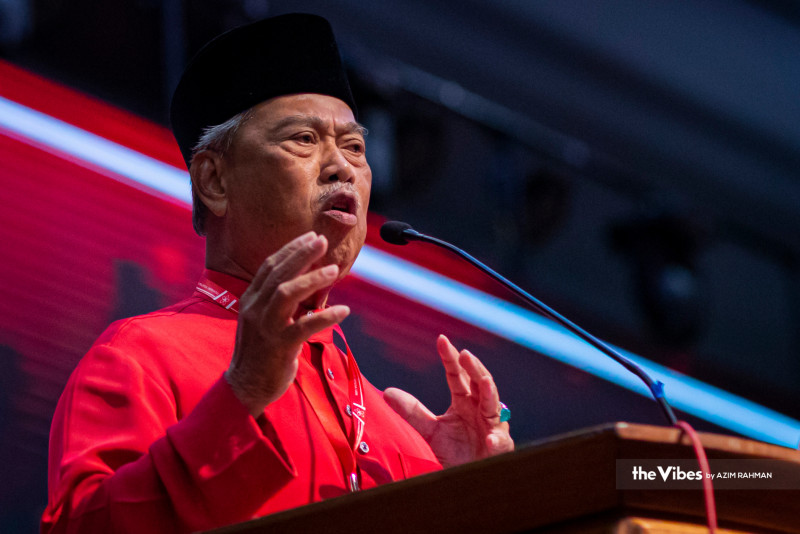
PARTI Pribumi Bersatu Malaysia’s decision to name Tan Sri Muhyiddin Yassin as its prime ministerial candidate ahead of the 16th General Election has sparked friction within Perikatan Nasional (PN), raising fresh concerns over the coalition’s long-term cohesion.
Political analyst Dr Ahmad Zaharuddin Sani Ahmad Sabri described the move as more than just a symbolic announcement, suggesting it was a calculated attempt by Bersatu to assert dominance and lock in its leadership claim before formal negotiations take place.
“This reflects an effort by Bersatu to ‘secure’ its position early. The lack of explicit support from PAS leaders shows the party is deliberately maintaining room for negotiation,” he told *Sinar Harian* on Thursday.
Dr Ahmad Zaharuddin noted that the premature declaration by Muhyiddin, absent a collective PN decision, exposed weaknesses in the coalition’s internal coordination – particularly as no election date has yet been announced.
He pointed to recent remarks by Kedah Menteri Besar Datuk Seri Muhammad Sanusi Md Nor at PAS’s 71st Muktamar, which he said revealed deeper dissatisfaction within PN.
“Sanusi is not merely speaking for PAS but also voicing the frustration of other component parties that feel sidelined in key decisions,” he said. “His stance reflects an attempt to reposition PAS as a central force within the coalition.”
According to internal PN sources, Sanusi’s criticism is rooted in frustration over the distribution of resources and decision-making authority.
“The defensive response from Bersatu suggests it understands PAS’s strategic importance. Losing PAS’s support could seriously threaten Bersatu’s political viability,” the analyst said.
He added that the underlying conflict reflects clashing leadership cultures between the traditionalist, grassroots-driven PAS and Bersatu’s more corporate and centralised structure.
“Sanusi’s outspoken and populist rhetoric contrasts with Bersatu’s more measured, corporate style,” he explained.
Dr Ahmad Zaharuddin also observed that recent leadership changes within PAS, including the inclusion of former UMNO figures like Datuk Seri Shahidan Kassim and Haim Hilman Abdullah, signalled internal shifts within the party.
“This introduces new expertise but also brings the risk of ideological dilution, potentially eroding PAS’s original identity,” he said. “The party’s demographic is evolving from one dominated by clerics and activists to one that includes professional politicians and technocrats.”
He further pointed out that PAS’s leadership remains heavily concentrated in Kelantan, Terengganu, Kedah and Perlis – the so-called SG4 states – suggesting a persistent regional mindset.
“Neglecting states like Selangor, Perak, Johor and Melaka in the party’s leadership structure implies they are viewed as testing grounds rather than core strongholds. This may hinder PAS’s appeal in urban and cosmopolitan areas,” he said.
Financially, he argued that PAS holds an advantage, owing to its grassroots donation model, whereas Bersatu remains reliant on corporate donations and is currently grappling with frozen accounts.
“This financial imbalance gives PAS greater resilience amid internal conflict. Sources say unresolved issues surrounding campaign funding and access to corporate donors continue to cause friction,” he said.
On the communications front, he said the narrative clash between PAS and Bersatu is increasingly visible online.
“PAS promotes a strong religious and Malay-Islamic message, while Bersatu focuses on attacking the current government’s policies. These public displays of division risk alienating young voters, who are more concerned with pragmatic issues than internal power struggles,” he said.
Dr Ahmad Zaharuddin concluded that such infighting may undermine PN’s ability to present a united front ahead of GE16.
“The coalition appears to be locked in a leadership tug-of-war, which runs counter to the expectations of younger voters who are looking for constructive cooperation and real solutions to national challenges,” he said. - September 19, 2025