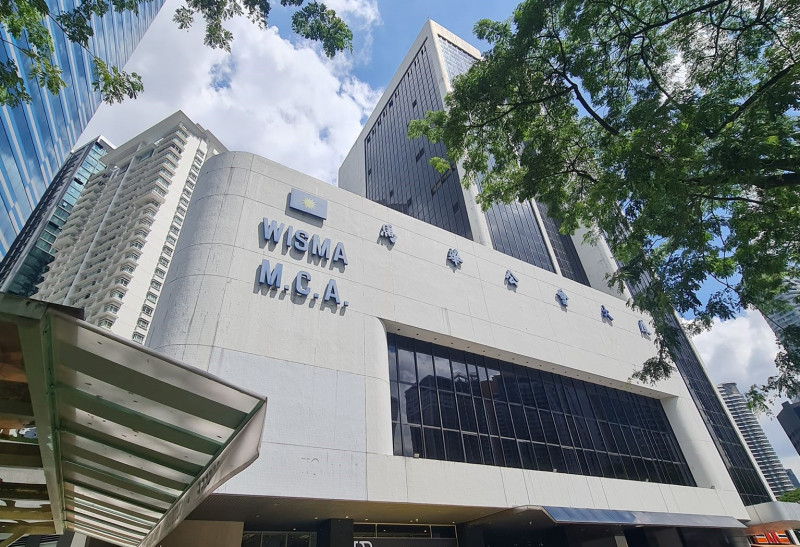
MCA’s continued relevance in Malaysian politics hinges on its willingness to make bold, principled decisions in an increasingly fluid and opportunistic political environment, former party vice president Ti Lian Ker has said.
Speaking to Mingguan Malaysia, Ti observed that communal-based politics, particularly among Chinese political actors, has been significantly weakened.
“Many who are involved in politics today are more opportunistic. They see politics as a form of trade—wherever there is opportunity, that is where they go,” he said.
Ti highlighted that MCA’s past strength lay in its deep engagement with Chinese communities, especially in new villages, where the party addressed development, welfare, and business concerns.
“MCA was relevant because we could manage and resolve their problems. Once issues were solved, support followed,” he said.
Although MCA rarely commanded a majority of the Chinese vote, Ti explained that the party consistently secured around 30 per cent, which proved decisive for Barisan Nasional (BN) when combined with overwhelming Malay support, a formula that has now collapsed.
The former leader attributed MCA’s loss of traditional support to a “culture of hatred” propagated by political opponents.
“As long as it is not UMNO, MCA is targeted. If it is not PAS, MCA is targeted as well. Whatever MCA does, it gets attacked,” he said.
Ti cautioned that joining Pakatan Harapan (PH) under the current political configuration would marginalise MCA further.
“With the present combination, joining PH would bury MCA,” he said, emphasising that the party must confront misinformation and uphold BN’s original formula of moderation and national unity.
Beyond coalition dynamics, Ti lamented the lack of political maturity at the grassroots level across parties.
“Leaders were never serious about educating the people on political science, political maturity, and principles. Instead, they played with emotions—race, religion, and culture,” he said.
He also criticised parties that claim ideological labels without consistency.
“When a party claims to represent justice or religion, we must ask whether they are consistent. Otherwise, they are merely riding on sentiment, not values,” he added.
Indecision among MCA leaders, Ti said, is a critical weakness.
“Leaders are elected to make decisions. If they are afraid to decide and push everything back to the grassroots, that is a failure of leadership,” he said, adding that the party cannot survive alone in Malaysia’s coalition-based political system.
On cooperation with PAS, Ti argued that demands for vague “changes” create confusion. “When PAS was part of government, they were not as extreme as portrayed.
They did not implement hudud. The same applies to other parties that moderated their stance once in power. Saying PAS is rejected by the Chinese community is a trap set by others. MCA has worked with PAS before without such claims.”
“Politics today is about survival with principles,” Ti concluded. “Without courage and clarity, MCA risks being trapped—and eventually erased—from the political map.” - December 21, 2025