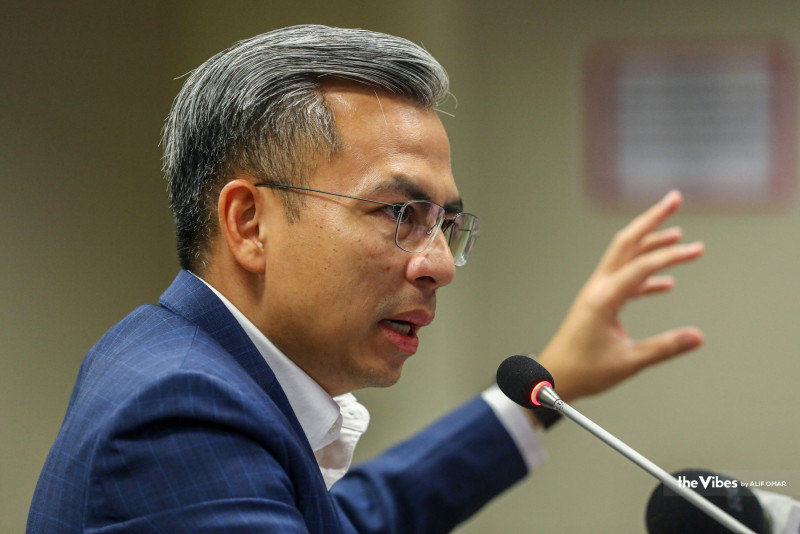
COMMUNICATIONS Minister Datuk Fahmi Fadzil has emphasised that Malaysia’s resilient digital infrastructure, supported by stable governance, has catalysed a surge in technology and digital investments.
Speaking in an exclusive interview with Bernama, Fahmi credited the success of the National Digital Network (JENDELA) initiative as laying a firm foundation for further growth, positioning Malaysia as a strategic location for data centres and other digital ventures.
“With JENDELA Phase 1 and Phase 2, the national fibre optic programme has yielded extraordinary results.
“The costs are considerable, but we view this as an investment in our people,” he said.
Launched under the Twelfth Malaysia Plan (2021–2025), JENDELA is designed to strengthen the country’s digital infrastructure and prepare Malaysia for a seamless transition to 5G technology.
The RM21 billion initiative, co-funded by the Universal Service Provision Fund (USP) of the Malaysian Communications and Multimedia Commission (MCMC) and industry players, aims to provide nationwide broadband access, enhance 4G network quality, and gradually phase out 3G services.
“This has placed Malaysia in a strong position to become a highly attractive investment destination,” he said, citing international firms that have established regional operations in the country.
“Among them, Canadian cybersecurity firm BlackBerry expanded its Asia-Pacific headquarters to Malaysia, while Italian defence and aerospace company Leonardo opened a regional cyber centre in the country.
Fahmi highlighted that investors consider not only infrastructure and costs but also political stability and government policy clarity.
“Government policy is crucial,” he said, noting that Malaysia’s neutral geopolitical stance and effective governance under the MADANI administration have further strengthened investor confidence.
He expressed confidence that Malaysia will continue to attract digital and technology investments, thanks to a stable environment, strategic location, and resilient digital infrastructure.
On the evolving telecommunications landscape, Fahmi noted that companies are transitioning beyond basic connectivity to offer innovative value-added services.
He highlighted Telekom Malaysia’s transformation from a traditional telecom provider to a technology-driven company, reflecting the sector’s future where fibre infrastructure underpins operations while services and solutions become key differentiators.
“TM is unique because it handles secure government communications, but it also offers numerous new technologies and solutions that can be applied across the industry,” he said.
Fahmi stressed that telecom companies can no longer rely solely on traditional voice and data services; they must understand customer segments and develop services aligned with lifestyles and industrial needs.
The minister also praised Malaysia’s rapid 5G deployment, noting the transition from a single wholesale network to a dual-network model, which provides more options for consumers and encourages healthy competition.
The first 5G network now covers more than 82.4 per cent of populated areas, while UMobile’s second network has reached approximately 57 per cent coverage within just a few months.
“This progress was achieved in just three to four months, which is quite fast. By 2026, we expect further collaboration and partnerships,” he said. With shared infrastructure, future competition is expected to focus less on coverage and more on innovation and service offerings that fully exploit 5G capabilities.
Fahmi estimated that of Malaysia’s 45 million accounts, around 60 per cent are 5G users, a milestone reached in about a year compared to four to five years in countries like South Korea. “This rapid 5G adoption positions Malaysia ahead of many other nations,” he said.
He added that Malaysia offers some of the fastest internet speeds in the region at among the lowest costs globally, contributing to one of the most digitally connected societies in the world. Certain applications, such as WhatsApp, achieve over 94 per cent penetration, among the highest regionally, if not globally.
Malaysia’s strategic digital investment initiatives, combined with political and economic stability, are increasingly drawing global attention, reinforcing its position as a leading hub for technology and innovation in Southeast Asia. - December 23, 2025