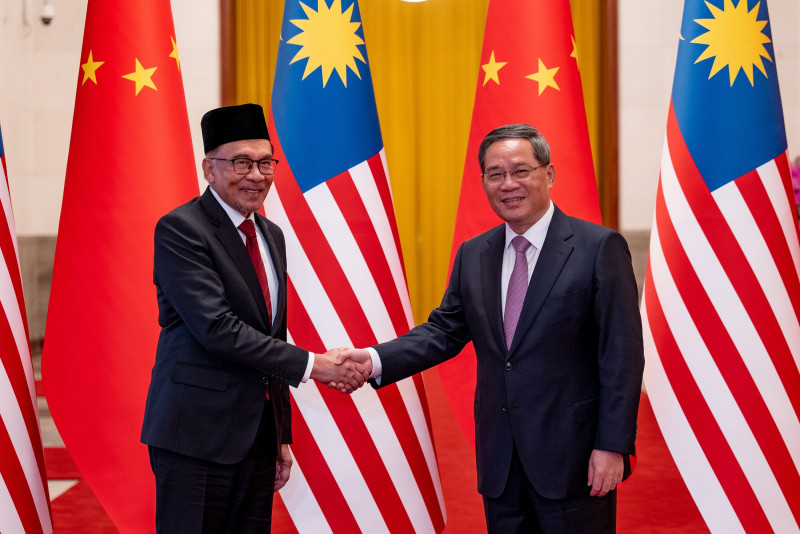
MALAYSIA and China are increasingly settling bilateral trade in their respective local currencies, with the use of ringgit and yuan rising as both countries move to reduce reliance on the US dollar and strengthen resilience against global financial shocks.
Prime Minister Datuk Seri Anwar Ibrahim said today that the share of trade conducted in local currencies has risen from less than five per cent previously to 18 per cent of total bilateral trade between the two countries.
“Not necessarily that de-dollarisation efforts are still important in terms of financial transactions, but we have been using currencies denominated in local units, the yuan and the ringgit, in most of our transactions,” Buletin TV3 reported him saying at the launch of the Ant International Global Development Centre in Kuala Lumpur.
He said the shift reflects broader efforts to strengthen economic resilience through deeper financial cooperation and reduced dependence on the US dollar in selected cross-border transactions.
Anwar added that Malaysia–China economic ties now extend beyond traditional diplomatic relations, with more structured policy coordination aimed at improving economic outcomes for both sides.
He also revealed that he had received an invitation from Chinese Premier Li Qiang to jointly officiate a major technology conference in Shanghai.
The Prime Minister said the current global financial system continues to favour large multinational corporations over smaller enterprises, while remaining heavily dependent on the US dollar, leaving developing economies vulnerable to external shocks.
He cited the 2008 global financial crisis as an example of how economic disruptions originating in the United States had far-reaching global consequences.
Anwar also pointed to ongoing geopolitical tensions as a continuing threat to global growth, stressing the need for financial innovation to build resilience and broaden access to financing.
He called for expanded microfinancing and more inclusive financial systems to support small businesses and communities, while reducing exposure to external economic volatility. - July 1, 2026