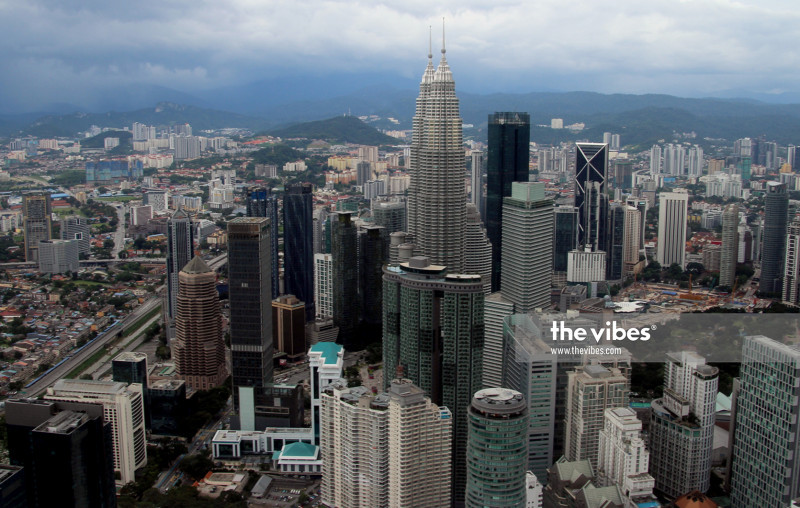
MALAYSIA’S economy maintained its strong growth momentum in the first half of 2026, with the government now turning its attention towards ensuring that economic gains are translated into meaningful improvements for households, workers and businesses.
Economy Minister Akmal Nasrullah Mohd Nasir said preliminary estimates indicated that the economy expanded by 5.8 per cent in the second quarter of 2026, lifting overall growth for the first six months of the year to 5.6 per cent compared with 4.5 per cent recorded during the same period last year.
He said the latest performance reflected resilient domestic demand and Malaysia’s strengthening role in global technology supply chains, despite persistent challenges from geopolitical uncertainties, trade pressures, fluctuating energy prices and supply chain disruptions.
“Today, we assess the country’s economic compass after the first six months and set the trajectory for the following six months,” he said in his address at the Economy Ministry’s monthly assembly on Monday.
“Resilience gives us space. Reform determines how that space is used. Delivery determines whether the people feel it.”
Akmal said the estimated second-quarter growth exceeded market expectations and was above the International Monetary Fund’s July 2026 World Economic Outlook projection of 4.7 per cent growth for Malaysia this year.
He added that inflation remained under control at 1.9 per cent in June, while labour market conditions continued to demonstrate stability.
The latest labour data for May showed that Malaysia’s workforce expanded to 17.34 million people, with 16.82 million employed. The labour force participation rate remained steady at 70.9 per cent, while unemployment was maintained at 3.0 per cent.
Akmal said government employment interventions had also contributed to reducing job losses, which declined 22 per cent to 6,631 as of July 21 from 8,100 in June.
However, he stressed that economic performance should not only be measured by the number of jobs protected but also by how quickly displaced workers could return to employment.
“Until now, 82,823 job placements, including new employment opportunities, have been recorded this year,” he said.
“Measuring our effectiveness is not only about how many people lose their jobs, but how quickly they can return to work.”
Malaysia’s export sector also continued to provide strong support to growth, with monthly exports reaching a record RM184 billion in May 2026, driven by electrical and electronics products, semiconductors, automotive industries and rising demand linked to artificial intelligence.
Akmal said the country’s economic expansion was broad-based, supported by improvements across several key sectors.
The mining and quarrying sector grew 10.2 per cent, largely due to a recovery in natural gas production, while manufacturing expanded 7.5 per cent and construction rose 6.6 per cent.
The services sector recorded growth of 5.4 per cent, supported by trade, digital activities, transport and storage services.
However, he cautioned that growth remained uneven, with the agriculture sector contracting 3.7 per cent due to weaker performances in palm oil and fisheries.
“This reminds us that food security, the income of smallholders, fishermen and rural communities must remain priorities,” he said.
Akmal said the government would continue monitoring global economic risks, particularly developments involving energy prices, financial markets, commodities, food supplies and electricity demand.
He said Brent crude oil prices had declined 20.6 per cent from US$107.54 per barrel in May 2026 to US$85.35 per barrel in June before rebounding sharply to US$105.59 per barrel by July 23.
LNG prices followed a similar pattern, falling from US$20.68 per MMBtu in March to US$16.97 per MMBtu in June before increasing again to US$22.10 per MMBtu on July 23.
“These developments directly create ripple effects on the domestic macroeconomic landscape, particularly on supply chain costs and price stability,” he said.
He added that average coal prices increased 9.2 per cent from US$132.24 per metric tonne in May to US$144.35 in June, reflecting continued reliance on coal as a stable energy source.
In financial markets, Akmal said the FBM KLCI traded between 1,664.06 and 1,712.03 points in June, compared with 1,683.07 to 1,758.85 points in May.
While investor sentiment remained cautious amid global uncertainty, he said Malaysia’s equity market had remained relatively stable.
Commodity markets showed mixed movements, with crude palm oil prices rising slightly to RM4,491.20 per tonne in June, while natural rubber prices increased 4.3 per cent to RM9.24 per kilogram.
Peak electricity demand climbed to 20,541 megawatts in June, reflecting continued economic activity, business operations and domestic consumption.
On essential goods, Akmal said the government remained vigilant in monitoring food prices amid shifting global conditions.
The average price of chicken increased to RM10.05 per kilogram in June, partly due to higher production costs, particularly animal feed.
Egg prices also rose, with Grade C eggs reaching RM3.98 per 10 pieces, while meat prices declined 3.2 per cent to RM36.02 per kilogram following improved supply conditions.
Seafood and vegetable prices remained generally stable, supported by adequate supply, favourable weather conditions and recovering supply chains.
Akmal said Malaysia’s long-term resilience depended on reducing vulnerabilities while expanding capabilities across food security, energy, exports, logistics and technology.
“True resilience is the ability to reduce dependence, expand choices and build our own capabilities,” he said.
For the second half of 2026, Akmal said the Economy Ministry would prioritise implementation and delivery under the 13th Malaysia Plan (RMK13), with greater emphasis on measurable outcomes.
“We already have RMK13 and various strategies relating to industry, technology, talent, regions and social protection. Now the people want to see change,” he said.
He outlined four key priorities: resolving implementation challenges quickly, ensuring benefits reach intended communities, measuring progress through improvements in income, productivity, skills, employment and quality of life, and strengthening interventions where targets are not achieved.
“We need to move from the amount of allocations to the changes produced; and from investment commitments to quality jobs, local supply chains and technology transfer,” he said.
“A good policy is not the most complicated policy. A good policy is one with a clear purpose, visible results and accountability.” - July 27, 2026