By Murray Hunter
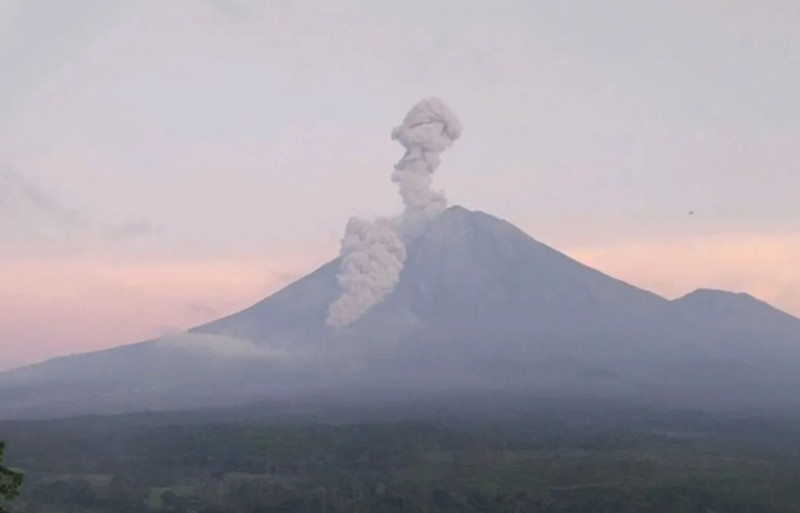
JAVA, one of the world’s most densely populated islands, currently faces elevated volcanic activity from Mount Semeru, Mount Merapi, and Anak Krakatau in the nearby Sunda Strait.
While these volcanoes remain at Level III (Siaga) alert and eruptions have so far been manageable, a significant intensification could trigger cascading disasters across the island and beyond.
Aviation routes, local communities, weather patterns, agriculture, and population stability all stand at risk.
If activity worsens, ash clouds could close major air corridors linking Australia northward and disrupting intra-Asia flights. Recent events at Anak Krakatau already forced widespread cancellations at Jakarta’s airports and affected hundreds of thousands of passengers.
A larger or more sustained eruption would likely ground flights across the region for days or weeks, isolating economies and stranding travellers.
On the ground, powerful eruptions threaten to devastate communities near the volcanoes.
Pyroclastic flows, ash falls, lahars, and rock ejections could destroy homes, roads, bridges, and power infrastructure, particularly in East and Central Java.
Mount Semeru’s frequent eruptions and Merapi’s ongoing rockfalls already demand strict exclusion zones; an escalation would expand those dangers dramatically, overwhelming local response capacity.
Weather patterns would shift as volcanic aerosols and ash alter rainfall and temperatures.
Reduced sunlight and acid rain could damage crops across Java’s fertile volcanic soils, threatening rice and other staple production that feeds tens of millions.
Food shortages would compound the crisis, especially if supply chains break down.
In the worst case, large-scale displacement of Javanese populations could follow.
With over 150 million people living on the island, even partial evacuation of high-risk zones would strain Indonesia’s resources beyond breaking point.
Refugee flows could extend into neighbouring Malaysia and, in extreme scenarios, pressure northern Australia as people seek perceived safety.
Such an exodus would create humanitarian, political, and logistical challenges far exceeding current preparedness levels.
History provides a stark precedent.
The 1883 eruption of Krakatoa, located in the same Sunda Strait as today’s Anak Krakatau, remains one of the most destructive volcanic events on record. Explosions heard thousands of kilometres away generated tsunamis that killed more than 36,000 people along the coasts of Java and Sumatra.
Ash darkened skies across the region, destroyed villages, and caused global climate anomalies, including cooler temperatures and vivid sunsets for years afterwards.
The event demonstrated how a single Indonesian volcano can disrupt local societies, regional weather, and international systems simultaneously.
Earlier, the 1815 Tambora eruption farther east produced the “Year Without a Summer,” with worldwide agricultural failures, though its direct impact on Java was less concentrated than Krakatoa’s. More recent events, such as Merapi’s 2010 eruptions that displaced hundreds of thousands, show that even smaller-scale activity can overwhelm infrastructure when population density is high.
Authorities continue to monitor the current situation closely through Indonesia’s PVMBG and MAGMA systems, maintaining alert levels and exclusion zones. Preparedness measures, early warning systems, and international coordination remain essential.
While the present activity has not yet reached catastrophic levels, the combination of dense population, critical aviation routes, and historical precedent underscores the need for vigilance.
Escalation is not inevitable, but the potential consequences demand serious attention before any worst-case scenario unfolds. – September 10, 2026