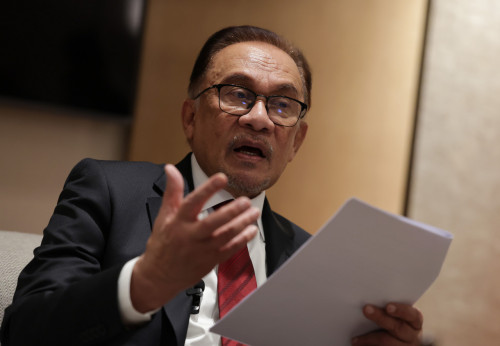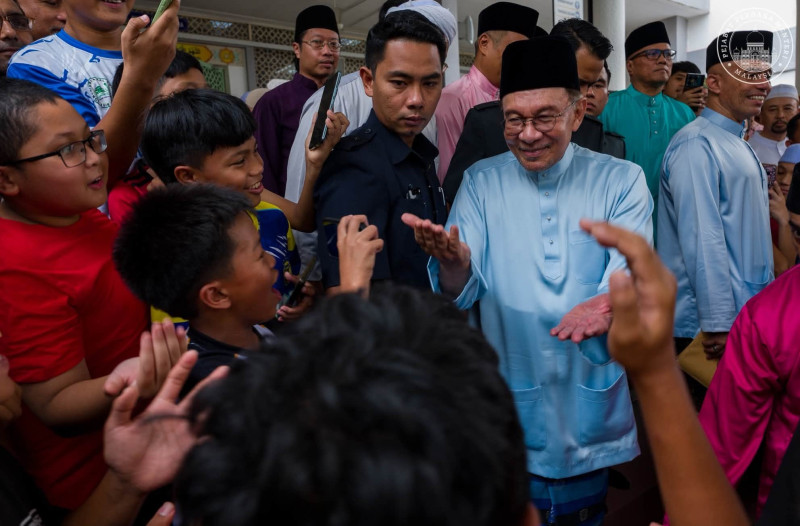
PRIME MINISTER Datuk Seri Anwar Ibrahim has demanded greater discipline in the management of public funds, directing the Rural and Regional Development Ministry (KKDW) and Finance Ministry (MOF) to resolve their dispute over delayed contractor payments through direct discussions.
“We discuss this properly. I want the ministry to discuss, both ministries, properly,” he told reporters after Friday prayers at Masjid Bukit Indah, Ampang, today.
Anwar’s intervention follows complaints from KKDW, led by Deputy Prime Minister Datuk Seri Dr Ahmad Zahid Hamidi, over delayed payments to contractors working on government development projects, including rural roads.
Zahid said some contractors had completed work and achieved the progress stipulated under their contracts but were still waiting for payment, creating serious cash-flow problems.
He said some contractors had been forced to cease operations, while others faced legal action from suppliers and subcontractors.
However, Treasury secretary-general Tan Sri Johan Mahmood Merican said MOF had imposed no restrictions on KKDW’s allocations for rural road projects.
He said all funds allocated to KKDW had been fully channelled, with the current payment constraints arising because the allocation had already been fully spent.
Johan said MOF had approved an additional RM300 million to help settle outstanding payments to contractors.
The dispute comes after Chief Secretary to the Government Tan Sri Shamsul Azri Abu Bakar reminded ministries and government agencies to spend within their approved budget allocations.
The issue of financial discipline also comes amid calls for stronger safeguards over Tabung Haji’s investment activities, with experts saying tighter regulatory oversight is needed to strengthen accountability and protect depositors.
Senior consultant at Global Asia Consulting, Samirul Ariff Othman, said the proposal to place Tabung Haji’s investment arm under the supervision of the Securities Commission Malaysia (SC) should proceed, but with clear boundaries for the regulator.
“SC oversight is a necessary reform, but it is not a single ‘cure’. Its real value lies in the ability to create a clear line separating political power, the responsibilities of board members, the professional independence of fund managers and the enforcement powers of the regulator,” he said.
Samirul said the proposed framework had yet to be finalised but would retain Tabung Haji as an institution while creating a dedicated investment function, proposed as “Dana Haji”, to be registered or licensed under SC.
He said SC should regulate the investment function rather than become another committee making Tabung Haji’s day-to-day investment decisions.
“SC cannot guarantee that every investment will be profitable. What SC can do is ensure every decision is made through a professional process, can be audited and is protected from informal instructions,” he said.
He said stronger oversight was particularly important in light of past governance failures identified by the Royal Commission of Inquiry (RCI), including questionable approval processes, concealment of information, manipulation of investment reports, payments without adequate collateral and transactions proceeding despite weaknesses in due diligence.
“Of the 14 problematic investments, seven were reported to have suffered total losses. In the Al-Rawda case, for example, an advance payment of more than RM1.5 billion was made even though the bank guarantee requested by the risk department had not been obtained.
“The loss was not merely an ‘investment that did not work out’; it reflected a failure of controls before the decision was made,” he said.
Samirul said SC oversight should include clear investment mandates and asset-allocation policies, exposure limits, risk and liquidity assessments, portfolio concentration controls, independent due diligence, conflict-of-interest safeguards and separation between investment, risk and compliance functions.
The proposed reforms, alongside Anwar’s intervention in the KKDW-MOF dispute, underscore the Government’s wider challenge of ensuring public money is spent within approved allocations while strengthening institutional checks against poor financial decisions and governance failures. - September 4, 2026