


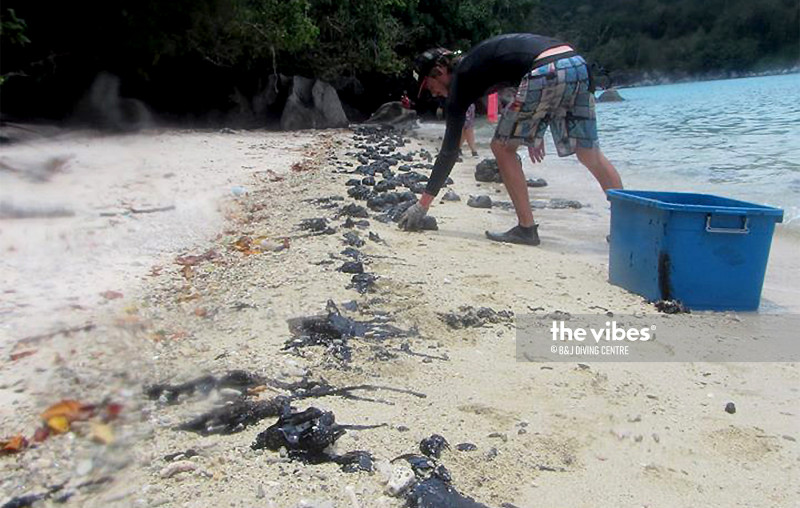

KUALA LUMPUR – Marine conservation and protection bodies have decried the failure to catch the culprit behind the 2km-long oil slick off Port Dickson, and bemoaned that many more spills have occurred in the country’s seas but not been publicised.
Reef Check Malaysia programme manager Alvin Chelliah said such spills happen more frequently than one thinks.
“On Tioman island alone this year we have had five different occasions where oil was found in the water or washed up on the shores. This happens every year,” he told The Vibes.
He added that the authorities reacted when alerted about the spills.
“This year we had the local Tioman Development Authority, the marine and fisheries departments, and Alam Flora, involved in cleanup efforts with local business operators and villagers,” he said.
However, small locations like Tioman may lack the equipment to deal with large spills, and endure a delay as the materials are transported there.
Reef Check has collected some oil samples in the past and sent them to the Department of Environment, he said. This year the NGO is working with Universiti Putra Malaysia to identify the type and source of the oil that washes up on Tioman.
Louisa Ponnampalam, executive director of MareCet, which focuses on research and conservation of marine mammals in Malaysia, said the situation at Port Dickson would have been easier to contain if the party responsible had admitted about the spill early.
“Significant damages to coastal environments would likely have been averted," she said
“In disaster management, early notification is crucial to mobilise appropriate response personnel and equipment to safeguard critical habitats from being impacted.”
Volume of oil spilled ‘substantial’
Louisa told The Vibes that while MareCet lauds the efforts taken by the government and other parties in the cleanup, considering the current pandemic health situation, she is concerned by reports that oil spills seem to be more frequent in recent times.
“It does seem like there have been more cases occurring, especially in areas in close vicinity of ports and harbours,” she said.
Louisa noted, however, that these may be due to many vessels not being operational due to limited activities in the maritime industry currently.
“It is of concern though that when an incident like this occurs, it is almost always reported only upon it (the oil) reaching the coast, when earlier notification of the incident would have likely resulted in lower impacts to the environment,” she said.
“The volume of the oil spilled appears to be fairly substantial and thus will likely cause significant impact to the coastal ecosystems present within the affected area.
“The area is not only an important recreational ground, but is also an important area for marine fauna, fish, sea turtles and waterbirds, among many others,” she added.
Louisa suggested a remote monitoring system for oil spill be in place, although MareCet acknowledges that such systems are not 100% reliable, and are also costly to install and operate.
“Establishing rapid response teams with appropriate training and equipment at key areas around the country, with 24-hour mobilisation capabilities would be helpful. Unfortunately, pollution and contamination issues are unlikely to end in the foreseeable future as maritime industries continue to be necessary, and use of fossil fuels remains strong,” she said.
Alvin also said oil is harmful to the marine environment as it disrupts the insulating ability of otters, and sticks to the feathers of birds, making them unable to swim or float and leading to death.
"It can also affect turtles and dolphins as the oil slicks can affect them when they come to the surface to breathe. I have actually seen turtles accidentally eaten tar balls, mistaking them for food," he said.
He added that the oil affects crabs, intertidal marine life and mangroves, as they could accidentally ingest oil when they clean themselves. - The Vibes, October 20, 2020
















_Datuk_Rusdi_Mohd_Isa._Facebook_pic..png)
