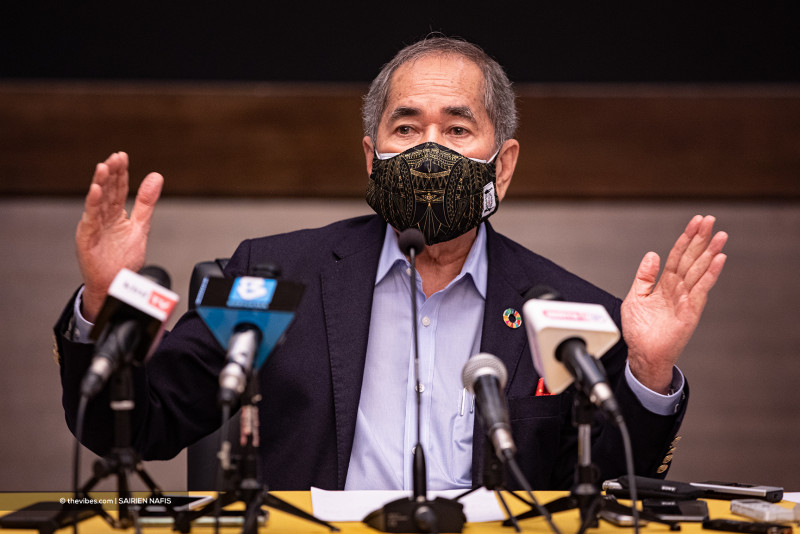
KOTA KINABALU – The Malaysia Agreement 1963 (MA63) is still a valid document despite Singapore leaving the federation in 1965, said Law Minister Datuk Wan Junaidi Tuanku Jaafar.
He said there is no court decision to say the agreement was not valid at this point and its inclusion by the recently passed constitutional amendments further validates its legitimacy.
“One could not arbitrarily claim it to be invalid. I do not understand why he (Parti Bumi Kenyalang president Voon Lee Shan) continues to raise this matter.
“Furthermore, the inclusion of MA63 into the federal constitution would further validate the legitimacy of the treaty and would truly give recognition to the demands and special status and position of Sabah and Sarawak in Malaysia,” he said in a statement, here today.
Wan Junaidi’s response came after Voon had claimed that the MA63 was not valid.
Voon severely questioned the legitimacy of the agreement and described the passing of the constitutional amendments Article 1(2) and Article 160 (2) as meaningless and bringing no benefit.
The Sarawak opposition leader also called the amendment an election gimmick as Sarawakians will be heading to the polls tomorrow.
“To this, I am afraid Voon could not be further from the truth. Again, I would explain that by recognising MA63 in the federal constitution, the government can now refer to all the promises made in 1963 in detail and spell out in the Inter-Governmental Committee (IGC) report, which is the in-depth study of the Cobbold Commission report on the demands of Sabah and Sarawak,” he said.
Wan Junaidi said the federal government can no longer say the demands of Sabah and Sarawak are not in line with the constitution or the law of Malaysia, thanks to these amendments.
He said the amendments would allow the states to demand the return of their rights.
The Dewan Rakyat on December 14 unanimously passed the bill to amend the federal constitution in regards to MA63, allowing for the first time the realisation of its terms.
This, Wan Junaidi said, would allow Malaysia to become the real Malaysia in the context of the three agreements – the Federal Agreement 1948, the Federal Agreement 1957 and MA63.
This is just the first step. Of course, we will be looking into more amendments, moving forward.
“To questions on the tangible benefits derived from this, maybe at this point of time, it is still too early to see the impact of this from material and monetary aspects.
“What this amendment would do is give recognition to the special privileges of Sabah and Sarawak.
“Sabah and Sarawak should now talk about equal status simply because we have already been given special status upon the formation of Malaysia back in 1963,” said Wan Junaidi.
He added that this was why they had authority over immigration borders, complete control over natural resources including oil and gas, forests, land, and all things under the subsoil of the two states.
“What we should be demanding now is to have our own judicial commission, the right to appoint a judicial commissioner and many more in the IGC report.
“We still do not have one now, despite being one of the promises under the agreement.
“As per the agreement, Sabah and Sarawak state governments via the governors should have the authority to appoint the judicial commissioner, unlike any other states in Peninsular Malaysia.
“Yes, I admit, over the years, some of those privileges and rights have been eroded.
“Now with the amendments, we can focus on reclaiming them. I must admit that this is not an easy matter to digest, especially to laymen,” he said.
Towards this end, Wan Junaidi said he implored politicians not to exploit this issue further to cause confusion and sow anger and dissatisfaction against the ruling government.
A total of 200 MPs, out of 220, voted for the bill during its second reading and close to 200 MPs voted for it in the third. – The Vibes, December 17, 2021.