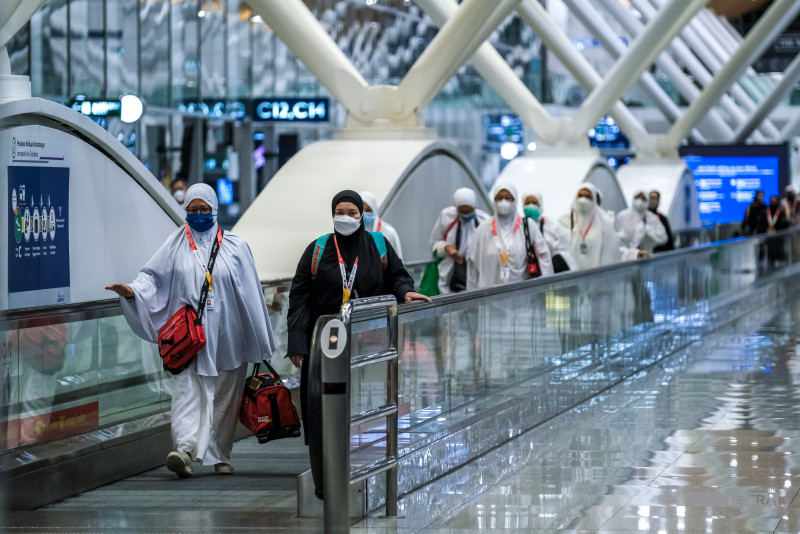
KUALA LUMPUR – As this year’s haj season comes to a close, there emerges a possibility that first-time pilgrims’ cost of performing the ritual will increase.
Lembaga Tabung Haji (LTH) chairman Tan Sri Azman Mokhtar raised the issue last month when he disclosed that the Malaysian pilgrim management and fund board is expected to review next season’s costs with the government.
Travel agencies handling haj operations think any increase in the rates for the 2023 haj season is justifiable in view of factors such as inflation, foreign currency exchange rate, introduction of new charges and taxes, service improvements, and the pace of development in Mekah and Madinah.
Nevertheless, Malaysian pilgrims performing the haj for the first time need not bear the brunt of the cost increase, thanks to the haj financial support offered by LTH.
Cannot be avoided
Sharing his views on this issue, Andalusia Travel & Tours Sdn Bhd executive chairman Datuk Md Daud Che Ngah said the higher cost of performing the haj is something prospective pilgrims have to accept because it is unavoidable.
According to him, the increase is inevitable, especially in the post-Covid-19 era.
“In fact, it is a given that haj costs go up every year due to several factors, including costs pertaining to accommodation and transportation and movement of pilgrims as well as other matters set by the Saudi Arabian government at a time when we are all still grappling with the Covid-19 pandemic.
“Muslims wishing to perform the haj must be ready to face any cost hike as they cannot rely solely on the subsidy or financial aid (extended by LTH to fulfill their religious duty,” he said.
This is also in line with the “maqasid syariah” approach whereby the obligation to perform the haj is incumbent upon Muslims who are physically and financially able to make the pilgrimage.
Hence, the prospective pilgrims’ sound understanding of this “concept of capability” within the ambit of Islamic principles will surely play a part in helping to alleviate the haj financial support burden borne by LTH.
“The term ‘capability’ can also be broken down into the following aspects, namely whether or not the prospective pilgrim is able to bear the cost of performing the haj, his family can sustain themselves during his absence, has transportation, can travel safely (without causing any disturbance) and is healthy and has the time and permission (to perform the haj).
“The time has come to stop burdening LTH with the soaring haj subsidy costs… prospective pilgrims must be prepared to pay more and can no longer rely solely on LTH’s assistance,” said Md Daud.
LTH spent an estimated RM200 million on this year’s haj season to cover a part of the pilgrims’ costs.
No targeted assistance
Md Daud said as a person with wide experience in the field of haj management, he personally felt that the provision of a blanket financial aid or subsidy for haj purposes must be re-examined, pointing out that it should only be offered to deserving pilgrims.
Currently, the financial assistance rendered by LTH is not only benefitting the targeted groups but also those earning high incomes who have the means to pay the full cost of performing the haj.
“I have dealt with LTH for about 25 years and I’ve observed that the subsidy allocation for first-time pilgrims is too high… in fact, it covers over 60% (of the cost) for each pilgrim.
“I personally think that LTH should carry out a comprehensive re-evaluation of the haj subsidy provision because we don’t want this aid to have (a negative) impact on LTH itself over the long term. To me, financial aid of around 30% will suffice,” he said.
He added: “In a situation like this, we must revert to the “maqasid syariah”. In addition to financial ability, those eligible (for the haj journey) must also be healthy and free from diseases. I’ve seen pilgrims in wheelchairs that are pushed by the haj staff. By right, individuals who are sick are not obliged to perform the haj.”
Early this year, LTH had estimated the cost of performing the haj for first-time pilgrims at RM25,540 per person. But the actual cost shot up to RM28,632 a person during the 2022 haj season.
Out of the total cost, first-time pilgrims from the B40 group only paid RM10,980 each while the rest paid RM12,980 each, with the remaining cost borne by LTH.
Wira Saujana Travel & Tours executive director Mohamad Adzri Othman also agreed that the haj financial aid should only be given to targeted groups, focusing on those without the financial means.
“The aid must be channelled fairly because we have wealthy people among the first-time pilgrims who can afford to go on the haj without any help from LTH. I feel this is among the things that need to be re-evaluated,” he said.
Better Services
Mohamad Adzri said pilgrims should embrace the higher haj costs as they are not only consistent with the quality of services and facilities offered but also lower than the charges set by other countries.
“(In our country) the first-time pilgrims receive a subsidy so they only need to pay a small amount compared to the actual cost of performing the haj.
“Meanwhile, pilgrims performing the haj privately need to pay over RM30,000 per person. The figure may seem huge but the services (and facilities) provided by private haj operators are good. These include comfortable accommodation and transportation for the pilgrims,” he said.
He added that hikes in the haj cost are made in accordance with the prevailing situation and as and when the Saudi Arabian government upgrades its services to ensure the comfort of the pilgrims who come from all parts of the world.
“If a person doesn’t have the capacity, they don’t have to force themselves to undertake the haj. (As for those capable of performing the haj), the big amount they will have to fork out enables them to enjoy the best facilities – not just those provided by the Saudi Arabian government but also by the haj operator,” he said. – Bernama, September 21, 2022