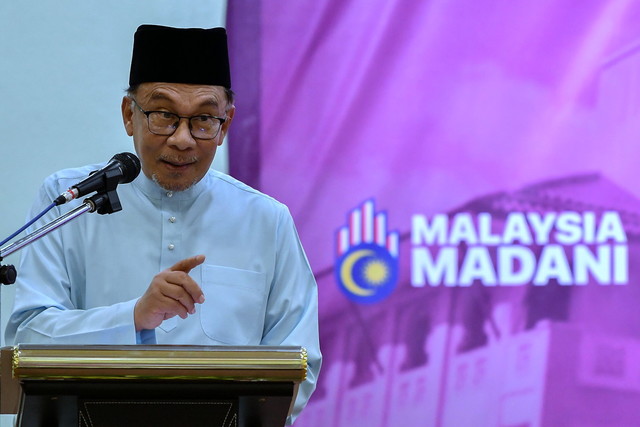
THE Madani government made a commendable decision in May, as announced by Prime Minister Datuk Seri Anwar Ibrahim, to substantially increase pay for civil servants.
Set to commence in December of this year, the nearly 15% hike is said to be the largest in the history of our country.
Around 1.6 million public servants will greatly benefit from this, particularly given the rising cost of living. This increase also recognises their efforts and sacrifices in supporting and serving the rakyat, especially during the challenging MCO periods.
However, as the prime minister rightly pointed out, not everyone would automatically benefit from this pay increase.
It must be linked to productivity, personal performance, and work ethics/behaviour. Those with poor employment records, dishonesty, or disciplinary issues should not be entitled to the same benefits.
The concept of tenure-based raises blurs the lines between high achievers and low achievers.
Rewards tied to performance will help us cultivate a more dynamic, responsible, and innovative workforce.
Nevertheless, the current performance appraisal system must undergo thorough reform to successfully implement a performance-based reward system.
Greater emphasis must be placed on evaluating the impact, quality, and outcomes of work rather than just quantity or outputs. Integrity, professionalism, initiative, and teamwork are other important qualities that should be incorporated into the evaluation criteria.
More comprehensive 360-degree evaluations that include constructive feedback from peers, superiors, and subordinates can provide a more complete picture of a person’s behaviour and performance. This multi-rater approach has been shown to reduce biases and improve the validity and objectivity of assessments.
The diverse job scopes and skill standards across the civil service will require the careful development of specific KPIs and evaluation criteria.
This will necessitate close collaboration between employee representatives, the Human Resources Ministry, the relevant ministries and agencies, and the Public Service Department (JPA). Adequate training must be provided for all evaluators to ensure impartial, fair, and objective assessments.
There must be avenues for government employees to contest unfavourable evaluations and seek clarification. Effective communication is essential to securing the agreement and trust of all public servants regarding any changes to the appraisal process.
Beyond the mechanics of performance reviews, deliberate efforts to strengthen a culture of excellence and integrity need to be intensified.
The actions of a few errant individuals involved in corruption, abuse of power, and misconduct have undermined public confidence in our civil service.
Integrity should be a core competency in the performance review of every federal officer to counter this.
Regardless of status or rank, ethical violations must be addressed swiftly and firmly. Simultaneously, whistleblowing protection and channels must be enhanced to allow staff members to report any wrongdoing without fear of retaliation.
Outstanding behaviour and performance should be appropriately recognised and rewarded, inspiring others to follow suit.
To boost productivity and efficiency in the public sector, we also need to accelerate the digital transformation.
The simplicity of manual processes can be replicated through technology and data, allowing public servants to focus on more value-added tasks.
For instance, automation and AI can help optimise resource allocation by aligning human availability with periods of high demand across agencies.
Big data analytics can offer insights to help anticipate potential service issues and enable more evidence-based solutions.
Digitalisation will also improve accountability and transparency, allowing for real-time performance monitoring and more responsive government services.
Capacity building is another critical component of the civil service reform agenda. We must continue to invest in upskilling and reskilling to develop a future-ready workforce.
While functional competencies should be a focus in training programmes, so too should digital literacy, problem-solving, resilience, and adaptability.
Mentorship, secondments, and job rotations could provide valuable exposure and knowledge transfer.
Scholarships and study leaves should motivate more government employees to pursue postgraduate degrees and specialisations, addressing critical skill gaps in public policy, finance, technology, and other areas.
A competency-based talent management approach can help identify and accelerate the advancement of high-potential candidates into leadership positions.
The ultimate goal is to create a world-class civil service that is rakyat-centric, innovative, and agile.
While the pay increases will provide some financial relief to our federal personnel, we must seize this opportunity to advance long-overdue reforms.
I am confident that, with strong political will and collaborative efforts from all stakeholders, we can build a civil service truly deserving of the rakyat’s trust and pride.
The work ahead is challenging, but the rewards will be transformative.
Let’s all do our part, however small, to bring about this change for the betterment of our country and future generations. – August 15, 2024.
* Dr Roselina Ahmad Saufi is a professor at the Malaysian Graduate School of Entrepreneurship and Business, Universiti Malaysia Kelantan. She is also a Fellow of the Chartered Management Institute of the United Kingdom (CMI UK), and serves as a CMI Regional Board member.
The views expressed in this article are her own and do not represent any organisation she is affiliated with.