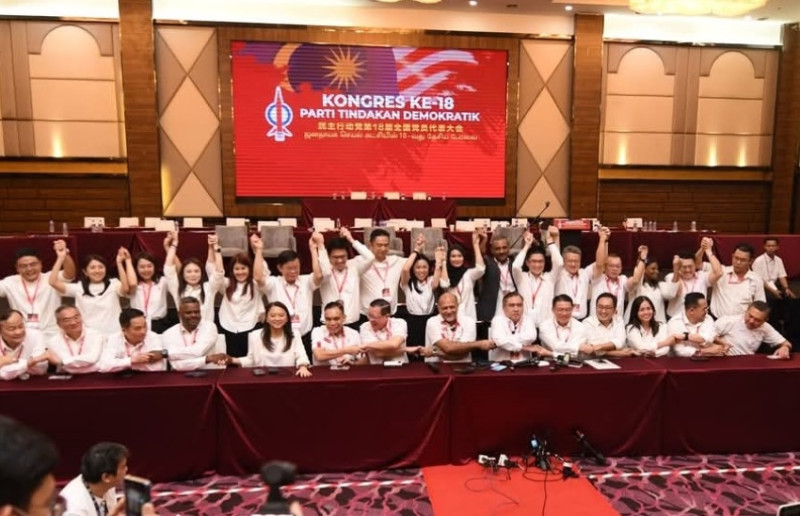
THE appointment of Digital Minister Gobind Singh Deo as the National Chairman and Transport Minister Anthony Loke as Secretary-General of the Democratic Action Party (DAP) for the 2025-2028 term marks a significant turning point in the party’s history.
The victory of these two young leaders not only represents a new chapter in Malaysian politics but also reflects the party's shift towards a more open and inclusive future.
This change is seen as a clear sign of DAP’s evolution, moving away from its past dominance by the Lim family and embracing a broader vision for the diverse Malaysian populace.
For over five decades, DAP was characterised by the dominance of the Lim family, particularly Tan Sri Lim Kit Siang and his son, Lim Guan Eng.
Both leaders shaped the party's direction, and DAP was often viewed as a party primarily advocating for the interests of the Chinese community. However, this recent leadership change signals a fresh direction for DAP, with a more inclusive and nation-centric approach.
Gobind Singh, regarded as a pragmatic and youthful leader, is seen as a beacon of hope for the party's future.
His commitment to an open and inclusive approach holds the potential to revitalise DAP, making it more relevant to the current generation, particularly the youth who demand change.
His focus on unity and the overall welfare of the Malaysian people could position DAP as a political force that transcends narrow racial struggles.
This leadership shift also reflects a paradigm change within DAP. It is evident that party members now seek a more inclusive nationalism, moving away from the narrow ethnic-based politics of the past.
This new direction could help DAP gain acceptance among a wider cross-section of Malaysian society, including the Malay majority, who have traditionally been sceptical of the party.
Anthony Loke, a young leader with significant experience, is expected to further strengthen DAP’s organisational structure.
His tenure as Transport Minister has shown his ability to manage significant challenges within the government, instilling confidence in the public that DAP’s leadership is maturing and becoming more responsible.
This could give DAP the impetus to move forward more effectively in the country’s political arena.
Crucial Questions
However, the election results raise a crucial question: Does the failure of former Penang Chief Minister Lim Guan Eng to retain the position of National Chairman signal the end of the Lim family’s legacy and influence within both the party and the wider political landscape?
The Lims have long been pillars of DAP’s identity, and their diminished role now suggests a shift towards a new era of leadership.
This election results not only point to a change in leadership but also reflect the growing demand from the Chinese community for a more progressive, less racially charged political discourse.
There is now a palpable shift towards a politics of unity, one that embraces diversity without neglecting the interests of any particular group.
As DAP moves forward, it faces the challenge of balancing the defence of Chinese rights with the promotion of equality for all Malaysians.
The party’s identity, often criticised for being narrowly focused on ethnic interests, now has the opportunity to evolve into one that appeals to all citizens, regardless of their background.
While this transformation offers hope, it also presents risks. DAP must navigate the delicate process of staying true to its roots while expanding its appeal to a broader audience.
Maintaining the relevance of its struggles while embracing inclusivity is no easy task, but it is crucial if the party is to remain a key player in Malaysia’s political landscape.
The leadership change signals a positive development for DAP, but the road ahead will require significant effort and courage. The party’s future success hinges on its ability to manage this transformation wisely, ensuring that it remains both a relevant force and an inclusive voice in Malaysian politics. – March 17, 2025