By Tengku Datuk Seri Zafrul Tengku Abdul Aziz
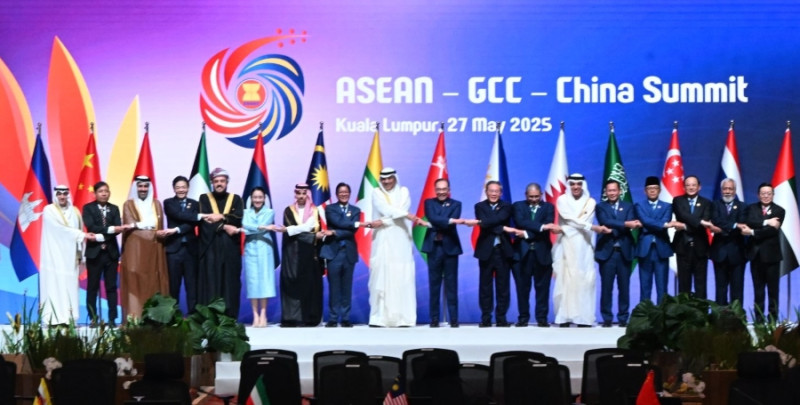
THE inaugural ASEAN-Gulf Cooperation Council (GCC)-China Summit held in Kuala Lumpur on 27 May 2025 may well be remembered by future generations as a historic inflection point in the evolution of the global order, said Minister of Investment, Trade and Industry, Tengku Datuk Seri Zafrul Tengku Abdul Aziz.
“Due to ongoing trade wars and geopolitical fragmentation, many see the ASEAN-GCC-China Summit as a catalyst for change within ASEAN itself,” Tengku Zafrul stated, reflecting on the significance of the event.
The 46th ASEAN Summit and its related meetings, including the second ASEAN-GCC Summit, were landmark occasions that moved ASEAN’s broader agenda forward, he added. Malaysia, he said, took pride not only in hosting the summit, but in its role in forging a shared vision among key voices of the resurgent Global South.
Among the notable outcomes was the joint communique—often the most difficult element of any multilateral meeting—which saw unanimous condemnation by ASEAN, GCC and Chinese leaders of continued atrocities in Gaza and a united call for a ceasefire, “in line with the sentiments of all rational and humanitarian-minded people across the world”.
Deepening Trilateral Economic Integration
Looking beyond the political dimension, Tengku Zafrul underscored the vast potential for deeper economic integration between the three groupings. Together, ASEAN, the GCC and China account for 2.15 billion people—or more than a quarter of the global population—with a combined GDP nearing US$25 trillion.
In terms of foreign direct investment (FDI), the region’s appeal is evident. In 2024 alone, ASEAN attracted US$235 billion in FDI, representing 17 percent of global flows (UNCTAD). China received US$114.76 billion (State Council of PRC) and the GCC secured approximately US$70 billion (Khaleej Times), collectively amounting to around 30 percent of global FDI.
“From these figures alone, the strategic and economic relevance of this trilateral bloc is undeniable,” said Tengku Zafrul.
He pointed out that ASEAN could serve as a strategic gateway to East Asian markets, while Malaysia—with its strong industrial and trade ecosystem, robust legal framework and investor-friendly infrastructure—is well positioned to facilitate investment into ASEAN and beyond.
He added that the GCC, with its geographic positioning between Europe, Asia and Africa, its economic dynamism, and cultural and religious affinities with Malaysia and ASEAN, is a natural partner in advancing deeper economic ties.
In 2023, ASEAN-GCC trade reached US$130.7 billion, with FDI inflows from the GCC totalling US$390.2 million. Meanwhile, China remains ASEAN’s largest trading partner, with trade amounting to US$696.7 billion and FDI of US$17.3 billion.
Malaysia will soon begin negotiations for a free trade agreement (FTA) with the GCC, Tengku Zafrul revealed, citing the US$22 billion in current Malaysia-GCC trade as a base for significant expansion.
Delivering Benefits to the People
Tengku Zafrul stressed that these developments are not just macroeconomic, but aimed at directly benefiting Malaysians, including youth, women and micro, small and medium enterprises (MSMEs).
Under Malaysia’s ASEAN Chairmanship in 2025, the Ministry of Investment, Trade and Industry (MITI) is spearheading 18 Priority Economic Deliverables (PEDs), many of which are aligned with engagement with China and the GCC.
“We have concluded negotiations not only to enhance the ASEAN Trade in Goods Agreement (ATIGA), but also the ASEAN-China Free Trade Agreement (ACFTA) 3.0. Both are expected to be signed in October 2025,” he said.
Malaysia has also finalised a Joint Declaration on ASEAN-GCC Economic Cooperation, which will pave the way for collaboration in market integration, sustainability, decarbonisation, digital transformation, and inclusivity—particularly for MSMEs.
In sector-specific terms, he highlighted ASEAN’s ongoing development of guidelines to support its regional electric vehicle (EV) roadmap. China’s global leadership in the EV sector is particularly relevant here, producing more than 70 percent of the world’s electric cars and EV batteries in 2024.
Sustainable Energy, Tourism and Halal Synergies
Tengku Zafrul also pointed to ASEAN’s Energy Cooperation Action Plan 2026–2030, which aligns with the GCC’s strategic push to diversify from oil and gas into renewable energy. The bloc has committed US\$100 billion to clean energy investment by 2030.
The synergies are equally clear in tourism and the semiconductor supply chain. China and the GCC are key source markets for ASEAN tourism, while China remains a dominant player in global chip production and consumption.
“Malaysia has been deliberate in its proposal of PEDs under its ASEAN Chairmanship, ensuring they catalyse ASEAN’s socio-economic dynamism and strengthen ASEAN-GCC-China trilateral cooperation,” he said.
He also noted the global halal market—currently valued at over US$3 trillion and projected to reach US$5 trillion by 2030—as another promising area for collective engagement.
“This is a market that ASEAN, the GCC and China can explore—and potentially lead—together,” he concluded. - May 31, 2025
Tengku Zafrul Tengku Abdul Aziz is Malaysia's Minister of Investment, Trade and Industry