By Murray Hunter
EVENTS in the Middle East can shift with startling speed, much as the Arab Spring demonstrated how localised triggers can rapidly erode long-standing regimes.
In September 2026, a sequence of military, economic, and diplomatic setbacks has placed significant pressure on Saudi Arabia under Crown Prince Mohammed bin Salman (MBS).
What began as a response to Houthi advances in Yemen has disrupted oil exports, exposed gaps in alliances, and raised questions about legitimacy- factors that, if prolonged, could amplify internal vulnerabilities in a system long reliant on oil revenues, coercive control, and regional standing.
The immediate catalyst lies in Yemen. Following Saudi-linked actions, including reported airstrikes, the Houthis launched a rapid offensive.
They captured the port of Mocha (Mokha), Dhubab, and other coastal areas, then seized Perim (Mayun) Island in the Bab al-Mandeb Strait along with the Hanish Islands.
This consolidates Houthi control over nearly all of Yemen’s Red Sea coastline (save limited pockets near the Saudi border). Perim sits astride the narrow strait, where sea passages on either side are roughly 12 miles (under 20 kilometres).
This places shipping within range of short-range missiles and artillery.
The Houthis have restricted traffic, effectively complicating or blocking Saudi-linked vessels while claiming openness to others.
Concurrent missile and drone strikes have hit southern Saudi provinces including Jizan, Najran, Asir (Abha and Khamis Mushait), and Sharurah, wounding dozens of civilians, damaging infrastructure (including a mosque), and forcing shelter alerts.
These are primarily aerial attacks rather than sustained ground occupations of Saudi soil, yet they underscore the spillover.
Compounding this, Saudi Arabia’s East-West (Petroline) pipeline, which is critical for moving crude from eastern fields to Red Sea terminals at Yanbu, bypassing the disrupted Strait of Hormuz, was hit by drones launched from not yet determined positions.
The roughly 1,200-kilometre line was shut down as a precaution amid fires and damage to pumping stations.

With Hormuz constrained by the broader Iran conflict and Red Sea routes now contested, Saudi oil export capacity faces serious constraints.
Revenue shortfalls strike at the core of the kingdom’s economic model and Vision 2030 diversification efforts.
Diplomatic isolation has deepened the situation. According to reports citing regional diplomatic officials (including Israel Hayom), MBS indirectly sought intelligence and other assistance from Israel via U.S. Central Command (CENTCOM) amid the Houthi advances threatening Bab al-Mandeb.
This followed U.S. President Donald Trump’s reluctance to commit to direct military intervention, offering only limited intelligence and targeting support.
Saudi Arabia holds the prestigious role of Custodian of the Two Holy Mosques, the Al-Masjid al-Haram in Mecca (surrounding the Kaaba) and Al-Masjid an-Nabawi in Medina (containing the Prophet’s burial site). Seeking help from Israel, widely viewed in parts of the Islamic world as a Zionist state, risks perceptions of compromised legitimacy among religious conservatives, Islamists, and the broader Ummah (the Muslim public).
Experts note that direct Israeli cooperation remains unlikely due to political sensitivities on both sides.
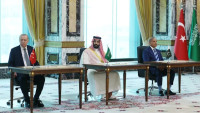
The recently formalised Makkah (Mecca) Joint Defence Agreement with Turkey and Pakistan, signed in August 2026 and featuring collective-defence language treating an attack on one as an attack on all, has yet to yield visible support.
Analyses highlight its limited institutionalisation, absence of automatic military mechanisms, and credibility gaps, where neither partner has intervened despite ongoing attacks.
Reports of a delayed regional summit in Salalah, Oman (involving Iran and Gulf states on maritime arrangements), further illustrate constrained regional manoeuvring, with Saudi Arabia citing the Yemen crisis.
These external shocks intersect with internal dynamics within Saudi Arabia itself. MBS has consolidated power since 2015–2017 through centralisation, sidelining rivals (including former Crown Prince Mohammed bin Nayef), co-opting or repressing the religious establishment, and neutralising organised opposition via surveillance, arrests, and high execution rates.
Support among youth and women for social reforms has broadened the base, while oil wealth and security forces provide buffers.
Residual risks exist, where royal family frictions (long-term succession ambiguity), conservative backlash against reforms, Shiite grievances in the Eastern Province, economic discontent from fiscal strain, and fragmented Islamist networks could pose potential issues for the MBS regime.
Border tribes in Najran, Jazan, and Asir add volatility. Transnational confederations (e.g., elements of Khawlan, Waylah, Yam) straddle the Yemen frontier, where Houthi mobilisation of aligned factions, cross-border strikes, economic disruption from closed trade and energy attacks, and spillover insecurity create pressures.
Divided loyalties and Houthi outreach could complicate local security if the conflict intensifies.
Prolonged revenue loss, military setbacks, and legitimacy questions could embolden elite manoeuvring, tribal opportunism, or broader discontent, especially if external actors perceive openings, echoing how rapid crises have historically tested authoritarian systems.
Saudi Arabia retains substantial resources and coercive capacity.
Yet the combination of contested chokepoints, oil disruptions, alliance shortfalls, and a high-profile outreach to Israel has created a compressed crisis.
Like earlier regional upheavals, the speed of these developments underscores how external shocks can rapidly test internal resilience.
Whether the pressures remain contained or cascade further depends on the duration of the Yemen conflict, restoration of export routes, and the regime’s ability to manage perceptions and potential internal fissures.
Saudi Arabia is currently under immense political strain, and no political partners like the United States and Pakistan are willing to assist presently. – September 16, 2026