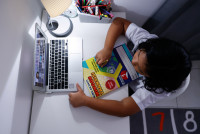
_during_online_class_at_Flat_Lembah_Subang_-_Sairien_02.jpg)
THE Consumers’ Association of Penang (CAP) urges the government to take urgent measures to control the prices of laptops and tablet computers that are desperately needed by students for their online education, which has been badly affected since last March.
It is the responsibility of the relevant authorities to ensure that there is no profiteering with the surge in demand for these items in Malaysia.
The current rise in prices of these equipment was attributed to a shortage in stock and an increase in logistic costs from the producing country.
It was reported that a branded affordable tablet that cost RM399 before MCO 2.0 is now priced at RM599, an increase of 25%.
The reason given is unacceptable. The manufacturers of these items, which are large corporations, should lower their profit margin as part of their social responsibility in these trying times.
Retailers should not take advantage of the temporary shortage to hike up the prices for unjustified profits. The authorities should have foreseen the problem and taken proactive measures to ensure there is enough supply, as it has almost been a year since MCO 1.0 was implemented.
When tabling the Budget 2021 in November, Finance Minister Datuk Seri Tengku Zafrul Abdul Aziz announced that government-linked companies (GLCs) and government-linked investment companies would be contributing RM150 million to Tabung Cerdik to provide laptops to 150,000 students from 500 schools.
The allocation of this sum of money alone will not solve the difficulties faced by children in getting education. Other associated problems must also be addressed.
According to a Education Ministry survey last March, there were serious limitations concerning online teaching and home-based learning.
The survey was conducted among 670,000 parents and about 900,000 pupils, and the results were shocking. Only 6% of students surveyed had personal computers and tablets, 9% had laptops, and 46% had smartphones, while 36.9% did not have any devices.
Even then, there are about 4.9 million students in preschools and primary and secondary schools nationwide. The 150,000 laptops and tablet computers will be sufficient only for 3% of the student population.
This excludes those at tertiary levels whom we cannot assume are rich to afford such devices.
Even if the computers and other equipment are made available, there is still the problem of poor internet service.
It is often touted that Malaysia has high-speed internet but there are places where the internet is intermittent or slow.
The government has to take internet service providers to task in ensuring that coverage and transmission speed are up to acceptable standards.
The prices and supply of laptops and tablets should be closely monitored and regulated because of the increased demand generated by the education sector and the business sector, the latter of which is switching over to cashless transactions.
If laptops and tablets are not easily available, then the government should not proceed with education online and consider alternative methods.
School classes can be held on alternative days for core subjects with reduced batches of students. Children who are in the vulnerable category can have home schooling.
Retired teachers who are fit to work can be mobilised for this purpose.
We call upon the government to speed up the distribution of laptops and tablet computers as many students have been deprived of education for almost a year.
The internet services must be improved and made available throughout the country. Where this is not possible, for example in the interior regions, other arrangements must be made to educate the children. – The Vibes, February 10, 2021
Mohideen Abdul Kader is CAP president