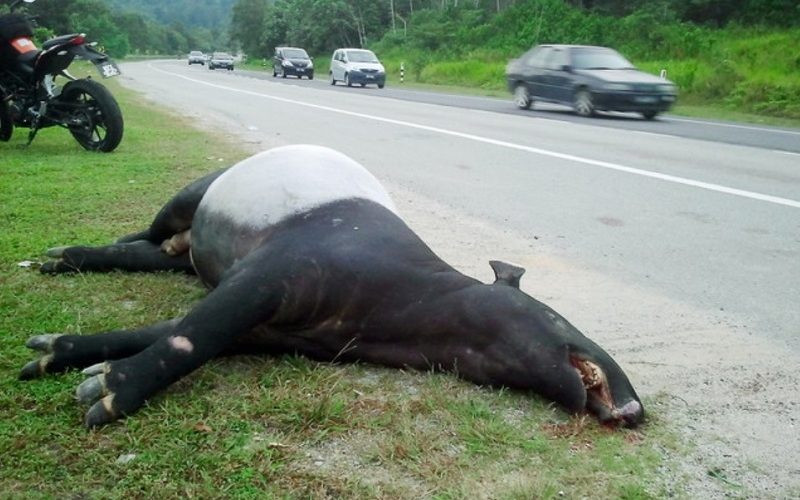
THE increasing number of wildlife killed on our roads is an issue that Sahabat Alam Malaysia (SAM) finds it increasingly difficult to ignore. The latest incident involved two tapirs at a road crossing.
The first case happened in Terengganu where the tapir after being hit by a car stumbled into a nearby forest in an injured condition. Injured wildlife often suffer long painful deaths.
However, the second accident in Johor involving a tapir was unfortunate as the animal died from head injuries, possibly from being hit by a vehicle.
This alarming rise in the number of roadkill involves not only wildlife but domestic animals as well.
In road accidents involving human deaths, these cases are noted, investigated with follow-up action taken.
But with wildlife deaths, there are no investigation or preventive safety measures taken.
Drivers of vehicles go off scot-free as there is no compensation to be paid regardless of whether the animal is an endangered or rare species.
Worst, some dead animals are mutilated by people for their body parts because of beliefs in its aphrodisiac value.
Who is at fault for roadkill? When driving, most drivers do not keep an open mind to the possibilities of slow scurrying mammals, amphibians and reptiles.
Most commonly killed are monitor lizards, snakes, pangolins, frogs, monkeys and so on. There are also those who pay no heed to the signboards on animal crossing.
The expanding network of roads through wildlife habitats and increasing traffic volume are accelerating species extinction.
This is one of the major causes of wildlife decimation along with forest clearance, habitat destruction, clearance of wetlands, overexploitation, and poaching and trade in wildlife.
Construction of roads through wildlife habitats resulting in fragmented forests should be a serious concern for the country as it opens more roads that dissect age-old wildlife travel routes.
To reduce roadkill, the authorities have come up with eco-bridges or viaducts, underpasses and overpasses to enable wildlife to move from one fragmented forest to another. But the question remains as to how effective these facilities are for the purpose of safe wildlife crossings.
Wildlife crossings may help to lessen the impact of roadkill, but it is not the panacea to foil the ill-effects of roads on wildlife and should not justify the building of roads into wildlife habitats.
The first option is to avoid road cutting through wildlife habitats.
Nothing will completely eradicate animal deaths. But highway authorities should make people aware of the enormity of roadkill tragedies that should be incorporated into driver education courses.
Drivers must be encouraged to watch out for animals in or near roads. Involving news media through radio and television announcements would do well to educate drivers.
If any road development is likely to cause an impact to native fauna, an environmental impact assessment must be carried out and advice sought from wildlife authorities.
With an expanding human population needing more roads and connectivity, proactive and strategic planning to reduce roadkill should be the main focus in road projects that involve wildlife habitats.
The best strategy is to reduce the need for roads along wildlife habitats. – The Vibes, October 6, 2020
Meenakshi Raman is president of Sahabat Alam Malaysia