
WHEN the government introduced the National Wages Consultative Council Act 2011 (Act 732), it was intended to address the low pay then prevailing in the country, especially in the private sector.
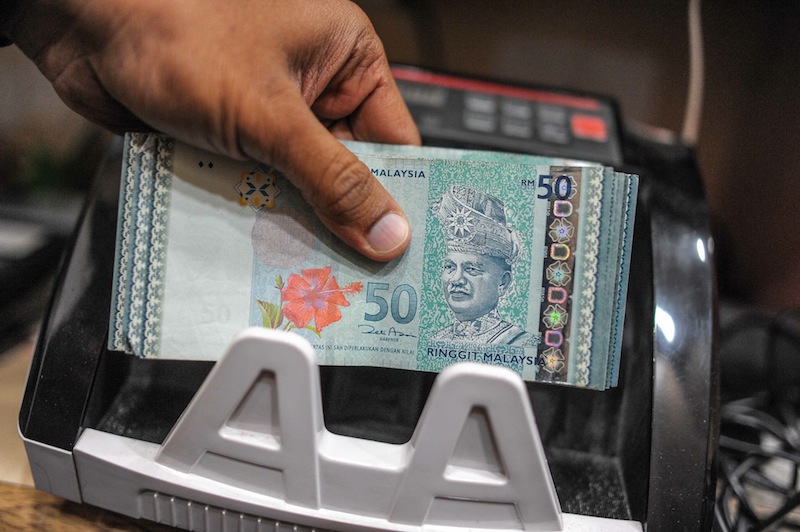
At the time, employers were paying very low basic salaries not only in the Klang Valley, but nationwide. In accordance with the act, the Minimum Wage Order 2012 was introduced and a RM900 minimum salary was established.
The reason behind the introduction of the minimum wage system was to mitigate unfair salaries, with the government intervening when employers failed to pay equitable wages, thus driving salary levels to what was described as “the race to the bottom”.
Fast forward to 2021, and one wonders whether this system is still relevant given the fact that salaries, even for degree holders, have been compromised on account of the weak job market.
Youth and graduates’ unemployment
Last year, youth unemployment stood at about 11.72%, and total unemployment at about 4.8%. Even more alarming is that about 70% of jobs seekers were youth, according to an EIS-UPMCS Center for Future Labour Market Studies report.
A Higher Education Ministry survey revealed about 10% of fresh graduates were paid between RM1,001 to RM1,500 a month since 2010.
Last year, more graduates fell into the said income bracket, reaching a decade-high of 22.3%, it said.
The statistics seem to suggest a nexus between low pay and the high jobless rate among youth and fresh graduates.
In today’s economic conditions, youth and fresh graduates are forced to accept low salaries to secure a job, however incompatible those salaries may be.
Low salaries, by any standard, are an indication that young workers are being exploited on account of the suffering job market.
Is the current minimum wage system still relevant?
A Bank Negara Malaysia (BNM) study in 2018 stated that for a single adult to sustain himself or herself in Kuala Lumpur, he or she would need RM2,700 a month.
It also said a couple without children would need RM4,500 a month, and a couple with two children, RM6,500.
This study is based on the consideration of what is termed as a “living wage”, which is defined as the minimum income necessary for a worker to meet his or her basic needs, including food, housing and basic necessities.
On the contrary, a minimum wage is set by the government with the aim of protecting workers against unduly low income.
As such, based on this study, middle- and low-income (M40 and B40) workers are not earning enough to sustain themselves.
In my view, working long hours is as good as modern day slavery – where the lack of a decent sustainable salary for an eight-hour work day forces a worker to supplement his or her income by working overtime, on off days and public holidays, or get a second job.
Working prolonged hours – by extension enhancing production for employers – results in the deterioration of workers’ physical and mental well-being.
What needs to be postulated is whether the existing minimum wage system is still relevant under these circumstances.
A living wage module v a minimum wage system
Sunway University Business School’s Prof Yeah Kim Leng opined that, given the BNM study, workers will need a side gig to make ends meet on a minimum wage of RM1,200.
Therefore, it is apparent that workers cannot survive on the current system of a minimum wage of RM1,200 a month.
What needs to be deliberated, then, is whether there is a need for a paradigm shift from a “minimum wage” system to a “living wage” module.
The National Wages Consultative Council ought to be rebranded to the “National Living Wage Council”, which should be given absolute power to decide on a national living pay rate and not be subservient to the government.
Correlation between unionisation rate and wage inequality
Academic research has hinted to a correlation between the rate of unionisation and income inequality – the lower the rate of unionisation, the higher the income inequality.
In Malaysia, it is an indisputable fact that existing labour laws impede organising efforts by unions.
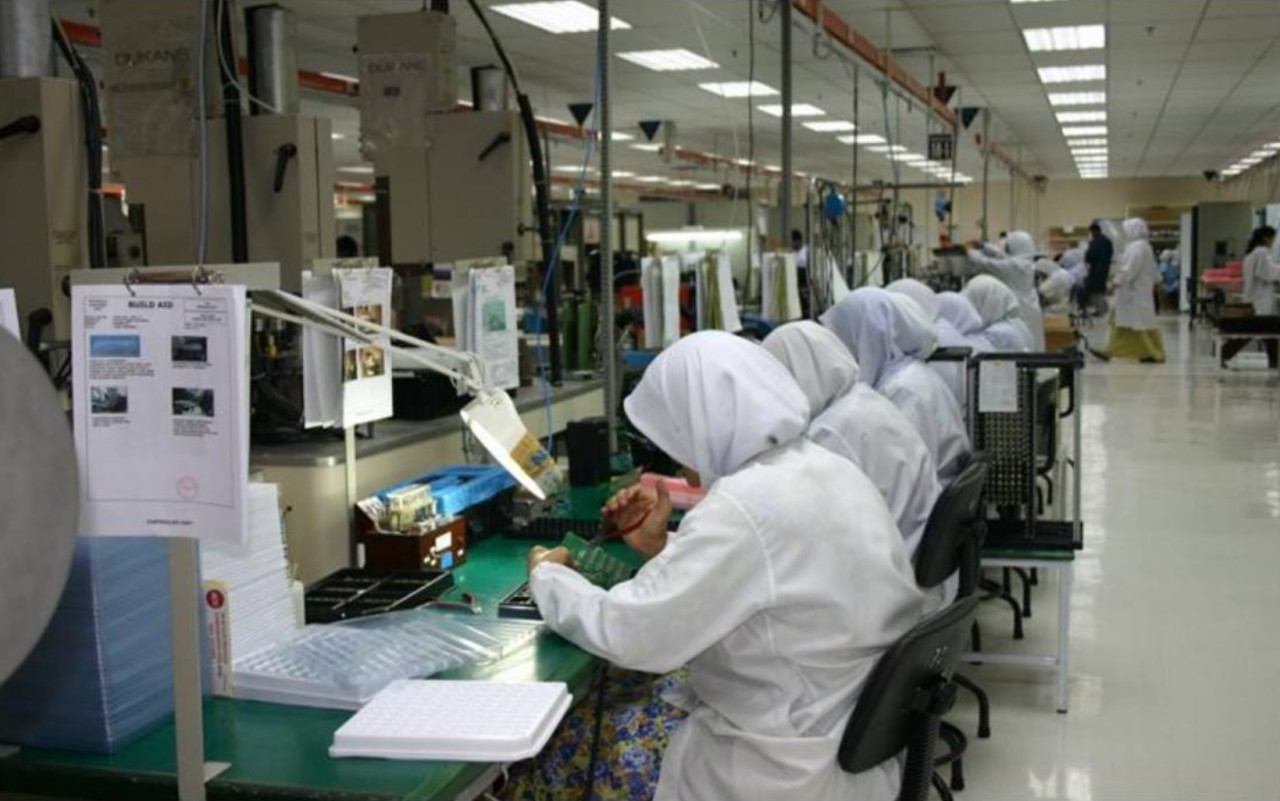
Take for example the case of electronics workers.
According to international standards, the electronics sector is classified under the electrical and electronics sub-sector. Going by that, existing Electrical Industry Workers Union (EIWU) ought to have been accorded the right to organise the workers in the electronics sector.
If EIWU had been accorded this right, chances are wage inequality could have been substantially addressed in the sector, which employs thousands of workers.
However, the government did not permit EIWU to organise electronics workers so as to suppress its numerical strength, and, in the process, prepertuate income inequality in the electronics sector. Ultimately, the government’s ploy was to dilute the unionisation of electronic workers into a regional demography.
It is obvious that a fundamental flaw exists in Malaysia’s income inequality in correlation with the rate of unionisation in the country.
What, then, are the challenges?
The challenges are clear.
Firstly, the labour movement has to pursue a transformation of the embedded pro-employer labour laws. We need to continue our struggle to ensure the government confirms with core International Labour Organisation standards, such as conventions 87, 98, 154 and 190.
Secondly, we need to realign the government’s socio-economic policies that give preferences to employers, thus marginalising both working class citizens and the trade union movement.
Thirdly, we need to demand that the outdated minimum wage system be recalibrated to a living wage module based on the 2018 BNM study. – The Vibes, April 22, 2021
K. Veeriah is Penang Malaysian Trades Union Congress secretary