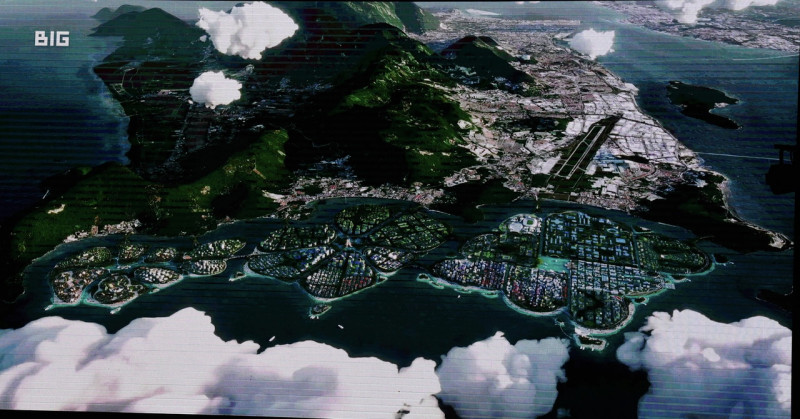
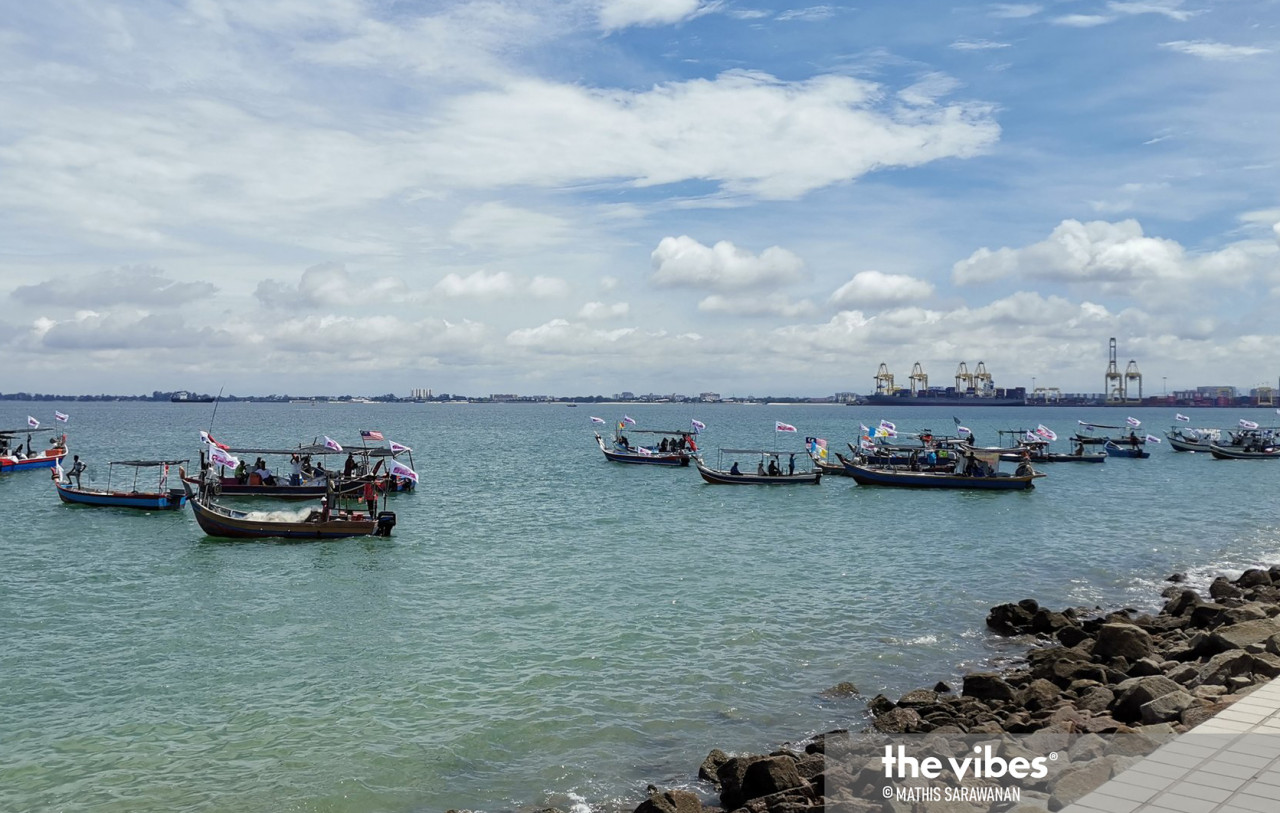
SINCE 2015, the fishermen of Penang have been protesting against the Penang South Reclamation (PSR), a project of the state government that will annihilate the fisheries commons where locals have fished for generations. No amount of rebranding for PSR, whether as “Penang South Islands” or “BiodiverCity”, will make this project green.
Two years ago, Penang Forum launched a petition with the support of 45 non-government organisations. We explained why the state’s project to reclaim three islands totalling 1,821ha is unnecessary, unjustifiable and likely to fail. All appeals to conscience, logic and good governance have been stonewalled by those in power.
The petition to cancel PSR has so far gained 115,000 supporters, while a second petition to save the turtles of Penang and Perak has attracted 225,000 supporters. Since then, more weaknesses, flaws and pitfalls of the PSR plan have come to light, with potentially grave consequences for Malaysian taxpayers and Penang ratepayers.
The following 10 questions demand answers:
1. Is building PSR Island A the best strategy for Penang’s industrial expansion?
Located near Penang airport and in the flight path, Island A may not be suited for certain high-tech industries. It might be more strategic to develop the Batu Kawan-Kulim industrial corridor to create synergies with the Kulim High-Tech Park and the proposed Kulim International Airport. With lower industrial land costs and ample room for expansion, it would be easier to attract companies offering manufacturing jobs. Factories could be built with attached dorms, thus reducing traffic jams from workers’ commute. It is puzzling why the Penang government is focusing yet more development on Penang Island, despite promising that “the future of Penang is in Seberang Prai”.
2. Who is the PSR residential development for?
The Statistics Department forecasts 1,983,200 Penang inhabitants by 2030. However, the Penang Structure Plan and Penang Transport Master Plan (PTMP) are based on an overinflated 2030 population projection of 2.45 million, perhaps to justify the territorial expansion. As a reality check, Penang recently emerged as the state with the lowest fertility rate in the country, at 1.3 children per woman. If not locals, will the additional 446,300 PSR population be mostly foreigners, like in Johor’s Forest City?
3. What about the looming water shortage in Penang?
Sg Muda supplies about 80% of Penang’s water, but the Ulu Muda headwaters are threatened by Kedah’s logging concessions. Anyhow, Kedah intends to channel the bulk of Sg Muda’s water to irrigate its “Rice Bowl”. As Penang is unwilling to pay Kedah for ecosystem services, how can it guarantee future water security for its present 1.77 million people, let alone provide for PSR’s additional 446,300 population?
4. Has the Penang public been fooled by bait-and-switch tactics?
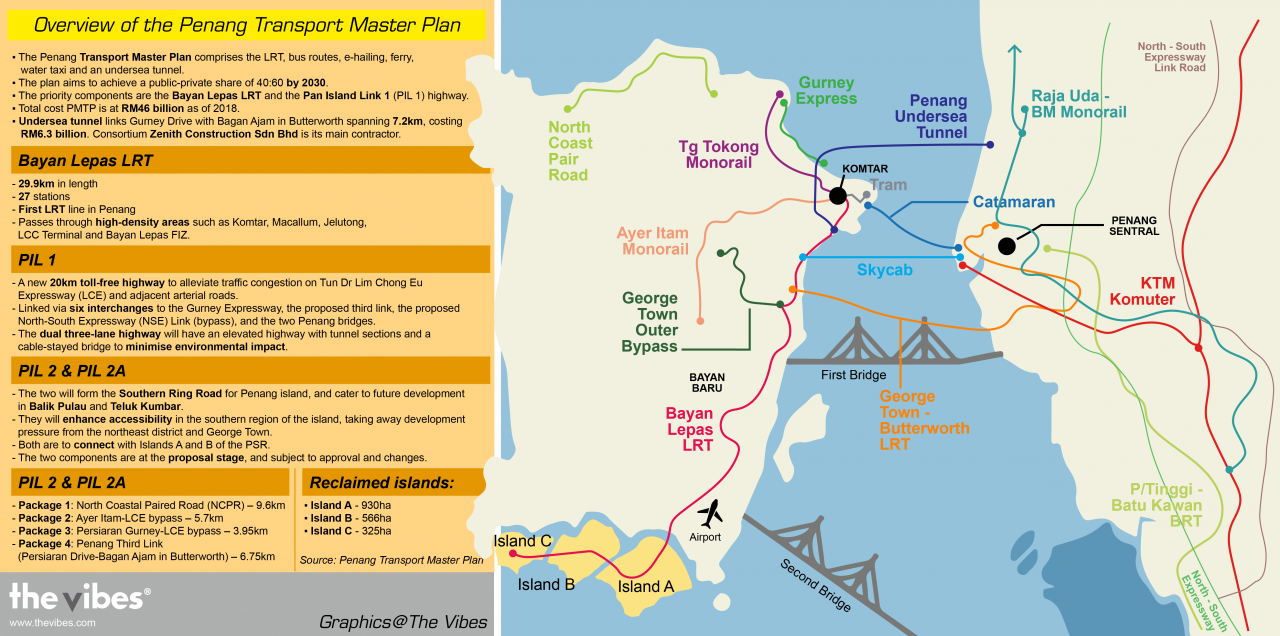
In response to the Request for Proposal (RFP) for PTMP in 2015, the winning developer consortium recommended the reclamation of the said three islands to finance the plan. PTMP then morphed into a RM46 billion mega project and highway plan. Finally, the transport plan was decoupled and jettisoned from the reclamation plan in the PSR environmental impact assessment (EIA) in 2019.
One might conclude that the public transport plan was conveniently used to bait frustrated Penang drivers to buy into the reclamation scheme, but costly land expansion through reclamation was the main intention from the beginning. What was promised: better public transport. What is delivered: artificial islands and more highways. Bait and switch.
5. Who is dictating the rules of the game?
When the Covid-19 pandemic changed economic realities, priorities and risk levels, Penang should have cancelled or at least postponed the PSR project. When it was unable to raise the RM2 billion loan required as initial capital, the state should have realised it was no longer in a position to undertake the project. The one with poor leverage will always be the loser.
Not knowing when to quit, the state is now pressured to privatise the reclamation of over 1,000ha of land (underwater) to one developer consortium, without going through transparent procurement practices such as open tender. The state retains 30% ownership of the project development company in a complex ownership structure representing the insidious coordination of corporate-state interests and private interests. It would come as no surprise if government officers are expected to remain silent whenever public interests are sidelined.
6. How did the project delivery partner (PDP) become the majority owner?
Originally, the developer consortium was supposed to act as PDP, an “agent” or “servant” of the Penang state. Now, it seems the tables have been turned, and the servant has become the master, having the upper hand. In the latest PSR agreement, the private developer consortium gets 70% control of the project development company appointed by the state.
This is in return for putting up the capital to reclaim the first 485ha (half of Island A) at an estimated cost of RM6 billion to RM7 billion, including road and bridge development. “On a back-of-the-envelope calculation, the reclamation cost works out at about RM95 per sq ft” – this could be much higher than the average reclamation costs in Melaka. If this is a public project, how is it that the developer consortium has the main say in the price and reclamation schedule?
7. Is our chief minister building Penang’s future on shifting sand?
With financial reserves of just over RM1 billion, and an annual budget of about RM1 billion (and a development budget a third of that), is the state government being overambitious in embarking on a RM46 billion project?
As the state is ultimately responsible for making the project viable, it may find itself burdened with new traffic, social and environmental issues in addition to old, unsolved problems, eating into its budget. Will the state then sell off more state assets (as it has done in the past) or take up loans just to stay in the game, or even trade off state assets from the future islands even before they are completed?
8. Can “too-big-to-fail” reclamation projects actually go wrong?
Look around. Kansai airport is sinking faster than expected. The financial future of Dubai’s Palmeira Islands and Johor’s Forest City has been disrupted. The reclamation of Teluk Jakarta and Teluk Benoa Bali continues to be delayed due to popular resistance by those fighting for survival.
The Melaka Gateway and South Korea’s Saemangeum reclamation works have missed their deadlines by years. Despite huge capital inputs and refinancing efforts, the ongoing reclamation project involving Sri Tanjung Pinang 2, north of Penang Island, is far from being sales-ready, while the developer’s stock prices have depreciated dramatically.
9. Is the Penang government trying to distract our attention from other failed projects?
Penang still has two unfinished mega projects. The first is the Gurney Wharf land swap for a tunnel and three highways, where nothing has been built after seven years (except for two high-end condominiums), and the developer consortium and politicians involved are being investigated by the Malaysian Anti-Corruption Commission (MACC).
The second is the Bukit Kukus paired road project, originally costing RM275 million and supposed to be completed in January 2019. It has now run over its budget, costing RM545.6 million, and is two years behind schedule after a landslide in 2018 that claimed nine lives. So much for transparency, accountability and competency.
10. Is “pollute first, clean up later” an acceptable development strategy?
The pollution from previous reclamation projects has yet to be addressed. Fishermen are left with declining catch. Severe erosion has been reported at public recreational beaches in Penang’s Batu Ferringhi and Melaka’s Pantai Puteri, possibly due to currents altered by private reclamation.
Who has to repair the eroded beaches, dredge the silted harbours and estuaries, mitigate floods and clean up the mess? The Irrigation and Drainage Department, harbour authorities, municipal authorities and the state – in short, taxpayers and ratepayers. This is how profits are privatised, and losses are socialised.
During the fasting month, Penang politicians kept announcing the start of PSR. Similarly, the EIA for the project was displayed during Ramadan in 2017 and 2019. Might this be construed as a deliberate attempt to break the spirit of the affected fishermen? Ex-gratia payments have been held out to stakeholders, but those who have accepted appear to be mostly part-time or retired fishermen.
The full-time fishermen of Sg Batu and Teluk Kumbar have largely rebuffed the state’s offers. Instead, they question the project’s legitimacy. They have mounted an appeal against the EIA approval, under the Environment Quality Act 1974. The appeal is scheduled for June.
Facing high-risk climate scenarios, many countries are planning for a green future of balanced development, for the sake of socio-economic stability. However, a neo-liberal state captured by private interests is incapable of virtuous planning for the people’s well-being and prosperity. It can be predicted that the Penang government’s monolithic development agenda will increasingly come into conflict with the needs and priorities of ordinary people.
Today, fishermen’s livelihoods and fishing grounds are being sacrificed by our state leaders. Tomorrow, Penangites will probably have to pay a higher assessment and quit rent, forego their fresh, wild-caught seafood, and worry about their water supply. With increased exposure to climate events and rising sea levels, there is no guarantee that the PSR islands will not sink in the foreseeable future.
And when they do, the current political leaders would have retired, the developers would have made off with the profits, and the people of Penang would be left staving off a man-made disaster. – The Vibes, May 12, 2021
Khoo Salma Nasution is Penang Forum spokesman