MALAYSIA is in a technical recession, which is defined by the US Federal Reserve as two successive quarters of economic contraction.
This is the second time in two years it has occurred, and in both cases, the cause is clearly the lockdown policy imposed by the government. This has been noted recently by former prime minister Datuk Seri Najib Razak and it deserves some attention when politicians recognise the implications of the government’s overreaction in imposing lockdown measures.
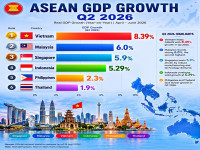
However, as is often the case in economics, the story is not quite so simple. Malaysia’s economic slowdown started well before the Covid-19 shock, with weak growth in the third quarter (Q3) and Q4 of 2019. It became worse after the first lockdown caused the recessionary phase in Q2 and Q3 last year. The deep 17.2% contraction of gross domestic product (GDP) year-on-year in Q2 2020 made Malaysia one of the worst performers in the top six Asean economies.
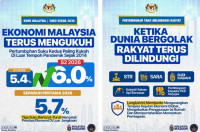
The lockdowns in 2021 repeated the 2020 experience with GDP contracting in two successive quarters by 1.9% q-o-q or 16.1% y-o-y in Q2 and 3.6% q-o-q or 4.5% y-o-y in Q3.
When compared with the top six Asean countries, the impact of Covid-19 has been worse in Malaysia for three main reasons. First, the lockdowns in Malaysia have been relatively longer and stricter than elsewhere and this caused structural damage to businesses, employment, income and savings, which has affected recovery prospects.
Second, the government stimulus packages have not been as large or as effective as they had been presented to be. Around half of the total allocation was not used quickly or at all and around half of what was used came from private sector sources such as Employee Provident Fund (EPF) withdrawals. In addition, the targeted approach, as opposed to a universal one, was inefficient.
Third, Malaysia was caught by Covid-19 in the middle of a structural transformation of the economy, substituting its engine of growth from investment to consumption and from the industrial to the services sector.
This structural change is a long-term trend that often happens as economies progress through successive phases of development. In Malaysia, this process has been somewhat forced by previous governments and successive Malaysia Plans involving progressive, relative reduction in funds to support public investment in all sectors of the economy apart from services.
Drop in FDI since 2018
Private investment and foreign direct investment (FDI) inflows have followed the same trend. Aggregate FDI inflow fell by half in 2018 and half again in 2019, only recovering to previous levels in 2020. FDI in agriculture contracted significantly in 2017 and 2018 saw a contraction in construction and real estate. In 2019, FDI in manufacturing was the underperformer. Net FDI has been in trend decline since 2016.
All of this was before the Covid-19 crisis and the current government took over. Indeed, it originated before the current and previous two prime ministers. Together, it has reduced the fuel needed for the engine of investment to help the economy grow.
At the same time, there has been a shift to consumption, which is powerful in pushing economic growth but, by itself, has not been able to promote robust and sustained growth over time. We must also remember that the structural impact on incomes and savings means that there is very little pent-up consumption.
We have also seen a significant increase in unemployment and underemployment, which has become a structural feature of the Malaysian economy. Again, we saw this before the Covid-19 crisis, but it has certainly been made worse by the lockdowns and employment recovery policies that have the same ineffective targeted approach as before.
A word on inflation is also appropriate because price hikes, especially for meat and vegetables, have become an issue of public concern and debate. Contrary to the consensus, we expect that inflation will be kept at bay – around 2.4% in 2021 falling to the normal 2.0% in 2022.
Despite the headline figures, which are affected by oil price and lockdown-induced supply shortages, both of which are temporary, inflation has been and will remain persistently low.
Core inflation, for example, has been stable at around 0.7% and may reach 1.5% in 2022, but persistent labour market slack will moderate wages and price controls, especially when petrol will help on the other side. Based on this, we see no particular need for Bank Negara to change its interest rate policy in the near future.
Country at a crossroads
There are three points of note on the current position of the Malaysian economy. First, we are at a turning point – moving from a technical recession into slow and fragile growth. From now on, we expect to see a recovery phase that will be slower than expected and certainly not by 6% to 7% as forecast by others. Growth will more likely be around half of that, in the 2.5% to 3.5% range.
Secondly, we do not have a balanced growth model in Malaysia, with recovery likely to be pushed by consumption, not investment. The impact of the Covid-19 crisis has caused significant structural damage that needs investment to be righted. Without that, the damage of the past will impact growth prospects in the future, and high growth, while possible, is not coming back any time soon, unless investment improves.
Thirdly, Malaysia is likely to emerge from the crisis as the worst performer among larger Asean countries, and if as has been predicted already, the move to the Covid-19 endemic phase – postponed by the Omicron variant – to slow and fragile recovery may be derailed, especially if the same futile policy of lockdowns re-emerges. – The Vibes, December 3, 2021
Dr Paolo Casadio is an economist at Help University
Prof Geoffrey Williams is an economist at Malaysia University of Science and Technology