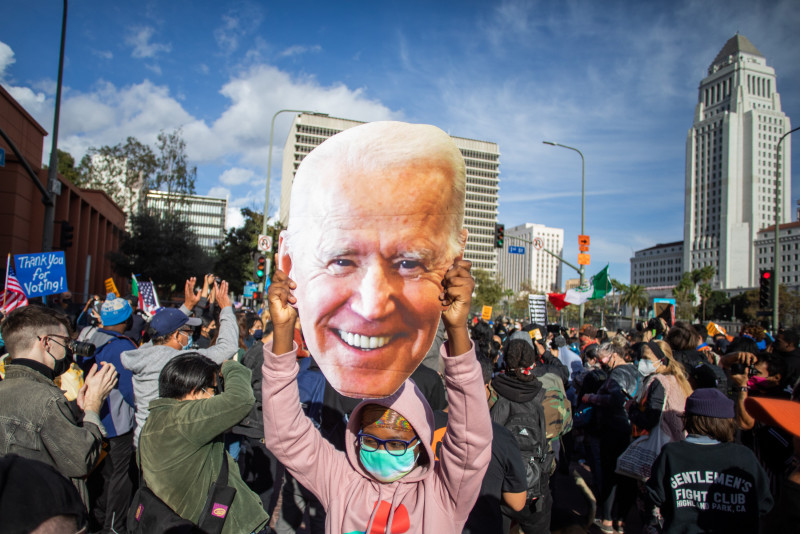

PRESIDENT-ELECT Joe Biden will have the most experienced State Department team in US history.
The world will see a far more stable foreign policy than we have seen put into motion by President Donald Trump, and most importantly, you will see the Biden team pointing to racism, international relations and climate change as things he will address in his first 100 days in office.
For those who are not familiar with Biden and his political history, it is important to note that in his 40 years as a senator from Delaware, no member of the upper chamber has, in the country’s history, sponsored more bipartisan legislation than he did.
Over his 47 years in Washington, Biden is widely considered as the most well-prepared and knowledgeable member of the US Senate, and above all, a compassionate man who reaches out to all sides to craft deals.
Why is his dedication to details important in his foreign policy decisions?
He studies all sides of an issue to ensure all perspectives are explored, and there will not be any rash or shoot-from-the-hip choices made by him or his administration.
Let’s look at trade with partners in the South Asia/Oceania region.
Biden has made clear his support for the Trans-Pacific Partnership (TPP), which includes Malaysia, along with 11 other countries. All indications are that he will rejoin TPP, the deal that Trump left in 2017.
It might require a bit of creative deal-making because Biden cannot ratify TPP without Congress’ consent, but he can rejoin the negotiations, and at the same time, work out any objections that US lawmakers have to the treaty.
Look for him to help the US become a bigger trade partner in the region, in the hopes of showing his support for the many countries that have made strides in a new green economy. He could use those deals to stop China from dominating the marketplace by dropping the Trump tariff plan.
Biden will re-establish US relations in the region that, in many cases, were overlooked or undervalued, both as a trading partner and key member of making the region a national security ally.
Also part of his plan to combat China is to ramp up US technological supremacy and the green policy, to have Ford, General Motors and Chrysler all produce a larger number of electric cars. As of today, China produces 47% of the world’s electric vehicle (EV) market, making the nation far and away the global leader.
Malaysia may find a willing trade partner in Biden’s new and expansive green policy. At present, the US has only about 26,000 EV charging stations with more than 84,000 plugs open to the public. Biden hopes to triple that number over the next five years, so partners in the emerging green market will be targets in his trade plans.
Let’s switch from trade to international security. What will the Biden administration do to help secure the South Asia/Oceania region?
We can expect the relationship between the US and long-time partners South Korea and Japan to be more stable once more. Under Biden, look for much more security, as once again, the US navy will have a greater presence in the South China Sea.
The US will be far less tolerant of North Korea, so the focus will shift to keeping a close tab on what the hermit state is doing on the nuclear side.
Don’t expect Biden to exchange any “love letters” with Kim Jong-un. There will be talks, but in a much more “I mean business” tone than the Trump administration.
There have been 28,500 US troops stationed in South Korea as a legacy of the technically unfinished 1950-53 Korean War. Biden is likely to ask for additional funding, to the tune of a 13% increase as discussed in negotiations with the Barack Obama-Biden administration that came to about US$1 billion a year, before Trump asked for upwards of US$5 billion to keep troops in the region.
“As president, I’ll stand with South Korea, strengthening our alliance to safeguard peace in East Asia and beyond, rather than extorting Seoul with reckless threats to remove our troops,” said Biden in an unprecedented op-ed published on October 30 by South Korea’s Yonhap news agency.
Some security comes from treating people right. Human rights and a sense of common decency are also major parts of a Biden foreign policy.
An example of what is to come was previewed by vice-president-elect Kamala Harris during her debate with Vice-President Mike Pence: “Joe Biden advocates taking a harder stand on human rights issues in China and the situation in Hong Kong, while keeping pressure on China for its trade practices.”
“I think he will be more forceful on issues of human rights in China, and frankly, elsewhere in the region... That would be a big difference,” Matthew Goodman, senior vice-president for economics at the Centre for Strategic and International Studies, told CNN Philippines’ New Day.
For Malaysia, if the past is a prologue, Biden will look to consult his old friend Datuk Seri Anwar Ibrahim, who shares the same passionate views on human rights and social justice.
One can only wonder how much more Malaysia would benefit from its US relations with Biden in the White House, if Anwar’s path to Putrajaya had not been scuttled by a political coup in March.
Both Anwar and Prime Minister Tan Sri Muhyiddin Yassin sent congratulatory messages to Biden. But, it is worth pointing out that Muhyiddin did not receive a similar message when he led the move to take over the government.
Also, as vice-president in the Obama administration, Biden was vocal in demanding the release of Anwar, who was then in jail.
However, while Biden could be helpful to Anwar, the communique will have to be via lower-level diplomatic teams. Biden will respect Malaysia’s sitting government and not directly do or say anything that could be perceived as the US attempting to interfere in the domestic affairs of a sovereign nation.
He is, however, someone who believes in building bridges, hence, one may expect to hear conciliatory comments if the president-elect is asked about Malaysia’s political situation.
Meanwhile, it should not go unnoticed that not only is Harris the first woman vice-president, but also a person of colour and proud of her South Asian heritage.
We don’t know exactly what anyone will do once they come into power, but with 47 years of experience in the US government, with a lifetime of being known as a compassionate man who holds one of the best views on how the world needs to work together, I think that Biden-Harris will be a welcome change for the region. – The Vibes, November 16, 2020
Jim Williams is a veteran political commentator who has covered every presidential election since 1976. He is a seven-time Emmy award-winning producer and broadcaster, and is The Vibes’ US correspondent