TOKYO − Brazil emerge from their team bus singing, clapping and cheering.
The bronze medallists from the Rio Paralympics in 2016 are keyed up and in the mood to make some noise ahead of meeting silver medallists USA in today’s big clash.
Banging their kit bags like drums, they march to the dressing room in a cacophony of chanting.
But that all changes on the field of play − the sound of silence dominates.
Welcome to the unique world of goalball.
"One, two, three, let's go USA!" scream their opponents as dance music booms around the Makuhari Messe Arena.
But once the referee announces: "Quiet please, play," you can hear a pin, or a ball, drop.
Most sports in the Paralympics have an Olympic equivalent.
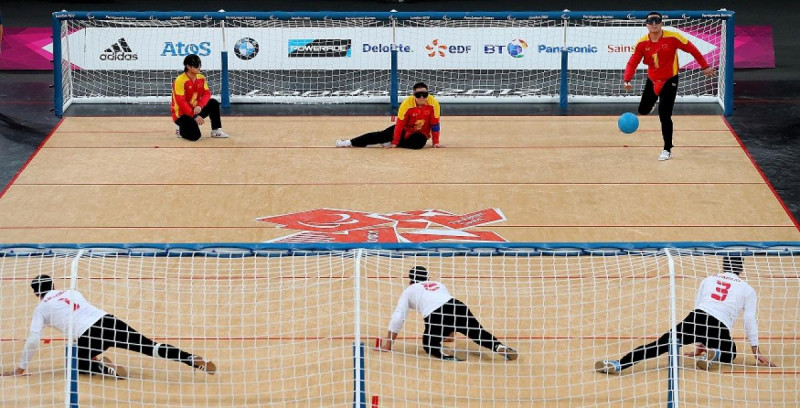
Not this one, where visually-impaired players try to score goals with a hard-rubber ball containing bells, while defenders rely solely on sound and instinct to make diving blocks and saves.
"Brazilians are widely known for their happiness," said star player, Leomon Moreno, about his teammates' Samba antics, which saw them dance into the arena.
"Every moment, on the bus, in the village, and at the venue we are like this.
"But once we get on the field of play, we focus, concentrate − in Portuguese we say 'you turn the key'."
With the US holding a slim 3-2 half-time lead, the intensity grew to a crescendo in the second half of this pulsating battle of the goalball giants, with the lead changing hands several times.
Finally, it was the US team who fought back from 5-4 down to inflict a first defeat in five years, 8-6, on pre-tournament favourites Brazil.
"It's a roller-coaster of a sport," American Calahan Young admitted after a man-of-the-match display in which he scored four goals, but also conceded several penalties.
"Every single play there could be complete catastrophe or there could be complete success.
"We went through a little bit of each. It's an emotional, emotional game. I've never beaten this team before in my life, they are an incredible team."
Most visually-impaired people have some degree of sight, so the players in Paralympic goalball wear blindfolds to make sure of a "level-playing field" where everyone is left totally in the dark.
The sport was invented in 1946 as a form of rehabilitation for visually-impaired World War II veterans and is played on a volleyball court with nine-metre-wide goals at each end.
The aim is to score by hurling the 1.25kg ball, slightly bigger than a basketball, underarm at high speed from one end into the goal at the other.
Some players go for sheer power, while others impart spin ten-pin bowling style or try to bounce the ball as they visualise in their minds where the opponents lie in wait.
Defenders attempt to keep their goal intact by not only utilising the sound of the ball, but also taking audible cues from opponents' footsteps, squeaks of sneakers, rustling of clothes or even the sound of breathing.
The sport is administered by the International Blind Sports Federation, who say that goalball is played in more than 100 countries. It has been a fixture of the Paralympic Games since 1976.
With two pool matches to go, Brazil are still confident of securing the gold that eluded them on home soil five years ago, especially after hammering defending champions Lithuania 11-2 in their opening match yesterday.
"It is hard, because no one wants to lose," said Moreno after the defeat to the US. "But if you are going to lose a match, this is the right time."
With only two of the 10 teams being eliminated before the quarterfinals, a place in the final is still firmly within grasp.
"We will learn from our mistakes," said Moreno. "We can still dream of the gold medal.
"A champion is made as much from his defeats as his victories." – AFP, August 26, 2021