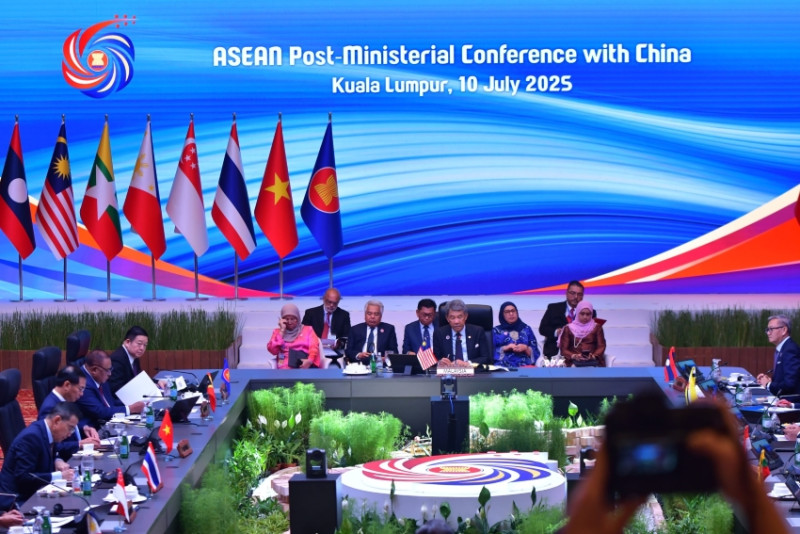
THE forthcoming ASEAN-United States dialogue in Kuala Lumpur on Thursday is expected to serve as a timely diplomatic outlet, or “pressure valve”, in the wake of new US tariffs targeting Malaysia and five other ASEAN nations.
Stephen Innes, managing partner at SPI Asset Management, said the visit by US Secretary of State Marco Rubio—his first official trip to Asia—provides a platform to manage tensions stemming from the latest trade measures announced by President Donald Trump.
“It signals the US still sees ASEAN as more than a pawn in the China game. If ASEAN leaders present trade ties as mutual ballast against global volatility, it could help recalibrate tone, if not terms,” he told Bernama.
Vietnam, Malaysia and Thailand are among the most affected by the newly announced tariffs, owing to their extensive integration with US supply chains. Malaysia, in particular, will face a 25 per cent tariff under the new regime.
“The tariff hikes, many jumping from near-zero to 10 per cent–25 per cent, are no longer pinpricks. They are blunt tools. The immediate impact is uncertainty—firms freeze expansion, and capital goes on standby. The real cost isn’t trade volume, it’s trade hesitation,” Innes explained.
He described Trump’s trade strategy as following a familiar pattern of “provoke, delay, extract”, with tariffs wielded more as leverage than policy.
“It is a power play, using tariffs less as policy and more as poker chips. ASEAN should treat US trade policy like weather—unpredictable, but not unmanageable,” he said.
He advised ASEAN members to “diversify trade exposure, deepen intra-ASEAN linkages, and build redundancy into supply chains”, adding that “policy might be political, but profits still speak loudly”.
With implementation set for 1 August, Innes outlined three likely outcomes: a delay, selective application to preserve leverage without major disruption, or full enforcement—potentially prompting retaliation, market fallout, and heightened pressure on emerging economies.
Economist Geoffrey Williams added that despite the current friction, long-term US engagement with ASEAN will likely endure due to shared economic interests.
“I believe Senator Rubio will restate the US position and reassure ASEAN countries that a solution is still available until 1 August,” he said.
“The best way for ASEAN to influence policy is to cooperate and be pragmatic by reducing tariffs and non-tariff trade barriers and allowing consumers and businesses to decide whether or not to buy US products.”
Williams cautioned that trade volumes may decline in the second half of 2025, following earlier front-loading, but anticipates eventual adjustment and a return to trade normalisation, albeit with tighter margins. - July 10, 2025