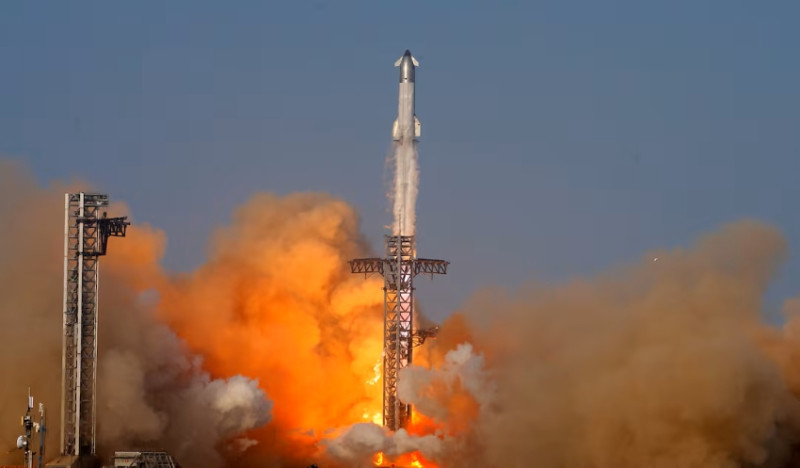
SPACEX's Starship rocket roared into space from Texas on Tuesday but spun out of control about halfway through its flight without achieving some of its most important testing goals, bringing fresh engineering hurdles to CEO Elon Musk's increasingly turbulent Mars rocket program.
Reuters reported today the 400-foot tall (122 meter) Starship rocket system, the core of Musk's goal of sending humans to Mars, lifted off from SpaceX's Starbase, Texas, launch site, flying beyond the point of two previous explosive attempts earlier this year that sent debris streaking over Caribbean islands and forced dozens of airliners to divert course.
For the latest launch, the ninth full test mission of Starship since the first attempt in April 2023, the upper-stage cruise vessel was lofted to space atop a previously flown booster - a first such demonstration of the booster's reusability.
But SpaceX lost contact with the 232-foot lower-stage booster during its descent before it plunged into the sea, rather than making the controlled splashdown the company had planned.
Starship, meanwhile, continued into suborbital space but began to spin uncontrollably roughly 30 minutes into the mission. The errant spiraling came after SpaceX canceled a plan to deploy eight mock Starlink satellites into space - the rocket's "Pez" candy dispenser-like mechanism failed to work as designed.
"Not looking great with a lot of our on-orbit objectives for today," SpaceX broadcaster Dan Huot said on a company livestream.
Musk was scheduled to deliver an update on his space exploration ambitions in a speech from Starbase following the test flight, billed as a livestream presentation about "The Road to Making Life Multiplanetary." Hours later, he had yet to give the speech and there was no sign that he intended to do so.
In a post on X, Musk touted Starship's scheduled shutdown of an engine in space, a step previous test flights achieved last year. He said a leak on Starship's primary fuel tank led to its loss of control.
"Lot of good data to review," he said. "Launch cadence for next 3 flights will be faster, at approximately 1 every 3 to 4 weeks."
SpaceX has said the Starship models that have flown this year bear significant design upgrades from previous prototypes, as thousands of company employees work to build a multi-purpose rocket capable of putting massive batches of satellites in space, carrying humans back to the moon and ultimately ferrying astronauts to Mars.
Washington will have the power to veto big decisions at U.S. Steel after it is taken over by Nippon Steel.
The recent setbacks indicate SpaceX is struggling to overcome a complicated chapter of Starship's multibillion-dollar development. But the company's engineering culture, widely considered more risk-tolerant than many of the aerospace industry's more established players, is built on a flight-testing strategy that pushes spacecraft to the point of failure, then fine-tunes improvements through frequent repetition.
Starship's planned trajectory for Tuesday included a nearly full orbit around Earth for a controlled splashdown in the Indian Ocean to test new designs of its heat shield tiles and revised flaps for steering its blazing re-entry and descent through Earth's atmosphere.
But its early demise, appearing as a fireball streaking eastward through the night sky over southern Africa, puts another pause in Musk's speedy development goals for a rocket bound to play a central role in the U.S. space programme. - May 28, 2025