IN a move poised to upend America’s position as a magnet for global talent, the Trump administration has proposed a sweeping overhaul of the H-1B visa programme by imposing an annual fee of US$100,000 per worker—effectively weaponising immigration policy in the name of protectionism.
Reuters reported on Saturday the H-1B visa, a cornerstone of the U.S. technology sector’s talent pipeline, has long been relied upon by Silicon Valley to fill skill gaps in science, technology, engineering and mathematics (STEM) fields.
More than 70% of recipients are Indian nationals, with China a distant second. In the first half of 2025 alone, Amazon and its AWS unit received over 12,000 approvals, while Microsoft and Meta each surpassed the 5,000 mark.
Commerce Secretary Howard Lutnick defended the administration’s position on Friday, stating: “If you're going to train somebody, you're going to train one of the recent graduates from one of the great universities across our land. Train Americans. Stop bringing in people to take our jobs.”
But critics argue the move amounts to short-sighted economic sabotage. The tech industry—some of whose major players once financially backed Trump’s campaigns—warns that this could force high-value work offshore, compromise the U.S. in the AI arms race, and drain innovation from its shores.
“Adding new fees creates disincentive to attract the world’s smartest talent to the U.S.,” said Deedy Das, partner at venture capital firm Menlo Ventures. “If the U.S. ceases to attract the best talent, it drastically reduces its ability to innovate and grow the economy.”
The proposed three-year visa, potentially costing US$300,000 in total, disproportionately affects smaller firms and start-ups, many of whom rely on international expertise but lack the deep pockets of corporate giants. While Lutnick claimed that “all the big companies are on board,” none have publicly endorsed the move, and many declined to comment.
Legal experts have also questioned the legality of the administration’s approach. “Congress has only authorised the government to set fees to recover the cost of adjudicating an application,” said Aaron Reichlin-Melnick of the American Immigration Council.
The rationale for the clampdown—outlined in an executive order signed Friday—points to the surge in foreign STEM workers, which doubled from 2000 to 2019, despite only a 44.5% rise in overall STEM employment. Yet this framing glosses over the chronic shortage of qualified domestic candidates in niche fields such as artificial intelligence, quantum computing and cybersecurity.
Elon Musk, a naturalised U.S. citizen and former H-1B holder, has previously defended the programme, saying it helps companies stay competitive and fuels innovation.
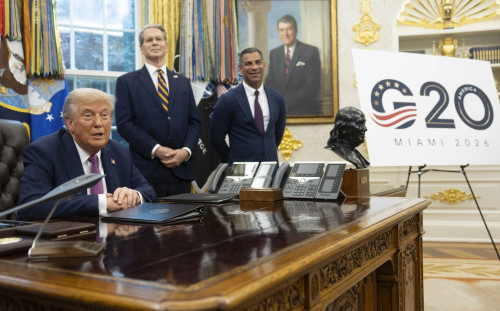
In parallel, Trump also signed an executive order to launch a so-called “gold card” scheme offering permanent residency for those able to pay US$1 million upfront—drawing sharp criticism for appearing to favour wealth over merit.
India, whose citizens represent 71% of H-1B beneficiaries, has yet to formally respond. But the ripple effects have already begun: U.S.-listed shares of Indian tech firms Wipro and Infosys closed down by as much as 5%, while Cognizant dropped nearly 5%.
Beyond the immediate market jitters, the policy signals a broader ideological shift. Rather than addressing skills development or workforce reform domestically, Washington appears to be taxing away its innovation edge in pursuit of populist rhetoric.
“In the short term, Washington may collect a windfall,” said eMarketer analyst Jeremy Goldman. “In the long term, the U.S. risks taxing away its innovation edge, trading dynamism for short-sighted protectionism.”
If implemented, the US$100,000 visa policy could become a cautionary tale: a rich nation choosing barriers over brains at the precise moment when brainpower is its most valuable currency. - September 20, 2025