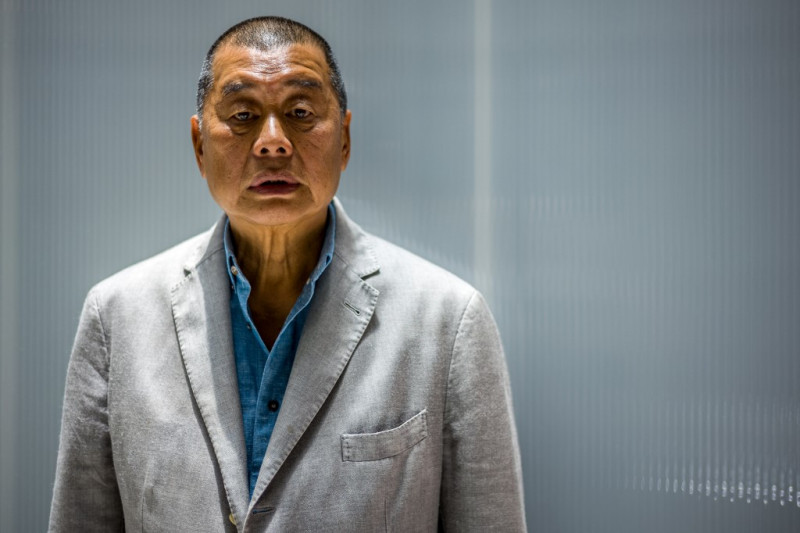
THE 78-year-old pro-democracy media tycoon and founder of the now-shuttered Apple Daily newspaper Jimmy Lai was found guilty on Monday of two counts of foreign collusion and seditious publication, in a case that has drawn global attention to the erosion of political freedoms under Hong Kong’s national security law.
AFP reported today that Lai, who has been in custody since 2020, was accused of masterminding two conspiracies to request foreign countries to impose sanctions, blockade, or engage in hostile activities against Hong Kong or China.
Prosecutors also charged him with publishing materials that they claimed “excited disaffection” against the government.
“There is no doubt that he had harboured his resentment and hatred of the PRC for many of his adult years, and this is apparent in his articles,” Judge Esther Toh told the court, referring to the People’s Republic of China.
“It is also clear to us that the first defendant has from an early stage, long before the National Security Law, been applying his mind as to what leverage the US could use against the PRC.”
Lai appeared impassive in court, wearing a light green cardigan and grey jacket, listening to the verdict with folded arms and offering no comment. He now faces a maximum sentence of life imprisonment, with his sentencing scheduled for a later date.
Security around the West Kowloon court building was tight, with dozens of police officers deployed and an armoured vehicle stationed nearby.
Consular representatives from the United States, European Union, and France attended, underscoring the international scrutiny of the trial. “We’re here to observe… to signal close interest in these cases,” said Matthias Kaufmann, deputy head of the EU Office to Hong Kong and Macau.
Lai’s family, including his wife Teresa and son Lai Shun-yan, were present, along with pro-democracy figures such as Cardinal Joseph Zen and former legislator Emily Lau.
The verdict has further strained Beijing’s relations with Western nations. The United States has reportedly called for Lai’s release, while the UK government, citing Lai’s British citizenship, has repeatedly described his prosecution as politically motivated.
The Committee to Protect Journalists condemned the ruling as a “sham conviction,” with CPJ Asia-Pacific director Beh Lih Yi stating, “The ruling underscores Hong Kong’s utter contempt for press freedom, which is supposed to be protected under the city’s mini-constitution, the Basic Law.”
Lai, who once described himself as a “born rebel,” amassed significant wealth through his clothing and media enterprises while challenging the Chinese Communist Party. Beijing, for its part, reiterated its support for Hong Kong in “safeguarding national security” from criminal acts.
Those close to Lai expressed concern for his health after years in custody. Former Apple Daily employee Chan recalled Lai’s aspirations for a “free and democratic China,” remarking, “He loved the country a lot, he just didn’t love the regime. (The situation) is absurd.”
Supporters outside the court noted visible weight loss and deterioration in Lai’s nails and teeth, though the Hong Kong government stated that he had received “adequate and comprehensive” care.
Authorities confirmed his solitary confinement, noting it was “all along made at his own request.”
The sprawling trial examined 161 items published by Apple Daily, including Lai’s op-eds and online talk shows, deemed seditious under a colonial-era law.
Prosecutors also accused him of financing and leading the protest group “Stand with Hong Kong, Fight for Freedom.”
Lai denied attempting to influence foreign policy, asserting that Apple Daily reflected Hongkongers’ fundamental values, including “rule of law, freedom, pursuit of democracy, freedom of speech, freedom of religion, freedom of assembly.”
Apple Daily was forced to close in 2021 following police raids. Six top executives charged alongside Lai have already pleaded guilty, further consolidating the government’s case.
The conviction of Jimmy Lai is widely seen as a stark indicator of shrinking political and press freedoms in Hong Kong, prompting continued international concern over the city’s autonomy under Beijing’s national security law. - December 15, 2025