THE United States has launched fresh military strikes against Iran after accusing Tehran of attacking three commercial vessels in the Strait of Hormuz, triggering Iranian retaliatory strikes against American military installations in Bahrain and Kuwait and significantly escalating tensions across the Gulf.
The exchange of attacks marks the most serious breach yet of a fragile interim ceasefire that had been intended to pave the way for broader negotiations on regional security, freedom of navigation through the Strait of Hormuz and Iran's nuclear programme.
Although both sides exchanged military strikes, neither Washington nor Tehran immediately indicated they were abandoning planned negotiations, suggesting diplomatic efforts remain alive despite the renewed hostilities.
According to the US military's Central Command, American forces targeted Iranian air defence systems, radar installations and more than 60 fast attack boats operated by the Islamic Revolutionary Guard Corps, describing the operation as a direct response to attacks on commercial shipping.
AP reported the command saying that the strikes were carried out "to impose heavy costs for targeting and attacking commercial shipping crewed by innocent civilians in an international waterway."
It added that US forces remain "postured and prepared to hold Iran accountable when the agreement is not adhered to or obeyed," while confirming that the latest operation had concluded.
Iran acknowledged the American strikes but did not disclose any casualties or damage. Iranian state media reported explosions in Bandar Abbas, Qeshm and Sirik following the attacks.
Hours later, missile warning sirens sounded across Bahrain, home to the US Navy's Fifth Fleet, and Kuwait, which hosts significant US Army forces, as Iran's Revolutionary Guard confirmed it had launched attacks against American military installations in both countries.
In a statement, the Guard accused Washington of violating the ceasefire.
"The child-killing and terrorist U.S. army ... openly violated the ceasefire and violated the Islamabad understanding by launching an airstrike on a number of coastal bases and civilian stations on the coasts of Hormozgan and Mahshahr provinces," it said.
The renewed confrontation unfolded during the funeral ceremonies for Iran's Supreme Leader Ayatollah Ali Khamenei, who was killed at the outbreak of the conflict on 28 February at the age of 86. The funeral, which concludes on Thursday, had been widely viewed as a period likely to see reduced military activity before formal negotiations resumed.
Those planned talks were expected to focus on permanently restoring unrestricted navigation through the Strait of Hormuz and addressing Iran's disputed nuclear programme, but the latest escalation has cast uncertainty over the diplomatic timetable.
Iran's Parliament Speaker Mohammad Bagher Qalibaf struck a defiant tone, declaring on social media: "The era of bullying and extortion is over. It leads nowhere. We don't fold."
The United States also intensified economic pressure by revoking a licence that had temporarily permitted Iran to openly export crude oil under the interim agreement. The arrangement had enabled Tehran to conduct oil sales in US dollars for the first time in years following sanctions relief linked to the ceasefire.
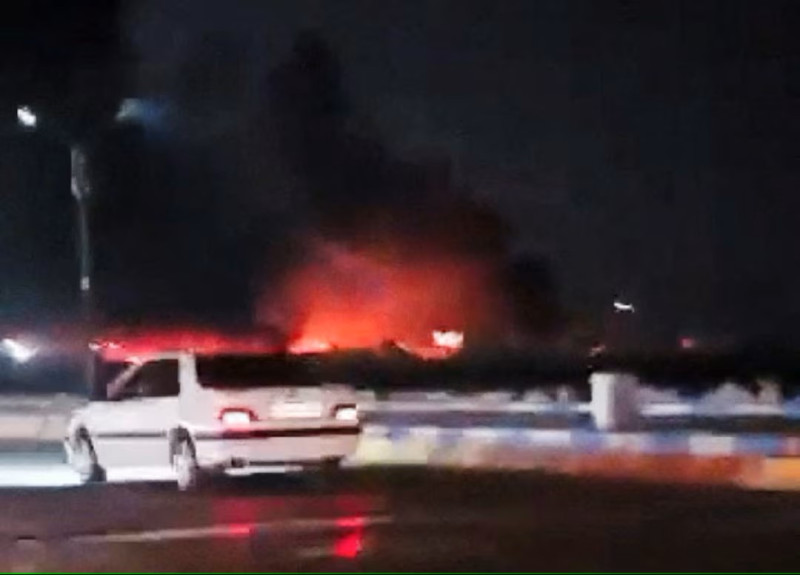
The move followed attacks on three commercial vessels operating in the Strait of Hormuz. One tanker travelling off the coast of Oman caught fire after being struck, while two other ships sustained limited damage but continued their voyages without injuries to their crews.
Iranian state television reported that the liquefied natural gas tanker had ignored official warnings before being attacked but stopped short of formally claiming responsibility.
The latest maritime incidents further threaten global energy supplies through the Strait of Hormuz, one of the world's most strategically important oil shipping routes. Since the outbreak of the conflict, Tehran has sought to control vessel movements through the waterway, insisting ships use routes approved by Iranian authorities rather than traditional international navigation lanes.
Qatar strongly condemned the attack on its tanker Al Rekayyat, with Foreign Ministry spokesman Majed al-Ansari describing it as "an unacceptable attack" on international shipping and global energy security.
He added that Qatar holds Iran "fully legally responsible."
Meanwhile, senior United Arab Emirates diplomat Anwar Gargash said the attacks on Bahrain and Kuwait demonstrated that Tehran remained unwilling to commit to lasting de-escalation.
"The Gulf Arab states cannot remain a target for Iran's wavering between the logic of escalation and the path of rationality, stability and peace," he said.
The renewed military exchanges have heightened concerns that the ceasefire could unravel entirely, risking a return to full-scale conflict across the Middle East and renewed disruption to global energy markets. - July 8, 2026