AS renewed tensions with Washington unsettle global trade, China is repositioning itself as a stable and predictable partner for countries seeking to reduce their reliance on the United States, resulting in a record trade surplus and an expanded global role for its currency, the yuan.
Reuters cited on Wednesday that when US President Donald Trump returned to office in January 2025 with an intensified “America First” agenda, many economists expected further strain on China’s already sluggish economy.
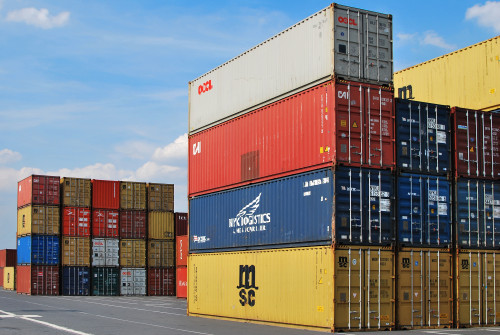
Instead, Beijing has responded by repairing strained relationships and strengthening trade links with key partners, helping the world’s second-largest economy post a record trade surplus of US$1.2 trillion in 2025.
While Washington’s policies have unsettled long-standing US allies, analysts say China has capitalised by building closer ties with countries including Canada and India.
Monthly foreign exchange inflows reached an unprecedented US$100 billion late last year, and global usage of the yuan has continued to expand.
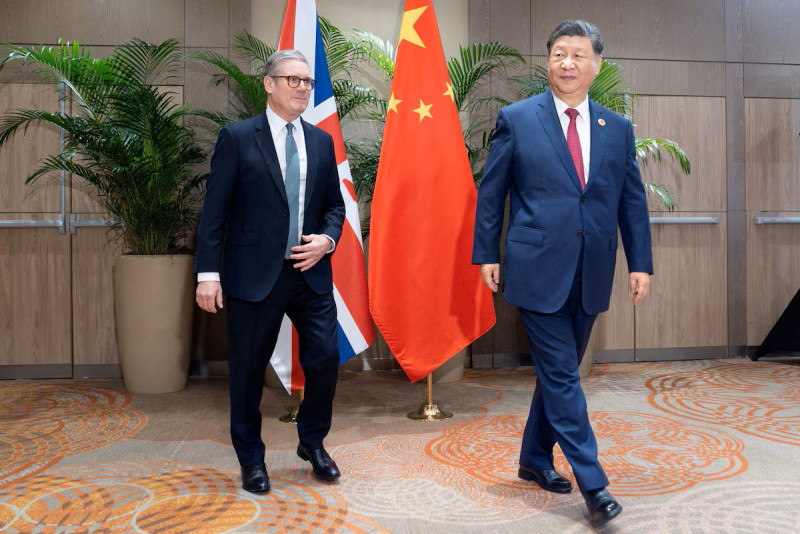
These shifts are likely to be reinforced when British Prime Minister Keir Starmer arrives in China on Wednesday evening, marking the first visit by a UK leader since 2018, as London seeks to revive business ties that have cooled in recent years.
Backed by a US$20 trillion economy and stock and bond markets worth an estimated US$45 trillion, China is increasingly viewed as a reliable counterpart, according to analysts.
“I think China has done a good job and rightly so to position itself as the reliable and stable trade partner,” said Derrick Irwin, co-head of intrinsic emerging markets equity at Allspring Global Investments.
“They basically said, look, you’ve got a massive trade partner in the US that’s become a little more uncertain. We can offer predictability and certainty. And I think that’s very fair.”
Aleksandar Tomic, an economics professor at Boston College, echoed that assessment, describing China as a “steady partner” for many governments recalibrating their trade strategies.
Starmer’s four-day visit follows a trip earlier this month by Canadian Prime Minister Mark Carney, the first Canadian leader to visit Beijing since 2017. During that visit, the two countries signed an economic agreement aimed at dismantling trade barriers and forging a new strategic relationship. Carney described China as “a more predictable and reliable partner”.
Across Europe, Germany, Britain, Denmark and other nations also signed a clean energy pact at the North Sea Summit in Hamburg this week, reflecting a broader push to diversify partnerships amid global uncertainty.
China is not alone in seeking alternatives to the US market. India and the European Union concluded a long-delayed trade agreement on Tuesday that is expected to slash tariffs and could potentially double European exports to India by 2032.
Despite deepening geopolitical rivalry, China’s economy has shown resilience. Trump’s return to the White House sharply escalated tensions, with tariffs on Chinese goods raised above 100% in April before being partially rolled back under a temporary truce.
Beijing responded by boosting exports to non-US markets and rolling out support measures for private enterprises.
While Chinese exports to the United States fell 20% in 2025, shipments rose 25.8% to Africa, 7.4% to Latin America, 13.4% to Southeast Asia and 8.4% to the European Union.
“Many countries previously have not been China-friendly are now kind of pivoting to China ... because the United States is becoming a lot less predictable,” Tomic said. “The more the US gets difficult to deal with, the more it opens up for China.”
Even as domestic consumption remains weak and the property sector continues to struggle, China met its official growth target of 5% in 2025.
Authorities have introduced a series of measures to attract foreign investment, including pilot programmes in Beijing, Shanghai and other regions to expand market access in sectors such as telecommunications, healthcare and education.
China’s official foreign exchange reserves reached a 10-year high of US$3.36 trillion, while its financial markets have rebounded strongly from trade disputes.
The Shanghai index has climbed 27% over the past year, outperforming US equities, with trading turnover hitting record highs.
As investor confidence in the US dollar wavers amid erratic trade and foreign policy signals from Washington, Beijing is pressing ahead with efforts to internationalise the yuan.
“We have seen quite a few cycles of China trying to internationalise yuan and then pulling back,” said a banker at a global bank with operations in China. “This time it’s different ... Trump policies are very conducive for boosting yuan usage.”
More than half of China’s cross-border transactions are now settled in yuan, compared with almost none 15 years ago, while nearly half of its overseas bank lending is denominated in renminbi, according to data from the People’s Bank of China and the State Administration of Foreign Exchange.
However, some analysts caution that warmer trade ties do not necessarily translate into trust. Patricia Kim, a foreign policy fellow at the Brookings Institution, warned that US allies remain wary of Beijing’s approach.
“Many of these countries harbour deep concerns about China’s approach to trade, its use of economic coercion, and unresolved maritime and historical disputes,” she said.
“In the current moment, China may appear more restrained or pragmatic when compared with the Trump administration’s extreme rhetoric and actions. But Beijing’s actual behaviour has not been especially reassuring.” - January 28, 2026