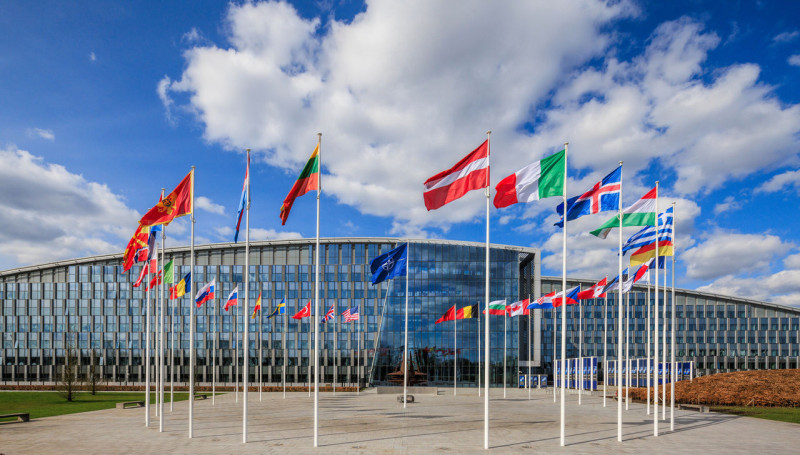
EUROPEAN and Canadian NATO allies sought to reassure one another on Thursday that the United States remains committed to the trans‑Atlantic alliance, despite the absence of senior U.S. officials from key meetings and worries that Washington may be shifting its global security focus.
AP reported on Friday that U.S. Defense Secretary Pete Hegseth did not attend the gathering of defence ministers at NATO headquarters in Brussels, a rare no‑show at the organisation’s highest decision‑making forum.
He was represented instead by U.S. Under Secretary of Defense Elbridge Colby. The absence followed a similar skip by U.S. Secretary of State Marco Rubio at the December meeting of NATO foreign ministers.
Iceland’s Foreign Minister Þorgerður Katrín Gunnarsdóttir acknowledged the unusual absence, saying, “Sadly for him, he is missing a good party. Of course, it’s always better that the ministers attend here, but I would not describe it as a bad signal.”
German Defence Minister Boris Pistorius echoed the sentiment, noting that schedules vary: “Each of us has a full agenda. And one time the American defence minister is here, and one time not, so it’s his decision and his duties he has to fulfil.”
For decades NATO has relied on U.S. leadership as a central pillar of collective defence. The alliance’s first secretary‑general after its founding in 1949 reportedly described NATO’s purpose as “To keep the Americans in, the Russians out and the Germans down.”
Today Germany is assuming a more significant role itself. Since Russia’s full‑scale invasion of Ukraine four years ago, Berlin has pledged to invest 100 billion euros to modernise its armed forces.
NATO Secretary‑General Mark Rutte emphasised the enduring importance of U.S. engagement, recognising Washington’s global security burdens.
“They have to take care of the whole world. This is the United States. I totally accept it, agree with it,” he said before chairing the meeting.
Allies nonetheless acknowledged that the United States has increasingly encouraged Europe and Canada to take on greater responsibility for their own conventional defence, while the U.S. continues to underwrite NATO’s nuclear deterrent.
Yet doubts remain about the stability of Washington’s commitments, particularly amid unpredictable moves by the Trump administration and concerns about potential further reductions of U.S. troops stationed in Europe.
“What for me is the most important is the no‑surprise policy that has been agreed between the NATO secretary‑general and the U.S.,” Dutch Defence Minister Ruben Brekelmans said, underscoring allies’ desire for clear communication.
Publicly at least, Washington’s NATO role has been in transition. Last year Mr Hegseth suggested that America’s security priorities lie elsewhere and that Europe must increasingly look after its own defence, including Ukraine’s defence against Russian aggression.
Under the Trump administration, U.S. supplies of arms and funding to Ukraine that flowed under the Biden presidency have largely dried up, obliging European allies and Canada to procure U.S. weaponry for donation.
Western supporters of Ukraine met in Brussels on Thursday to rally fresh military assistance. The Ukraine Defence Contact Group, long championed by the Pentagon, is now co‑chaired by the United Kingdom and Germany.
The U.K. Defence Secretary John Healey announced an additional £500 million in urgent air defence aid for Ukraine.
Sweden said it would fund more purchases of U.S. weapons, and the Netherlands pledged flight simulators to train Ukrainian pilots on F‑16 fighters.
Meanwhile, 16 former U.S. ambassadors and senior military officers who served at NATO issued a statement defending the alliance.
“If the United States were to withdraw from NATO, or diminish its utility by eroding trust among allies, the immediate result would not be a ‘peace dividend,’” they warned. Instead, they said it would bring higher costs, greater risks and a loss of U.S. influence and legitimacy.
Addressing the defence ministers, Mr Colby outlined a vision for what he called “NATO 3.0,” an alliance rebalanced for today’s security landscape, “balanced, credible and rooted in shared strength and realism.”
He said that while the United States protects its homeland, “interests in our hemisphere” and the Indo‑Pacific, it follows that “Europe should field the preponderance of the forces required to deter, and, if necessary, defeat conventional aggression in Europe.”
The one concrete outcome from Thursday’s meeting was the launch of “Arctic Sentry,” a NATO framework aimed at coordinating defence activities in the High North in response to perceived Russian and Chinese interests.
Rather than a new long‑term NATO mission, the initiative will bring existing national exercises under NATO’s umbrella, overseen by its military leadership.
Denmark, France and Germany are participating, with Finland, Sweden and possibly Belgium expected to be involved. The United States has not yet outlined its role.
Ahead of the meeting, U.S. Ambassador to NATO Matthew Whitaker stressed that burden‑sharing was essential.
“It can’t just be more from the United States,” he said. “We need capable allies that are ready and strong, that can bring assets to all of these areas of our collective security.”
Relations within the alliance have recently been tested by other unexpected developments, including Trump’s renewed suggestions last month of annexing Greenland, a semiautonomous territory of NATO ally Denmark.
The proposal startled partners because NATO’s core mission is to defend member territory, not to unsettle it.
European allies and Canada are now hoping that Arctic Sentry and continued dialogue between the Trump administration, Denmark and Greenland will help the alliance move past those tensions and refocus on what they see as NATO’s most pressing security priority: deterring Russia’s war on Ukraine. - February 13, 2026
.jpeg)

.jpg)