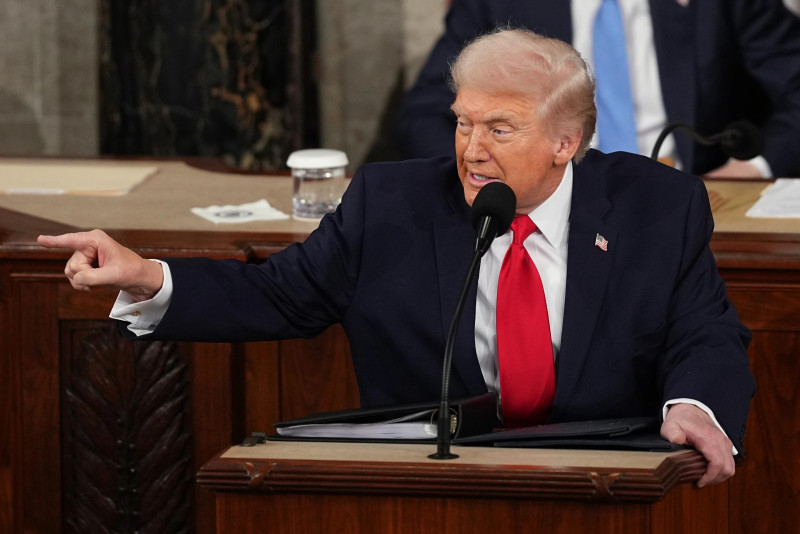
U.S. President Donald Trump delivered a marathon State of the Union address on 24 February, presenting a self-congratulatory vision of national renewal while seeking to counter low approval ratings and mounting political challenges ahead of the midterm elections.
Speaking before a joint session of Congress in the House chamber, Trump described America as “bigger, better, richer and stronger than ever before,” claiming, “Tonight, after just one year, I can say with dignity and pride that we have achieved a transformation like no one has ever seen before, and a turnaround for the ages.”
AFP reported on Wednesday that the address drew repeated standing ovations from Republican lawmakers, while Democrats remained largely seated in protest, occasionally heckling.
The primetime speech, broadcast across all major networks, was intended to persuade voters after a divisive first year back in the White House.
Trump faces a precarious political landscape, with low approval ratings and concerns that Republicans may lose control of Congress in November, which could stall his agenda and expose him to potential impeachment proceedings.
Amid rising tensions in the Middle East, Trump highlighted what he described as Iran’s pursuit of missiles capable of reaching US territory and reiterated that the country would never be allowed to acquire nuclear weapons, calling their ambitions “sinister.”
He added, however, that “my preference is to solve this problem through diplomacy,” leaving open the possibility of negotiations.
Trump also showcased recent US successes on the world stage, noting that Venezuela had resumed shipping oil to the United States and celebrating the killing of Mexican drug lord Nemesio Oseguera, known as El Mencho.
In a lighter moment, he invited the gold-medal-winning US Olympic ice hockey team to the Chamber, awarding the Presidential Medal of Freedom to the team’s goalie to widespread cheers.
Medals of Honor were also presented to a helicopter pilot injured during an attempt to oust Venezuelan leader Nicolas Maduro and to a 100-year-old Korean War veteran.
The tone shifted midway through the three-hour speech, as Trump turned to domestic issues with sharper rhetoric, accusing Democrats of “destroying our country” and alleging that Somali “pirates” had “ransacked” Minnesota.
He called on Congress to impose stricter voter ID requirements, reiterating unsubstantiated claims of “rampant” election fraud.
Critics argue that such measures would disenfranchise significant numbers of legal voters and could influence the upcoming midterm elections, in which Republicans are fighting to maintain narrow majorities in both the House and Senate.
Trump’s address came in the wake of a series of political and legal setbacks, including the Supreme Court’s striking down of his trade tariff policies, criticism over immigration enforcement in Minneapolis, fallout from the Jeffrey Epstein scandal, and a partial government shutdown.
Despite previous confrontations with the judiciary—he earlier labelled justices “fools and lapdogs” over the tariff ruling—Trump briefly shook hands with several justices in attendance while describing their decision as “very unfortunate.”
A Washington Post-ABC News-Ipsos poll published on 22 February indicated Trump’s approval rating at 39 per cent, with only 41 per cent approving of his handling of the economy and 32 per cent on inflation, reflecting the political pressures that framed his speech.
The State of the Union was both a platform to highlight policy achievements and a strategic effort to galvanise support ahead of a critical election year. - February 25, 2026