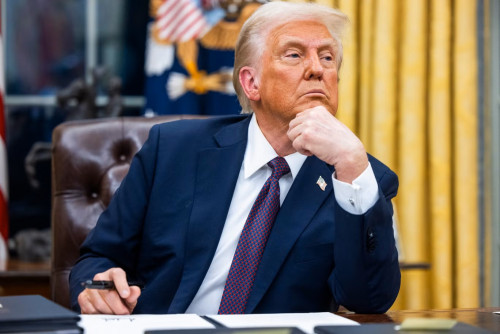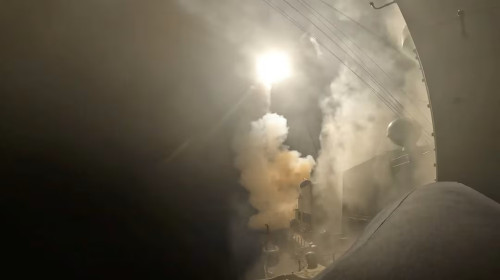
U.S. President Donald Trump has indicated that the United States may soon begin winding down its military campaign against Iran, even as several of his administration’s stated objectives remain unclear or incomplete after more than three weeks of fighting.
The conflict, which began on Feb 28, has seen Washington expand and refine its list of goals, reflecting shifting priorities amid mounting economic strain, pressure on alliances and uncertainty over the war’s long-term trajectory.
While US and Israel strikes have significantly weakened Iran’s military capabilities and eliminated senior figures, analysts say these battlefield gains do not necessarily equate to achieving broader strategic aims.
AP cited White House spokesperson Anna Kelly saying on Wednesday that the operation “has been a resounding success — Iran’s navy is destroyed, their defense industrial base is dismantled, and their dreams of possessing a nuclear weapon shatter more by the day.”
However, Trump’s evolving list of objectives underscores the complexity of the campaign and the difficulty of securing decisive outcomes.
One of the central goals has been to cripple Iran’s missile capabilities, with the president pledging to “destroy their missiles and raze their missile industry to the ground.”
US officials say progress has been substantial, with Defence Secretary Pete Hegseth stating that Iran’s missile and drone programmes are being “overwhelmingly destroyed”.
Yet Iran continues to launch missiles and drones, including recent barrages targeting Israel, highlighting the limits of the campaign’s effectiveness.
Another objective, the dismantling of Iran’s defence industrial base, has at times been presented as a separate goal, though it overlaps with efforts to degrade missile production.
Despite repeated strikes on manufacturing facilities, Tehran has maintained its ability to conduct attacks across the region.
The United States has also sought to neutralise Iran’s naval and air capabilities. American forces, supported by Israel, have established air superiority, while United States Central Command reports significant damage to Iranian vessels.
Even so, concerns remain over Iran’s capacity to disrupt maritime routes, particularly in the strategically vital Strait of Hormuz, where missile activity continues to threaten global shipping.
Preventing Iran from acquiring nuclear weapons has been another cornerstone of US policy.
Trump has claimed that Iran’s nuclear programme was previously “obliterated”, though officials have also warned that Tehran retains the capability to move rapidly towards a bomb.
One unresolved issue is the fate of Iran’s stockpile of enriched uranium, which Trump suggested could be retrieved under a future agreement.
Experts caution that any attempt to seize such material without Iranian consent would pose significant military risks.
In a later addition to his objectives, Trump emphasised the protection of regional allies, including Israel, Saudi Arabia, Qatar, the United Arab Emirates, Bahrain and Kuwait, while suggesting that responsibility for securing key shipping lanes should increasingly fall to other nations.
“Protecting, at the highest level, our Middle Eastern Allies, including Israel, Saudi Arabia, Qatar, the United Arab Emirates, Bahrain, Kuwait, and others. The Hormuz Strait will have to be guarded and policed, as necessary, by other Nations who use it — The United States does not!” he said.
Despite rhetoric around regime change, the administration has stopped short of formally adopting it as a policy objective, even as Trump has publicly questioned Iran’s leadership.
At the same time, earlier priorities such as cutting off Tehran’s support for proxy groups have received less emphasis in recent weeks, with limited detail on how such goals would be achieved.
As Washington explores the possibility of negotiations with elements of the Iranian government, uncertainty persists over whether the conflict will conclude with a durable settlement or leave unresolved tensions that could reshape the region and the global economy. - March 25, 2026