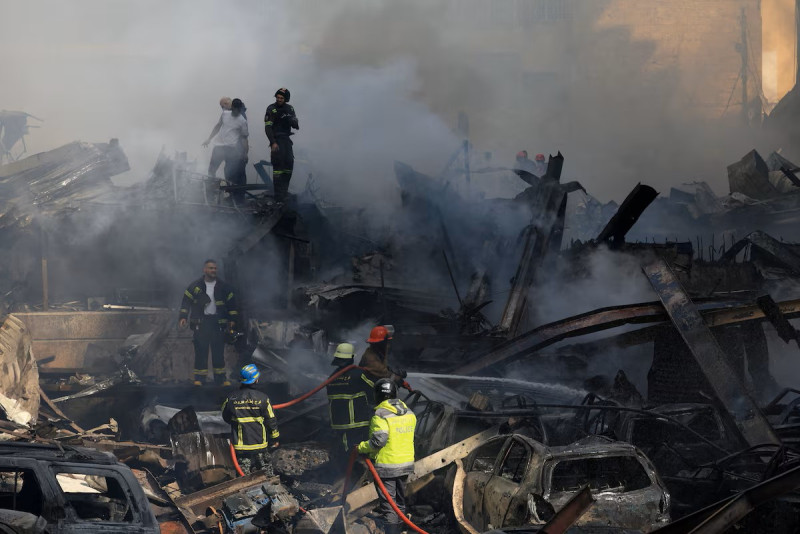
ISRAEL has launched its most intense wave of attacks on Lebanon since hostilities with Hezbollah erupted, killing more than 250 people in a single day and casting serious doubt over the durability of a fragile regional ceasefire.
The strikes came even as Hezbollah had halted its own operations under a two-week truce linked to negotiations between the United States and Iran, highlighting deep divisions over the scope of the agreement.
Reuters reported that in Beirut, multiple massive explosions struck the capital in rapid succession on Wednesday afternoon, as Israel said it had carried out its largest coordinated assault of the war.
More than 100 Hezbollah command centres and military positions were targeted within minutes across Beirut, the Bekaa Valley and southern Lebanon.
Lebanon’s civil defence authorities reported 254 dead and more than 1,100 injured nationwide, while the health ministry gave a provisional death toll of 182.
Beirut accounted for the highest number of casualties, with at least 91 people killed.
The scale of the bombardment marked the deadliest day since fighting began on March 2, when Hezbollah launched attacks on Israel in support of Iran following US and Israeli strikes on Iranian targets.
Scenes on the ground reflected the intensity of the assault. Rescue workers struggled to reach victims, with civilians transporting the wounded on motorcycles as hospitals faced acute shortages.
In one instance, emergency crews used a crane to evacuate residents trapped in a partially collapsed building.
“The scale of the killing and destruction in Lebanon today is nothing short of horrific,” said Volker Türk. “Such carnage, within hours of agreeing to a ceasefire with Iran, defies belief.”
Despite expectations that the ceasefire might ease hostilities, Israeli Prime Minister Benjamin Netanyahu made clear that operations in Lebanon would continue.
In a televised address, he said the country was not covered by the truce and that Israeli forces would persist in striking Hezbollah targets.
US officials echoed that position. White House Press Secretary Karoline Leavitt and Vice President JD Vance both stated that Lebanon was excluded from the agreement.
“I think this comes from a legitimate misunderstanding. I think the Iranians thought that the ceasefire included Lebanon, and it just didn't,” Vance said.
The discrepancy has fuelled anger among Hezbollah figures, who insist they had complied with the ceasefire terms. Senior lawmaker Ibrahim al-Moussawi said the group had halted attacks after being told it was included in the agreement.
“Hezbollah was informed that it is part of the ceasefire – so we abided by it, but Israel as usual has violated it and committed massacres all across Lebanon,” he said.
Another Hezbollah official, Hassan Fadlallah, warned that continued strikes would have “repercussions for the entire agreement”.
Iran has also issued a stark warning, with its Revolutionary Guards threatening a “regret-inducing response” if attacks on Lebanon persist.
Lebanese President Joseph Aoun condemned the strikes, while French President Emmanuel Macron signalled readiness to push diplomatically for Lebanon’s inclusion in any ceasefire framework.
On the ground, civilians described fear and exhaustion after weeks of conflict. In a neighbourhood hit by the strikes, resident Naim Chebbo said the attacks had left him unable to rest.
“Tonight, I'm not going to sleep because I'm going to be afraid that it's happening again. I'm living a nightmare,” he said.
Israel has also intensified its campaign in southern Lebanon, including striking a key bridge over the Litani River, effectively severing a vital link to the rest of the country.
The military said areas south of the river were now “disconnected from Lebanon”, reinforcing plans to establish a buffer zone.
The humanitarian toll continues to mount. More than 1.2 million people have been displaced, with widespread shortages of food and medicine reported in heavily bombarded areas. Prior to the latest strikes, more than 1,500 people had already been killed in the conflict, including over 130 children.
For many displaced civilians, hopes of returning home under a ceasefire have been dashed. In Sidon, families who had begun packing to leave temporary shelters were forced to reconsider.
“Hopefully a ceasefire will be reached,” said Ahmed Harm, a displaced resident. “Lebanon can't take it anymore.”
The escalation underscores the fragility of current diplomatic efforts, with the exclusion of Lebanon from the US-Iran truce threatening to widen the conflict rather than contain it. - April 9, 2026