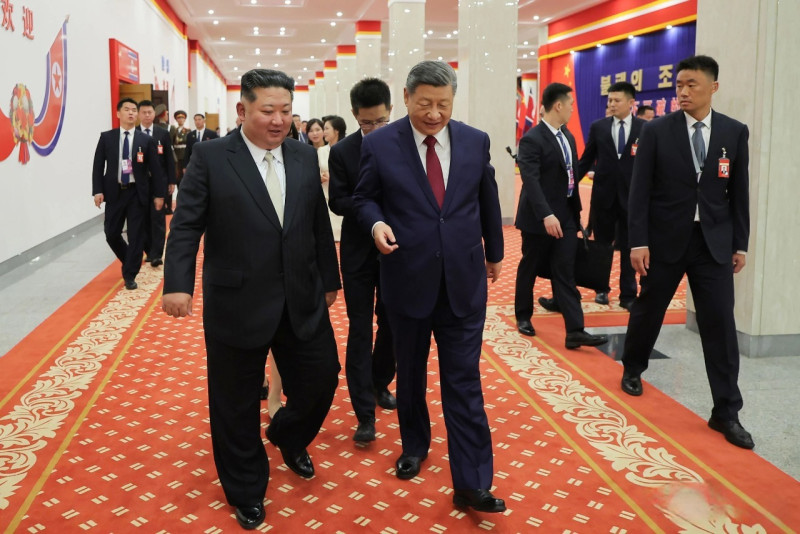
CHINESE and North Korean state media this week devoted extensive coverage to President Xi Jinping’s summit with North Korean leader Kim Jong Un, yet conspicuously omitted any reference to Pyongyang’s nuclear weapons programme, a silence analysts say may signal a subtle but significant shift in Beijing’s strategic posture.
AP. On Wednesday, reported that the omission comes despite years of Chinese diplomatic messaging in support of “denuclearisation” of the Korean Peninsula and long-standing coordination with the United States, South Korea and Japan aimed at persuading Pyongyang to abandon its nuclear ambitions in exchange for economic incentives and political recognition.
Until the collapse of disarmament negotiations in 2019, Beijing and Washington had intermittently worked in parallel on diplomatic efforts to curb North Korea’s weapons development. However, Xi’s latest visit to Pyongyang — his first in seven years — has revived debate over whether China is quietly reassessing the feasibility of that objective.
During earlier phases of engagement, China routinely referred to “denuclearisation”, a term broadly understood as the elimination of nuclear weapons from the Korean Peninsula. In Xi’s previous visit in 2019, Chinese state media even quoted him as saying Beijing would play a constructive role in achieving that goal.
This week’s messaging, however, marked a notable departure, with official coverage focusing instead on bilateral ties, economic cooperation and regional stability, without any public reference to North Korea’s nuclear arsenal.
For Beijing, analysts suggest the silence may reflect a growing acceptance of geopolitical reality following years of continued nuclear development by Pyongyang under Kim Jong Un, who has ruled since 2011 and has overseen a sustained expansion of the country’s weapons capabilities.
From China’s perspective, the priority appears increasingly centred on maintaining stability along its northeastern border and preventing instability in North Korea that could trigger refugee flows and broader regional disruption.
According to Jiyong Zheng, dean of the Institute of Regional Studies at Tianjin Foreign Studies University, Beijing has long framed its position in carefully calibrated language.
Instead of directly targeting North Korea’s nuclear programme, China has often called for the “denuclearisation of the Korean Peninsula” — wording that also implies scrutiny of US nuclear commitments to South Korea and the deployment of strategic assets in the region.
Zheng noted that Beijing’s evolving stance appears to prioritise stability over rigid diplomatic objectives.
“China is increasingly concluding that a rigid denuclearization-first approach is impractical and may worsen the regional security environment,” he said.
For Kim Jong Un, the absence of any public criticism of North Korea’s nuclear programme represents a diplomatic advantage, reinforcing Pyongyang’s long-held demand for recognition as a de facto nuclear-armed state, a status it argues is essential to regime survival and which could eventually underpin calls for sanctions relief.
South Korean Foreign Ministry spokesperson Park Il, responding to questions on Tuesday about Beijing’s position following Xi’s visit, insisted that China continues to support the goal of denuclearisation, despite the absence of explicit references in recent statements.
After last month’s summit between US President Donald Trump and Xi Jinping, the White House said both leaders reaffirmed a shared commitment to denuclearising North Korea. Beijing’s readout, however, only stated that the two sides discussed the nuclear issue on the Korean Peninsula, avoiding the terminology used by Washington.
Tensions over interpretation were further highlighted when Kim Jong Un’s sister and senior official, Kim Yo Jong, dismissed the US account of the Xi–Trump discussions as “false information”.
North Korea has simultaneously doubled down on its nuclear programme. Kim Jong Un recently unveiled a facility producing nuclear materials and pledged to expand the country’s nuclear arsenal “at an exponential rate”. His sister also rejected denuclearisation calls as an “anachronistic dream”.
South Korean President Lee Jae Myung has warned that North Korea is now producing enough fissile material annually for an estimated 10 to 20 nuclear weapons and is close to perfecting intercontinental ballistic missile technology capable of reaching the US mainland.
Some analysts argue that China’s omission of the term “denuclearisation” during Xi’s latest visit may indicate a gradual shift towards implicit acceptance of North Korea’s nuclear status, rather than continued insistence on disarmament as an achievable near-term objective.
Seong-Hyon Lee, senior fellow at the George H.W. Bush Foundation for US–China Relations, said the shift should not be dismissed as accidental.
“Beijing’s silence should not be viewed as a bureaucratic oversight but as a deliberate strategic signal,” he said. “By tacitly accepting North Korea’s nuclear status, Beijing strengthens its position as an indispensable stakeholder in any future negotiations.”
However, analysts also caution that China’s tolerance is not without limits.
Leif-Eric Easley, a professor at Ewha Womans University, said Xi’s engagement with Kim reflects a “strategic embrace” but not unconditional support.
“Beijing wants stability and respect for its regional ambitions,” he said. “North Korea’s persistent expansion of military capabilities is pushing the limits of what its larger neighbour will tolerate.”
As Xi and Kim deepen bilateral engagement, the absence of explicit nuclear language may prove as politically significant as the summit itself, signalling a potential recalibration of regional diplomacy in which North Korea’s nuclear status is increasingly treated as a strategic reality rather than a reversible condition. - June 10, 2026