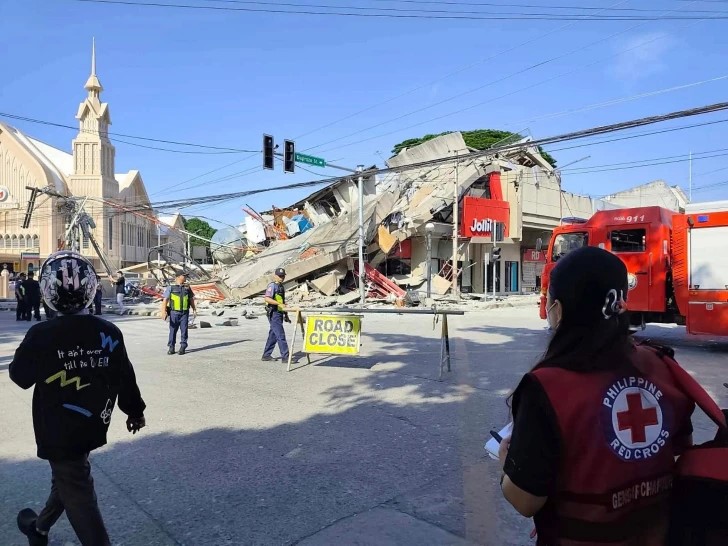
RESCUE operations continued across the southern Philippines on Tuesday as authorities worked to ensure no survivors remained trapped beneath the rubble of collapsed buildings, a day after one of the strongest earthquakes to strike the country in decades killed at least 37 people and displaced tens of thousands.
The 7.8 magnitude earthquake, centred offshore near Mindanao, struck on Monday morning and has left widespread devastation across multiple provinces, with officials confirming that more than 32,000 people have been forced from their homes and nearly 500 injured.
AP reported on Wednesday that while only four people were officially listed as missing, the Office of Civil Defense said multiple severely damaged and collapsed structures still required thorough inspection as rescuers worked methodically through debris in search of possible survivors.
Authorities warned that aftershocks could further destabilise already weakened buildings, raising concerns about secondary collapses as search efforts continue.
The earthquake triggered panic across coastal communities, with fears of a tsunami prompting mass evacuations.
Waves measuring up to 1.4 metres above tide level were recorded in parts of the Philippines, although structural damage from the sea surge was limited to a small number of stilt houses in a coastal village. Smaller waves were also observed in Indonesia, Palau and southern Japan.
Images from General Santos, a major coastal city known as the country’s tuna capital with a population exceeding 700,000, showed widespread damage, including collapsed buildings and debris strewn across urban areas.
At least 13 people were killed in General Santos due to building collapses and falling debris, while officials reported that another 18 died in Sarangani province, largely as a result of a landslide that buried homes in the mountain town of Glan, according to disaster response authorities.
Additional fatalities were recorded in South Cotabato, Davao Occidental and Balut Island, officials confirmed.
The scale of destruction has extended beyond human casualties, with initial government assessments indicating around 2,500 homes and 117 public buildings and facilities have been damaged across affected regions.
Transportation infrastructure has also been severely disrupted, with General Santos International Airport remaining closed for a second consecutive day. The shutdown has resulted in the cancellation of 63 domestic flights, although limited humanitarian operations have been permitted.
The disaster struck on the first day of the new school term following a two-month break, with thousands of school buildings now requiring structural assessments before reopening. Officials said approximately 6,000 public school facilities in affected provinces must be inspected for safety.
Many of those injured were students who had gathered for morning flag-raising ceremonies when the earthquake hit, underscoring the suddenness and severity of the disaster.
“We cannot force the immediate reopening of schools because we have to ensure the integrity of the buildings,” said Rafaelito Alejandro of the Office of Civil Defense.
The earthquake, which originated at a depth of 33 kilometres along the Cotabato Trench, is the strongest to hit the Philippines since a devastating 8.1 magnitude quake in 1976 that triggered tsunami waves and killed about 8,000 people, according to the Philippine Institute of Volcanology and Seismology.
Director Teresito Bacolcol said the 1976 event produced tsunami waves reaching between 8 and 10 metres, devastating multiple coastal communities.
The Philippines, located along the Pacific “Ring of Fire”, remains one of the world’s most disaster-prone nations, frequently affected by earthquakes, volcanic activity and an average of 20 typhoons annually.
In response to the latest disaster, President Ferdinand Marcos Jr has deployed senior defence and disaster mitigation officials to oversee rescue operations, coordinate humanitarian assistance and assess damage to critical infrastructure including roads and bridges.
International partners, including the United States, France, Japan and New Zealand, have expressed support and indicated readiness to assist Philippine recovery efforts.
As rescue teams continue combing through damaged structures, authorities warn that the full scale of the disaster may yet evolve as assessments progress and aftershock risks persist across already fragile communities. - June 10, 2026