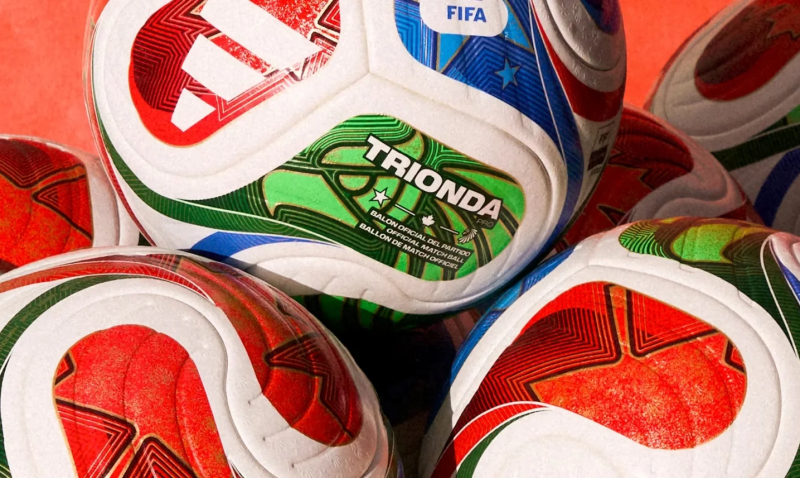
THE official FIFA World Cup ball, Adidas Trionda, has sparked growing controversy among football analysts and former international goalkeepers after reports emerged that its flight characteristics are proving unusually erratic, contributing to a series of high-profile errors and long-range goals at the tournament.
Two former England goalkeepers, Paul Robinson and Joe Hart, have raised concerns that elite shot-stoppers are being unfairly exposed by the ball’s unpredictable movement, which they argue is distorting defensive performance standards at the highest level.
Several prominent goalkeepers have already been affected, including England’s Jordan Pickford, who was beaten by a long-range strike from Martin Baturina during England’s 4-2 victory over Croatia, as well as former Chelsea goalkeeper Édouard Mendy, who conceded from distance against Kylian Mbappé.
Even veteran shot-stoppers have not been immune, with Argentina goalkeeper Luca Zidane reportedly struggling to read the trajectory of Lionel Messi’s early goal in a match against Algeria, where Messi went on to complete a hat-trick.
Speaking on a BBC sports analysis programme, Joe Hart said the ball’s micro-movements were making it significantly harder for goalkeepers to judge shot trajectories in real time.
"I really feel the ball is arriving at the goalkeeper far quicker than they expect once it is struck.
"Just look at the Jordan Pickford situation, he has already committed to the dive, but the ball suddenly seems to accelerate towards him at great speed. Even Édouard Mendy, a Champions League winner, was unable to time it correctly," Hart said.
Paul Robinson, also speaking on the programme, suggested that environmental and geographical conditions across North America could be amplifying the ball’s unpredictable behaviour.
"There are one or two situations where the ball is not behaving as it should. Take England’s match, for example, played in an air-conditioned indoor stadium. That certainly has an effect.
"Then you also have high altitude in Mexico City and the hot weather in Boston and New Jersey. All of these conditions will influence how the ball moves," Robinson explained.
Statistical trends from the tournament appear to support growing debate over attacking output, with 10 goals already scored from outside the penalty area and an average of 3.18 goals per match — the highest since the 1966 World Cup.
Players including Romano Schmid of Austria, Nathan Saliba of Canada and Sweden’s Yasin Ayari, who has scored twice from distance, have all capitalised on the conditions and the ball’s behaviour.
Despite the concerns, Hart believes the situation will stabilise as the tournament progresses and players adjust.
"I think as the tournament goes on, goalkeepers will start to adapt to the atmosphere and the speed of the ball.
"After that, we will start seeing these kinds of shots being saved," he said. - June 21, 2026

.jpg)






_director_Datuk_M._Kumar.jpg)