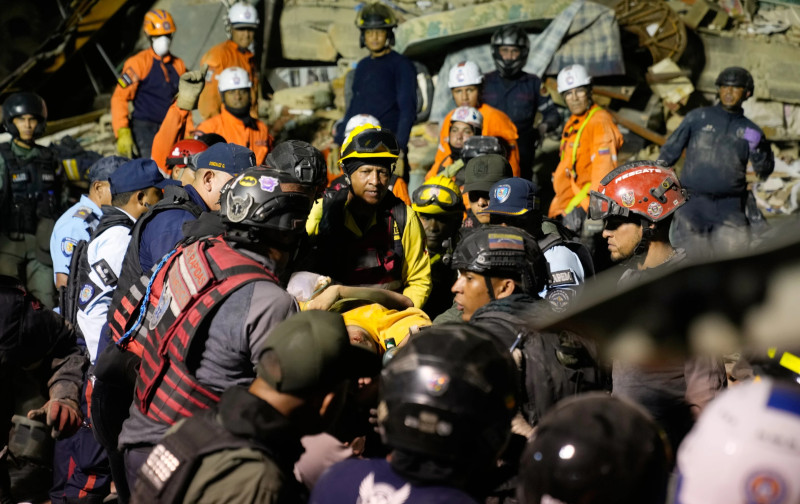
VENEZUELA has been plunged into a major national emergency after twin powerful earthquakes tore through the country on Wednesday evening, leaving at least 32 people dead, more than 700 injured and dozens of buildings reduced to rubble.
AP cited Acting President Delcy Rodríguez declaring a state of emergency late Wednesday as rescue teams raced against time to search collapsed structures and reach communities devastated by one of the strongest seismic events to strike the South American nation in more than a century.
The disaster began shortly after 6pm when a magnitude 7.2 earthquake struck off Venezuela's Caribbean coast west of Caracas. Less than a minute later, a second and even stronger magnitude 7.5 tremor rattled the same region, unleashing widespread destruction across several states.
Rodríguez warned that casualty figures were expected to increase significantly as emergency workers gained access to severely affected areas.
The official toll released early Thursday did not include La Guaira state, which authorities described as the epicentre of the catastrophe.
“Dozens of buildings have collapsed there, about 30 kilometres north of Caracas, and we are currently carrying out intensive rescue operations to save lives,” Rodríguez said.
The government designated La Guaira a disaster zone after reports of extensive structural collapses and large-scale rescue efforts involving emergency services and military personnel.
The earthquakes triggered scenes of panic across the country as residents fled homes, offices and apartment blocks while buildings swayed violently. In Caracas, streets filled with frightened residents as dust clouds rose from damaged structures and debris-strewn roads.
Large sections of the capital experienced power outages and disruptions to mobile communications, complicating efforts by families to contact loved ones.
“It started off gently and then gradually grew, and in the end, we all had to leave our houses, go outside and gather together,” said Caracas resident Hector Ricci.
Another resident, Roberto Gamas, described the force of the tremors as unlike anything he had previously experienced.
“The building really shook from side to side. Unreal. The force was incredibly strong.”
The devastation prompted authorities to suspend classes nationwide for several days, while some schools were converted into temporary shelters and aid distribution centres.
Rodríguez also announced the closure of Simón Bolívar International Airport near Caracas following damage to facilities, while subway operations and natural gas services in the capital were suspended as a precaution.
“We urge our population to remain calm,” she said.
“We urge unity.”
Hospitals across affected regions were placed on emergency footing, with healthcare professionals instructed to report for duty as medical facilities prepared for a continuing influx of casualties.
In Falcon state, Governor Víctor Clark said at least 32 people had been hospitalised and rescue teams were searching for 15 individuals believed trapped beneath collapsed structures.
The earthquakes were felt far beyond Venezuela's borders. Buildings were evacuated in cities across Brazil's Amazon region, more than 1,700 kilometres from Caracas, while tremors were also reported in parts of Colombia. No major damage or casualties were reported outside Venezuela.
Interior Minister Diosdado Cabello urged residents to remain vigilant amid continuing aftershocks and warned against re-entering damaged buildings.
“We understand that some people may be desperate, but we are acting according to protocols to activate aid and rescue efforts to help those who need it most,” he said.
“Be very careful with children and the elderly. Call each other and check that no one has been harmed.”
The disaster triggered an international response, with governments across the Americas offering assistance.
The United States announced the deployment of a disaster assistance task force to coordinate search-and-rescue operations, humanitarian support and medical aid in cooperation with Venezuelan authorities.
Messages of solidarity and offers of assistance also came from Argentina, Bolivia, Brazil, Chile, Ecuador, El Salvador, Mexico, Panama and Uruguay.
El Salvador President Nayib Bukele expressed support for the Venezuelan people, writing: “We send you all our solidarity and our prayers. Stay strong, Venezuela.”
Ecuadorian President Daniel Noboa pledged immediate humanitarian assistance, saying: “Ecuador will respond with the speed and commitment this moment demands because, despite our enormous differences, humanity must always guide the actions of a leader.”
Opposition leader María Corina Machado, speaking from exile, also appealed for national unity as the country confronted the crisis.
“May strength, serenity, and solidarity prevail among us in the face of this difficult time,” she said.
Although Venezuela sits near the boundary between the South American and Caribbean tectonic plates, major earthquakes of this magnitude remain relatively uncommon. The twin tremors nevertheless underscored the country's seismic vulnerability and revived memories of historic earthquakes that have devastated parts of the nation in previous centuries.
As rescue operations continue and aftershocks persist, authorities fear the scale of the disaster may become significantly clearer in the coming days, with thousands of residents displaced and critical infrastructure damaged across multiple regions. - June 25, 2026