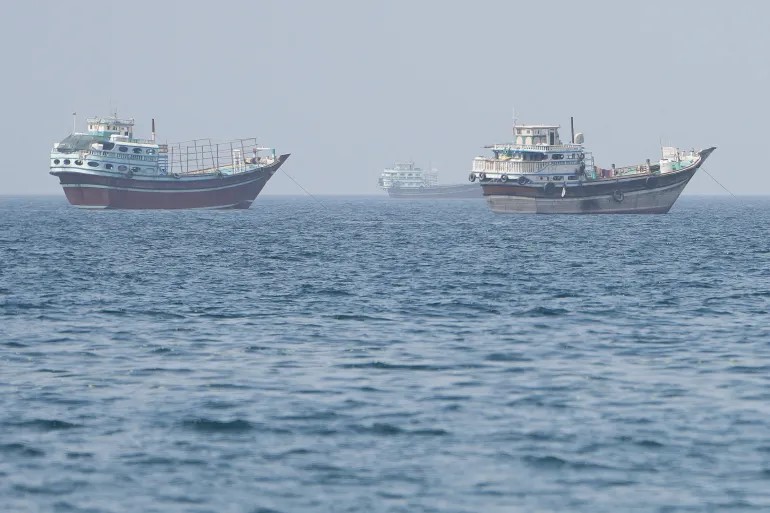
IRAN has successfully transformed its ability to restrict commercial passage through the Strait of Hormuz into a formidable economic weapon during its conflict with the United States and Israel.
According to data from IMF PortWatch, an average of only four ships per day passed through the strait in the seven days ending August 2, a staggering drop from approximately 90 ships daily during the corresponding week in 2025.
Over the same period, daily transit volume plummeted from 3.5 million metric tonnes to roughly 143,000 metric tonnes, marking a 96 percent decline in both key metrics.
Aljazeera reported on Saturday that the sharp drop represents a sustained disruption rather than a short-lived anomaly. Commercial vessel movements and estimated tonnage have remained far below historic baselines since February 28, confirming Tehran's ability to exert prolonged control over the maritime corridor.
Analysts highlight that Iran's operational strategy fits the concept of "weaponised interdependence", a framework where control over critical international hubs is converted into coercive political power.
In Hormuz, geography grants Iran direct command over a choke point vital to global markets. In 2025, nearly 20 million barrels of crude oil and petroleum products traversed the strait daily, representing a quarter of the world's seaborne oil trade, with 80 percent bound for Asian markets.
Furthermore, Qatar and the United Arab Emirates rely on the passage for nearly one-fifth of global liquefied natural gas exports, facing a lack of viable alternative shipping routes.
The financial fallout extends well beyond direct blockades. Rising threat levels from potential drone strikes, sea mines, and vessel seizures immediately drive up marine insurance premiums, freight rates, and shipping delays.
Research indicates these systemic disruptions trigger broader economic shocks that ripple through international supply chains.
By controlling the choke point, Tehran exerts indirect pressure on multiple global actors simultaneously. Gulf nations face threats to state revenues, Asian importers like India endure rising energy costs, and the United States remains vulnerable to global price spikes and expensive naval deployment requirements.
The disruption also threatens emerging strategic industries, including the Gulf's expansion into artificial intelligence infrastructure, which relies on affordable energy to support large-scale data centres.
Beyond fossil fuels, the strait is a critical conduit for agricultural inputs and specialised manufacturing materials. Recent agricultural studies show that countries such as India source up to half of their imported ammonia and nitrogen fertilisers from Gulf nations, leaving global crop yields and food security exposed to transit interruptions.
Additionally, Qatar and the UAE supply critical quantities of helium via Hormuz. Essential for semiconductor fabrication, medical imaging, and scientific research, helium shortages directly impact economies responsible for over 60 percent of global integrated-circuit exports, linking the regional dispute to high-tech manufacturing and healthcare systems worldwide. - August 8, 2026


.JPG)