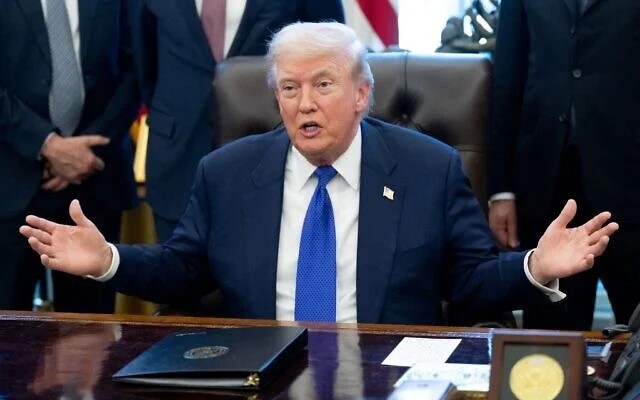
US President Donald Trump has demanded that Iran pay compensation for deaths and damage linked to wars, attacks and protests, adding a new hurdle to negotiations aimed at ending the conflict and reopening the Strait of Hormuz.
Trump’s demand came in response to conditions set by Tehran for a peace deal, including compensation, the lifting of sanctions and guarantees against further military threats.
Iran’s demands broadly reflect the terms of a preliminary peace agreement reached in June, although the arrangement has since collapsed.
“We're going to ask for money for the damage they’ve done over a 50-year period,” Trump told reporters at the White House, saying the payments should cover deaths involving civilians and US forces in the region.
“So, if there's damages to be paid, I think Iran should pay those damages,” he said.
The development came as oil prices settled about 5% higher on Monday, with Trump’s demands dimming hopes of an imminent agreement to restore shipping through the strategic waterway.
Trump also called on Iran to compensate the families of 17 US sailors killed in the October 2000 attack on the USS Cole in Yemen, although the attack was attributed to al-Qaeda rather than Iran.
“Also, with respect to the Iran negotiations, Iran should be responsible for the damages and death caused to the people of Lebanon, Syria, Yemen, and Gaza!” Reuters cited Trump saying in a post on Truth Social.
He also referred to Iran’s crackdown on demonstrations in late 2025 and 2026, claiming that about 52,000 protesters had been killed as of six weeks ago.
However, the US-based Human Rights Activists News Agency reported about 7,000 deaths in February, including around 6,500 protesters.
Trump has repeatedly alternated between threatening further escalation and suggesting that a peace agreement is close since the conflict began in February.
His latest demands came as Iran said negotiations with Oman over arrangements for the Strait of Hormuz were moving towards a final agreement, including the establishment of new shipping lanes.
Iranian Foreign Ministry spokesman Esmaeil Baghaei said the talks were “progressing smoothly and constructively”, with the two sides having agreed on a map for shipping routes, although several technical issues remained unresolved.
The discussions also covered maritime services, including safe navigation, environmental protection and efforts to combat crime.
However, US officials have repeatedly rejected any arrangement that would allow Tehran to impose fees for access through the strait.
The waterway, through which roughly a fifth of global oil and liquefied natural gas supplies passed before the conflict, has remained effectively blocked since the war began, contributing to higher energy prices and inflation.
Trump has maintained that the US Navy controls the strait, saying on Monday: “The only one that has control of the Strait of Hormuz right now is the United States Navy.”
However, months of US military operations, including a two-week campaign of strikes in July, have failed to break Iran’s effective control over the waterway.
Washington and Tehran agreed to a ceasefire in June, but the United States reimposed a blockade on Iranian shipping in July, which Tehran said breached the truce.
Iran has since retaliated with missile and drone strikes against US allies in the region and targeted commercial vessels attempting to transit the strait without its permission.
The standoff is also putting political pressure on Trump ahead of November’s midterm elections, with elevated fuel prices emerging as a major concern, particularly in rural areas that have traditionally supported him.
“What you're seeing here is the beginning of a capitulation,” Democratic US Representative Bill Keating said on CNN. “This is reality. It's sinking in.”- August 11, 2026