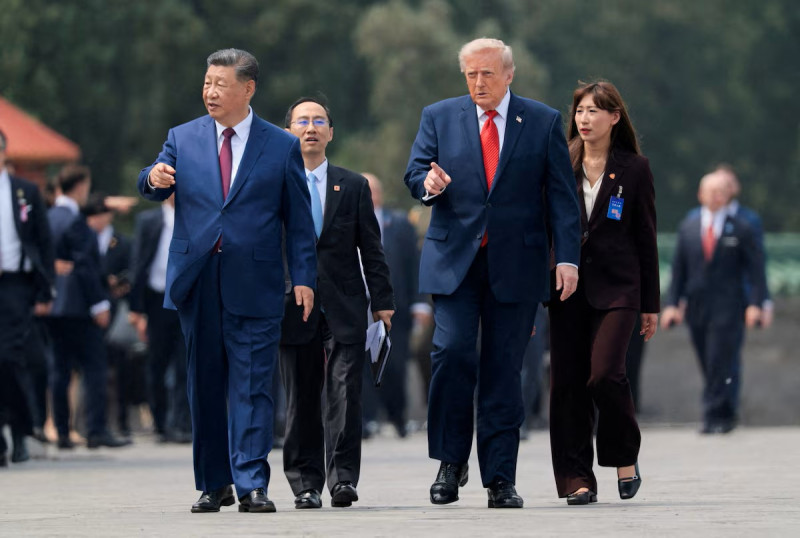
CHINA’S President Xi Jinping heads into his Sept 24 summit with US President Donald Trump with China’s export engine still running strongly, tempering expectations that Beijing will make major concessions as the two sides seek to extend a trade truce.
The leaders’ meeting comes four months after their last summit, with China’s global trade surplus on track to exceed US$1 trillion for a second consecutive year despite US efforts to curb Chinese exports through tariffs and trade restrictions.
Analysts cited by Reuters said the main focus of the Washington meeting would be whether Trump and Xi could signal an extension of the trade truce agreed last year, which helped avert a major shock to the global economy.
"Xi is not really looking for anything tangible. He wants to extend the gentleman's agreement with Trump so that China has time to fortify itself," said Jon Czin, a foreign policy expert at the Brookings Institution and former China director at the US National Security Council.
White House officials have sought to play down expectations of a major breakthrough, while US Treasury Secretary Scott Bessent and Chinese Vice Premier He Lifeng held preparatory talks in New York on Sunday aimed at laying the groundwork for possible agreements on artificial intelligence safeguards and trade in non-sensitive products.
The summit comes after Trump's 2025 return to the White House, when he vowed to use tariffs to tackle what he described as a trade imbalance with China.
But since agreeing the truce with Xi in October last year, Trump's attention has also been drawn to the wars in Iran and Ukraine and disputes with European allies.
China, meanwhile, continues to face weak domestic demand and a prolonged property crisis, but its exports have remained resilient.
More than half of the roughly 6,500 product categories China has sold to the United States so far this year have recorded growth from 2025, according to Reuters analysis.
The Chinese delegation accompanying Xi to Washington is also expected to include business leaders, potentially including executives from companies facing US regulatory scrutiny as they seek greater access to the American market.
"The Trump administration thought they could use massive unilateral pressure to force China to make concessions, and that did not occur," said Scott Kennedy, an expert on US-China economic relations at the Centre for Strategic and International Studies.
"Now this is Xi Jinping's world, and we're all living in it."
Taiwan is expected to be another sensitive issue at the summit, with US allies in Asia watching closely for any change in Washington's approach towards the democratically governed island claimed by Beijing.
Xi repeatedly raised Taiwan during his May meeting with Trump in Beijing, including the issues of US arms sales and Washington's resolve to defend the island, Trump has said.
Trump has described a pending US$14 billion arms package for Taiwan as a "negotiating chip" with Beijing, raising concerns among officials in Taipei and Tokyo that the issue could become part of broader negotiations.
Potential Chinese commitments on purchases of US goods, including Boeing aircraft and agricultural products, or efforts to curb the flow of fentanyl precursor chemicals could form part of any trade-related agreements.
"China-US ties have become more transactional," said Wu Xinbo, a professor at Shanghai's Fudan University who advises China's foreign ministry.
While Washington may prioritise trade, Beijing could place greater emphasis on Taiwan, he said.
"If you accommodate our concern on the Taiwan issue, then we would be willing to accommodate your concerns on other issues, be it law enforcement or on purchases of US agricultural products," Wu said.
Washington also sees Beijing as potentially influential in efforts to end the war in Iran, given China's economic ties with Tehran.
However, China has shown little inclination to use that leverage, with Reuters reporting earlier this month that Chinese goods worth billions of dollars were continuing to reach Iran through a sanctions-evasion scheme. China's Foreign Ministry has said it was not aware of such a scheme.
"For Trump, that is Iran. For Xi, that is building out China's domestic resilience for whatever comes after Trump," said Ruby Osman, senior geopolitical researcher at the Tony Blair Institute for Global Change. - September 21, 2026