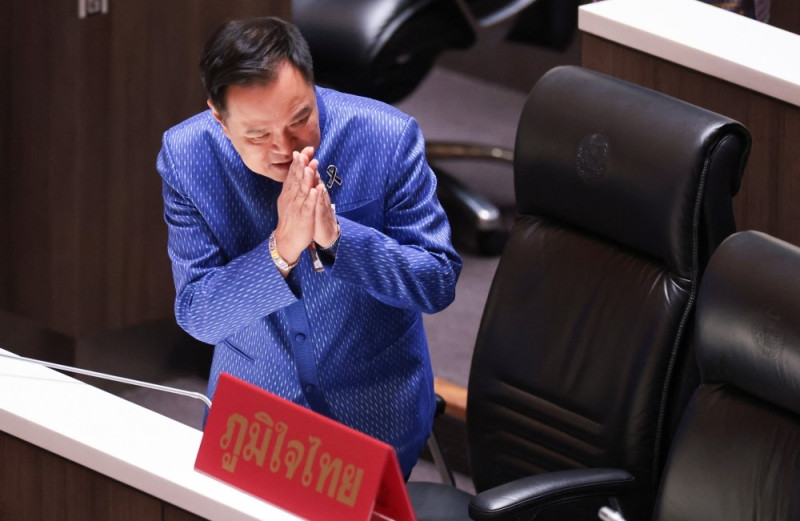
THAILAND’S Constitutional Court has dismissed a challenge to the legality of February’s general election, removing the prospect of a nationwide rerun and allowing Prime Minister Anutin Charnvirakul’s government to continue its mandate.
The court ruled on Monday that barcodes and QR codes printed on ballot papers did not violate constitutional guarantees of direct and secret elections, despite concerns that the markings could potentially allow votes to be traced to individual voters.
The case centred on unique barcodes and QR codes printed on ballots and corresponding stubs containing voter information. The Election Commission had said the identifiers were intended to prevent fraud and ensure ballots could be properly accounted for.
The court found that sufficient safeguards were in place to make it difficult to match voters with their ballots by using the three relevant components — voter rolls, ballots and voting stubs.
It said QR codes used on constituency ballots could not help identify voters, while barcodes used on party-list ballots could potentially lead to voter identification.
The court nevertheless concluded that the system did not violate constitutional principles protecting political expression and ballot secrecy.
Reuters reported today that the ruling ends the immediate legal uncertainty over an election won decisively by Anutin’s Bhumjaithai Party, which formed a coalition government controlling more than 290 of parliament’s 500 seats. Nearly 38 million Thais voted in the Feb 8 election.
The court also urged the Election Commission to consider using ballots without identifying markings in future elections, after acknowledging that the system had fuelled public mistrust.
The decision removes the prospect of another national election only seven months after the February vote, reducing a source of political uncertainty for investors and businesses as Thailand grapples with weak domestic demand, high household debt and elevated energy costs.
Thailand’s economy is projected to grow by about 2.5% this year, while the benchmark SET Index has gained more than 25% since the start of the year.
Anutin nevertheless faces political pressure, with a National Institute of Development Administration survey showing his support as a preferred prime minister fell to 13.76% in September from 21.7% in June. The nationwide telephone survey of 2,500 people was conducted from Sept 18 to 23.
Bhumjaithai’s support stood at 12.08%, according to the same poll, behind the People’s Party at 35.40% and Pheu Thai at 18.44%.
Thailand’s courts have annulled national elections before. In 2006, the Constitutional Court nullified an election amid concerns including ballot secrecy and other irregularities. The military ousted then-prime minister Thaksin Shinawatra four months later, ushering in another period of political upheaval. - September 28, 2026

.jpeg)