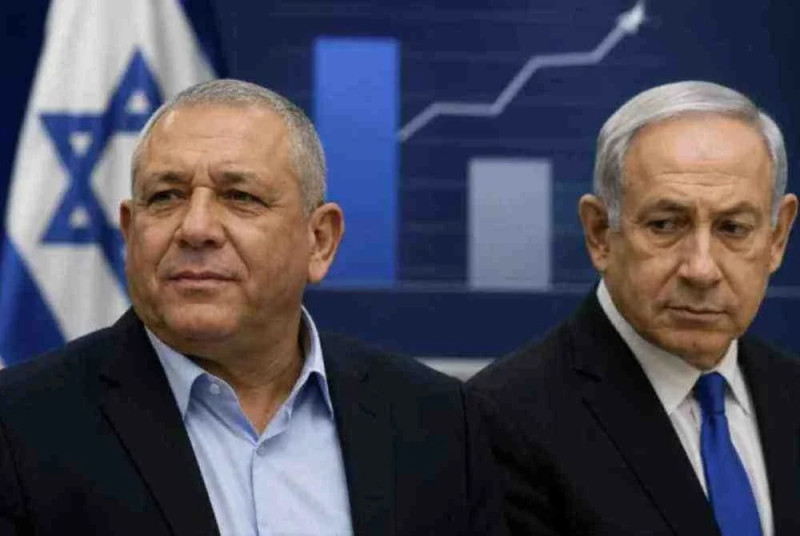
FORMER Israeli army chief Gadi Eisenkot's political bloc has launched a legislative push to reverse key policies of caretaker Prime Minister Benjamin Netanyahu as the country's new parliament convened amid uncertainty over the formation of a government.
Eisenkot's Yashar party submitted a series of proposals on Nov 10, including establishing an independent commission of inquiry into the security failures that allowed Hamas to carry out its Oct 7, 2023 attack on Israel, a move Netanyahu has long opposed.
AP reported on Wednesday that the party also proposed a sweeping repeal of the judicial overhaul introduced by Netanyahu's government, which had triggered some of Israel's largest protests before being overshadowed by nearly three years of war.
The legislative moves came as Eisenkot's broad political bloc secured sufficient support in the 120-member Knesset to appoint a new speaker, former senior military figure Matan Kahana.
Outgoing Speaker Amir Ohana, a Netanyahu ally, said he had approved a request by 67 lawmakers to hold a vote on his successor on Nov 17, despite opposing the emerging coalition's intentions.
However, neither Eisenkot nor Netanyahu has secured the 61 seats required to form a government.
Eisenkot, who was tasked by President Isaac Herzog with forming the next administration, has pledged to establish a national-emergency government as soon as possible.
Netanyahu, Israel's longest-serving prime minister, meanwhile renewed his appeal for a national-unity government, citing what he described as an escalating threat from Iran.
Speaking after the opening parliamentary session, Netanyahu warned of mounting international pressure to accept a nuclear-armed Iran and the continued rule of its clerical leadership.
Iran has denied seeking nuclear weapons, while Netanyahu and US President Donald Trump have previously claimed that Israeli and US military strikes had severely damaged its nuclear programme.
Eisenkot dismissed Netanyahu's remarks as a "shameful" exploitation of the parliamentary session, accusing him of being unfit to remain in office.
His Yashar party also cancelled a planned Nov 11 meeting with Netanyahu's Likud party, accusing the caretaker premier of prioritising his political survival over national unity.
Dispute Over Arab-Israeli Support
The formation of a new government remains complicated by divisions over the role of Arab-Israeli lawmakers, whose support has become crucial to Eisenkot's bloc.
Eisenkot's choice for parliamentary speaker is expected to secure approval with backing from Arab-Israeli lawmakers, whose representation has increased amid opposition to Netanyahu's far-right government.
However, right-wing bloc member Avigdor Liberman has ruled out serving in an administration dependent on Arab-majority parties.
Tensions were evident during the opening session, when several Arab-Israeli lawmakers left the chamber during the national anthem rather than stand for it.
Liberman criticised the walkout on social media, questioning whether Eisenkot intended to form a government with the lawmakers.
Far-right caretaker National Security Minister Itamar Ben Gvir also heckled Joint List leader Yousef Jabareen during the session, questioning his allegiance.
Meanwhile, Raam leader Mansour Abbas pledged to support efforts to replace Netanyahu's government, saying his party aspired to be "part of the solution".
Ultra-Orthodox parties hold key numbers
Liberman has instead advocated an alliance with ultra-Orthodox Jewish parties, despite his longstanding opposition to their exemption from compulsory military service.
Eisenkot's core bloc holds 48 seats but could secure a parliamentary majority with support from the 19 Arab-Israeli lawmakers, either through participation in government or external backing.
The two ultra-Orthodox parties control 13 seats, with United Torah Judaism, which holds seven, stopping short of reaffirming its support for Netanyahu.
That leaves Netanyahu's camp with 46 seats, prompting him to publicly urge the ultra-Orthodox parties to remain aligned with him.
"They're going to promise you the moon and the stars but one minute after, God forbid, they form a government run by the left, all of those promises will vanish," he said. - November 11, 2026