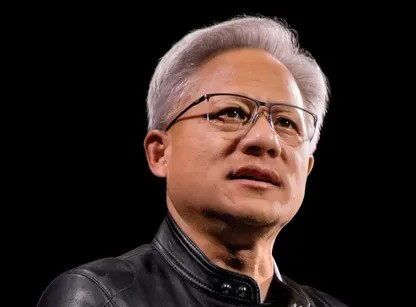
NVIDIA chief executive Jensen Huang's growing influence over the global artificial intelligence (AI) industry has raised concerns about the sector's dependence on a single individual, as the chipmaker expands its role beyond supplying the processors powering the AI boom.
Huang, 63, has become a prominent figure among technology investors and industry leaders, with his influence extending from controlling access to Nvidia's highly sought-after graphics processing units (GPUs) to financing companies across the AI ecosystem.
The company's growing financial resources have enabled it to invest in AI cloud-computing providers, suppliers and major AI laboratories, further deepening its involvement in an industry heavily reliant on its chips.
Analysts say the concentration of influence in Huang presents a potential vulnerability for the AI sector, particularly as Nvidia investigates whether he was targeted by foreign intelligence following revelations involving his alleged affair with a Chinese businesswoman accused of passing information to Beijing.
“It is hard not to read the news over the weekend as negative given it brings the stewardship of one of America's most important companies and the architect of the US AI trajectory under debate,” Reuters quoted Bernstein analyst Stacy Rasgon saying.
“Nvidia is not an ordinary company and Jensen is not an ordinary CEO; he is Nvidia, clearly sets the long-term strategy and direction, and pulls most of the company's strings himself.”
Huang's influence was illustrated in September 2024 when Oracle co-founder Larry Ellison recounted a dinner with Huang and Elon Musk, saying the two technology billionaires had effectively begged the Nvidia chief for more GPUs.
“I would describe the dinner as me and Elon begging Jensen for GPUs,” Ellison told analysts. “Please take our money... We need you to take more of our money.”
Beyond chip allocation, Huang has also emerged as one of the AI industry's most vocal advocates, repeatedly dismissing concerns about a potential investment bubble and challenging warnings that the technology could pose an existential threat to humanity.
His endorsement of companies and products can also move markets. A casual dinner in Seoul with the chief executives of Samsung and Hyundai in 2025 sent shares of two South Korean food companies soaring, while his description of Marvell Technology as a potential trillion-dollar company propelled the chipmaker's shares to record highs.
Huang, who co-founded Nvidia in 1993, maintains unusually tight control over the company through a relatively flat management structure, with more than 60 executives reporting directly to him, most of them in engineering-related roles.
Despite holding approximately 3.6 per cent of Nvidia as its fifth-largest shareholder, he does not possess the special voting shares that give founders such as Meta Platforms' Mark Zuckerberg and SpaceX's Musk majority control over their companies.
“The architecture of the company should reflect the environment in which it exists,” Huang said on the Lex Fridman Podcast in March, explaining his preference for a structure that allows senior executives to report directly to him.
His family members also occupy positions within Nvidia, with son-in-law Nico Caprez overseeing relationships with AI cloud-computing providers and data-centre operators, daughter Madison serving as a senior director responsible for marketing physical AI products, and son Spencer working in the robotics division.
Succession Concerns
The company's dependence on Huang has also raised questions about succession planning, with analysts saying Nvidia has no obvious replacement should he step down or become unable to lead.
Nvidia said over the weekend that Huang had the backing of its board, although the company has not publicly disclosed a succession plan.
“Jensen is not replaceable... there is no other person on the management team bench that can step in seamlessly as CEO,” said Dan Ives, partner and senior managing director at Yorkville Ives & Co.
Nvidia lists four other senior executives on its leadership page, including chief financial officer Colette Kress, who frequently represents the company at investor conferences.
The others are executive vice-president of worldwide field operations Nick Parker, executive vice-president of operations Debora Shoquist, and executive vice-president, general counsel and secretary Tim Teter. - November 10, 2026