CHINA is accelerating efforts to integrate artificial intelligence (AI) into its education system, targeting universal AI literacy among schoolchildren by 2030 as it seeks to strengthen its technological edge over the United States.
With nearly 200 million primary and secondary school students, China is undertaking one of the world's largest experiments in AI-assisted learning, although the nationwide push remains uneven and lacks a common framework for measuring students' AI capabilities.
A Reuters review of provincial education plans found that nearly half of China's provinces and municipalities have introduced binding AI education requirements, reflecting Beijing's determination to develop a generation of technology-savvy innovators.
Shanghai requires at least 30 hours of annual AI instruction for each school grade, while Beijing plans to incorporate AI into student health monitoring and establish 100 pilot demonstration schools.
Ningxia and Gansu, meanwhile, intend to include AI literacy in high-stakes school entrance examinations by 2027.
China's broader ambition is to move beyond basic familiarity with AI towards practical applications, advanced technological skills and critical thinking, with President Xi Jinping declaring AI education fundamental to educational reform.
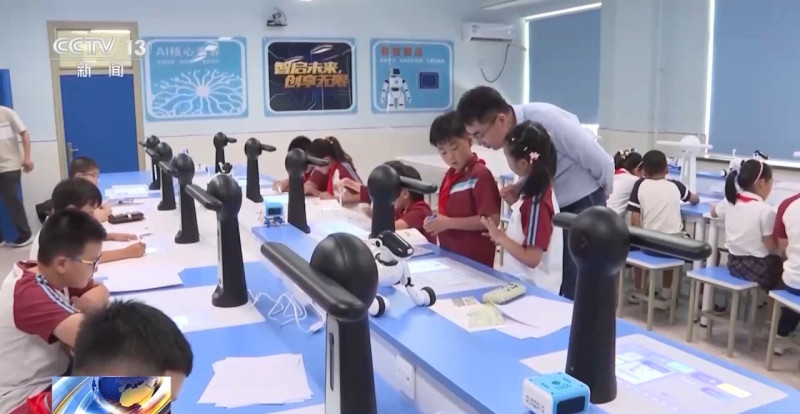
The push is also extending into classrooms, where AI is being used for personalised lessons, tutoring, coding and student monitoring.
At Beijing New Talent Academy, 13-year-old Peng Gaodi has used AI to develop more than 200 applications, including a homework-submission platform and a second-hand marketplace.
" In the past, if I couldn't solve a problem at home, I'd have to call my teacher, which increases their workload," Peng said. "But now I can just ask AI to help me learn better. It noticeably improved my learning efficiency."
The school has developed its own digital innovation curriculum covering AI, robotics and programming, while students also participate in coding workshops and build humanoid robots.
In rural Anhui province, Funan County Qinqing High School is using AI-generated lessons to address a shortage of qualified teachers.
Its 4,000 students, many from migrant-worker families, receive personalised lessons through tablets, with AI agents posing questions to guide students rather than simply supplying answers.
"An AI agent doesn't suffer from fatigue, and it never makes a student feel stupid for asking a basic question," headmaster Yang Tianliang said.
Yang credited the approach with helping increase university admission rates from below 60 per cent to 90 per cent in recent years, although Reuters could not independently verify the figures.
A Reuters review of more than 100 government procurement documents found that Chinese authorities committed at least US$31 million over the past year to AI classroom equipment, teacher training and educational platforms.
However, the rapid expansion is raising questions about whether students are developing genuine understanding or becoming increasingly reliant on technology.
China has yet to establish national standards for assessing AI literacy, leaving schools to adopt different approaches and making the effectiveness of programmes difficult to measure.
"Mature, widely adopted assessment rubrics for compulsory school-level AI competency are still being built," said Selena Guo, portfolio lead at research firm China Policy.
Research into AI's impact on children's learning has also produced mixed findings.
A study involving nearly 27,000 Chinese teenagers found AI adoption was associated with an 18 per cent improvement in homework scores but a 20 per cent decline in monthly examination scores within six months, particularly in social science subjects.
Another nationwide survey involving more than 320,000 pupils reported educational benefits but raised concerns over technology dependence and weaker independent thinking.
Students using AI at least three times a week showed lower memory, comprehension, analytical and creative skills than those using it less frequently.
The findings do not establish that AI use directly caused the decline, but they have reinforced concerns among educators about students increasingly outsourcing their thinking to technology.
Chen warned that children's reasoning abilities could be "completely bypassed" if schools failed to prevent them from relying on AI for quick answers.
Some educators and parents are therefore introducing safeguards to ensure AI supplements rather than replaces independent learning.
Peng said he tries to solve coding problems himself before turning to AI for hints rather than complete answers.
"I think AI is a tool that helps me, not something I depend on."
Beijing parent Rita Luan, whose 11-year-old daughter attends a leading public school, also supervises her daughter's use of AI tools at home.
She requires her daughter to spend 15 minutes attempting a difficult mathematics problem before seeking AI assistance, and later asks her to solve the same question independently.
"The point is to make sure she actually digested the solution," she said.
China's education ministry has encouraged schools since 2024 to introduce AI courses, train teachers and develop pilot programmes, but the absence of consistent national assessment standards remains a major challenge as the country pursues its 2030 target. - November 16, 2026