World

Iran says production of 60% enriched uranium ‘underway’

This follows the recent attack on its Natanz nuclear faciilty it blames on Israel

Updated 5 years ago · Published on 16 Apr 2021 11:00PM

Iran says production of 60% enriched uranium ‘underway’
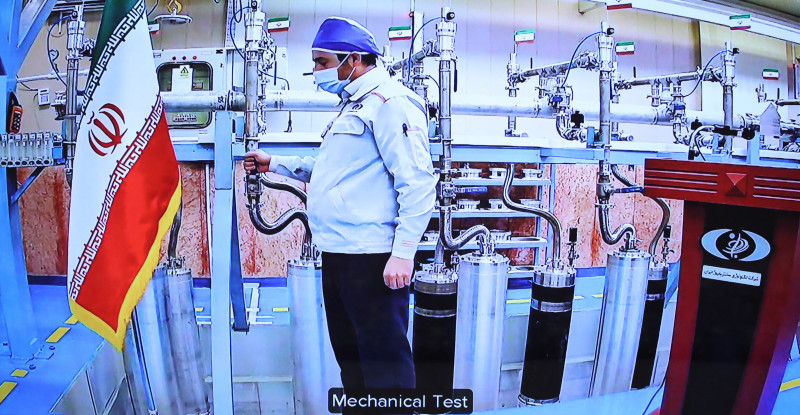
A handout picture provided by the Iranian presidential office shows a videoconference screen displaying an engineer inside the Natanz uranium enrichment plant. Scientists there are still working on how to install the two centrifuge lines Iran said would be dedicated to 60% enrichment operations. – AFP pic, April 16, 2021

TEHRAN – Iran said today it has begun producing uranium at 60% purity, in another breach of its commitments to the international community, which is concerned about its nuclear programme.

The Islamic republic had declared it would sharply ramp up its enrichment of uranium on Tuesday, two days after an attack on its Natanz nuclear facility that it blamed on arch-foe Israel.

The announcement cast a shadow over talks in Vienna aimed at salvaging the 2015 nuclear deal between Iran and world powers that former United States president Donald Trump abandoned almost three years ago.

Ali Akbar Salehi, head of the Atomic Energy Organisation of Iran, today confirmed the country was now producing uranium enriched to 60% purity.

“The enrichment of uranium to 60% is underway at the Martyr Ahmadi Roshan nuclear facility” in Natanz, he said, quoted by the Tasnim news agency.

“We are now getting nine grammes per hour,” Salehi said later on state television.

While production was underway, scientists at Natanz were still working on how to install the two centrifuge lines Iran said would be dedicated to 60% enrichment operations, Salehi said.

He added that it could see Iran’s production of 60% enriched uranium fall to six grammes an hour, but added that it would continue to make 20% enriched uranium on the same two lines.

The move to enrich uranium to 60% purity takes Iran closer to the 90% level required for use in a nuclear weapon.

The Islamic republic has gradually rolled back its nuclear commitments since 2019, a year after the US withdrew from the accord and began imposing sanctions.

The 2015 deal known formally as the Joint Comprehensive Plan of Action, or JCPOA, gave Iran relief from sanctions in return for curbs on its nuclear programme. – AFP, April 16, 2021
Related News

Opinion / 3d

US attacks in the Gulf show the weaknesses of MOUs

World / 1w

Iran’s My Lai: The Minab school bombing and the reckoning that never comes

World / 2w

Oil prices rise after Iran shuts Hormuz again, Trump threatens new attacks

Malaysia / 3w

The calm in the Strait of Hormuz could be very brief

World / 1mth

Iran announces closure of Strait of Hormuz to all vessels amid renewed US attacks

World / 1mth

Does Iran have nukes?

Spotlight

Malaysia

Anwar congratulates BN on Johor victory, assures federal government support

Malaysia

Johor PRN: BN officially forms state government, wins 29 seats

Malaysia

Malaysia-Thailand open historic border crossing to deepen trade, regional integration

By Ian McIntyre

Malaysia

Gerak Khas drama actress, Tisha Samsir denies drug involvement

Malaysia

Student stabbing: Teenage girl sent to Hospital Bahagia for psychiatric evaluation

Malaysia

Anwar wishes Tun M a happy 101st birthday

World

Israel shares intelligence with US over alleged Iranian plot to assassinate Trump

You may be interested

World

King Charles hosts Prince Harry and family in first reunion for years as royal rift eases

World

Iran Foreign Minister to hold Oman talks on Strait of Hormuz security

World

Venezuela earthquake death toll climbs to 4,118 as relief efforts intensify

World

Typhoon Bavi disrupts S’pore flights as Japan, Taiwan and China brace for severe weather

World

Fifteen Indian tourists killed after boat capsizes off Vietnam’s Phu Quoc Island

World

Minor earthquake shakes northern Thailand, no damage reported

World

Trump threatens 'complete destruction' if Iran attempts assassination

World

Trump: US and Iran to continue talks as Hormuz tensions overshadow fragile diplomacy