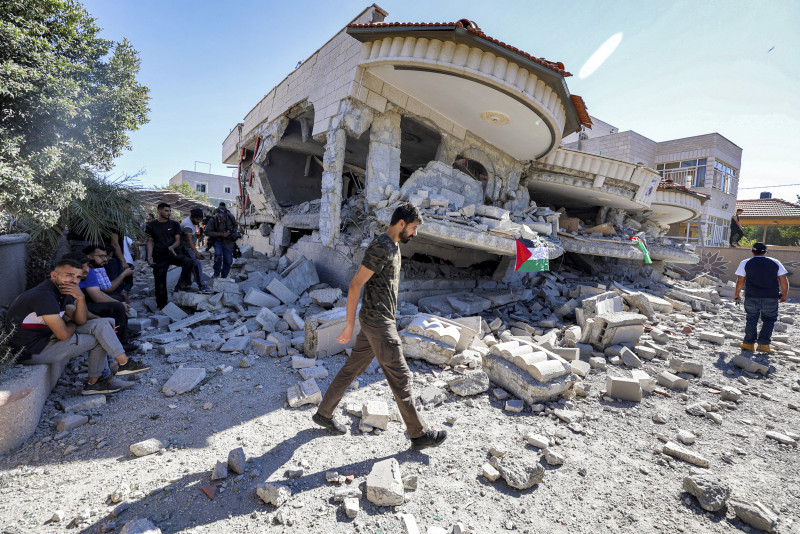
TURMUS’AYYA – The Israeli army yesterday said it has demolished the home of a Palestinian man with United States (US) citizenship accused of fatally shooting a Jewish student in the occupied West Bank.
The move was denounced by the US, which said the punitive demolitions of Palestinian homes “exacerbate tensions and undercut efforts to advance a negotiated two-state solution”.
An Israeli army spokesman confirmed that “troops demolished the residence of the terrorist (Montasser) Shalabi, in the village of Turmus’Ayya, northeast of Ramallah”.
Shalabi, 44, was arrested by Israeli forces in May after he allegedly fired on waiting passengers at a bus stop at Tapuah junction, south of Nablus in the northern West Bank.
The attack killed Yehuda Guetta, 19, a student at a seminary in the Itamar settlement, and wounded two of his friends.
Shalabi is in detention, but has not yet been convicted.
The demolition came after Israel’s top court rejected an appeal by Shalabi’s estranged wife, Sanaa, who claimed that his life centred on the US and that he made only occasional visits to the West Bank house.
The Supreme Court accepted the state’s position that the home belonged to Shalabi and that he spent time in it when he was in the West Bank, ruling that the army is, therefore, justified in carrying out a punitive measure at the property.
Sanaa, 40, told AFP that troops first arrived at 1am to place explosives around her home. The demolition operation lasted through the night and into the morning.
“This is our life. What happened to us is normal. We were prepared for it,” she said, and called her husband a “hero”.
“Security needs”
Israel believes that demolishing homes of assailants deters such attacks in future, but critics denounce the practice as unjustified collective punishment that often sees children lose their homes over the conduct of a parent or other relative.
The army said during the demolition “approximately 200 rioters hurled rocks and launched fireworks” at troops, who responded with “riot dispersal means”.
Shalabi does not live in the home that was destroyed, according to Israeli human rights organisation Hamoked, which unsuccessfully contested its demolition with Sanaa before the Supreme Court.
Executive director Jessica Montell said the couple were estranged. Sanaa lived in the home with three of their seven children. The whole family are also US nationals.
“The man accused of the attack does not live in the house,” she said, adding that he lived in the US and will come “once or twice a year”.
Sanaa “is not in any way involved, and didn’t know anything about the attack. We thought this should be grounds for not demolishing or just demolishing one room”, she added.
Montell said Shalabi suffers from mental illness, a claim that was raised in the court petition as well, but was rejected by the justices, who said he was examined after the attack and found to be mentally sound.
The demolition of homes and Israel’s overall conduct in the occupied West Bank is likely to cause friction between the US administration of President Joe Biden and Israel’s new prime minister, Naftali Bennett, a hard-line nationalist who previously ran a West Bank settler lobby council. – AFP, July 9, 2021

_-_AZIM_RAHMAN_2.jpg)