DURBAN – South Africans today cleaned up shopping centres and stores looted during a week of violence that rocked the country, claiming more than 200 lives and inflicting more than US$1 billion (RM4.2 billion) in damage.
Aid organisations also handed out food in communities that had been cut off from main roads or where food shops were ransacked in the unrest.
The violence – the worst in post-apartheid South Africa – erupted after former president Jacob Zuma was sentenced to 15 months in jail for snubbing a corruption inquiry.
His successor President Cyril Ramaphosa, who came to office promising to curb graft, said the riots were a “coordinated and well-planned attack” on the country’s young democracy.
“Using the pretext of a political grievance, those behind these acts have sought to provoke a popular insurrection,” Ramaphosa said in a televised address on Friday.
The rioting caused widespread destruction – estimated at 16 billion rand (RM4.7 billion) – leaving thousands of businesses trashed, including many retail shops that were specifically targeted.
South Africa is deploying 25,000 troops due to unrest linked to poverty and inequality. Over 70 people have been killed and hundreds of businesses damaged.
— AJ+ (@ajplus) July 15, 2021
Strict lockdowns have worsened post-apartheid inequalities, fueling poverty (55%), unemployment (32%) and police brutality. pic.twitter.com/snVsAdgNmk
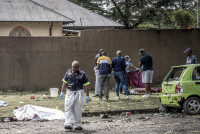
As an uneasy calm set in today, residents in the hard-hit KwaZulu-Natal province swept up debris at various sites, including at Dube Village Mall in Inanda township, north of Durban.
Behind them, walls topped with spikes and razor wire had been spray painted with the words “Free Zuma”.
Zuma, whose home province is KwaZulu-Natal, commands support among loyalists in the ruling African National Congress, who portray him as a champion of the poor.
As violence mounted after Zuma handed himself in to authorities last week, Ramaphosa addressed the nation today in a bid to defuse the simmering tension.
Just minutes later, recalls Sikhumukani Hongwane, who was working a shift as a private security guard at the mall, a mob of people set fire to a nearby garage and he fled.
Walking inside a charred shop, he describes the trauma for many: “We are scared, even now. All the memories... are coming back. We can’t sleep.”
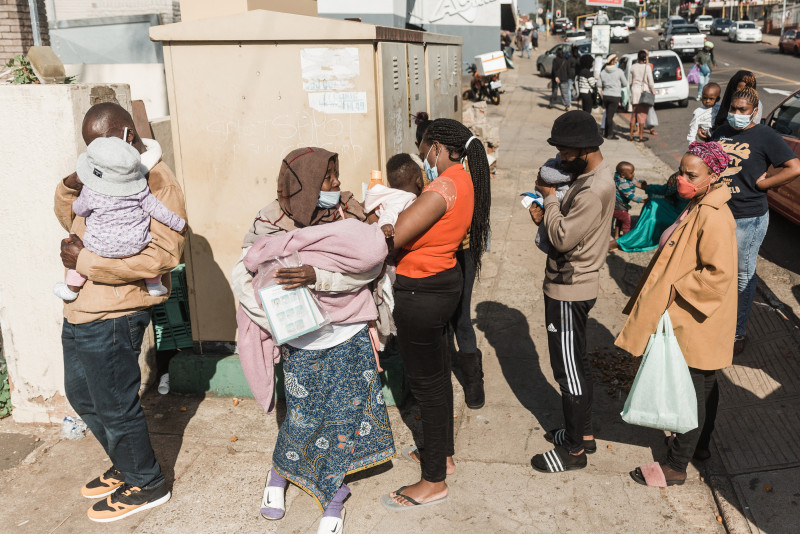
Many in the province are now going hungry after food stores were looted and burned, or cut off from suppliers as roads closed.
The government, charities, and religious groups were moving food to people in need, including hospital patients and families.
“We are loading bread for staff for five hospitals,” said Imtiaz Sooliman, leader of Gift of the Givers.
Footage shot from a helicopter shows fires at warehouses and people gathering outside truck depots in the north of Durban
— Sky News (@SkyNews) July 14, 2021
More than 70 people have been killed in the unrest, the worst in South Africa for years, and hundreds of businesses have been wrecked https://t.co/OxeTRI4I5H pic.twitter.com/v3e2cVIsy2
Sooliman said that his food convoys were being escorted by armed security. Journalists saw a supermarket delivery vehicle escorted by police.
“Yesterday we sent food for patients in private hospitals – they had no food to feed patients. They have all the money but they can’t buy anything, they called us saying patients haven’t eaten,” he said.
The organisation was also delivering food parcels door-to-door after a government minister told him on Friday that dozens of Durban areas had no access to food, Sooliman added.
The few shops that were spared only open for a few hours a day, and in some places the price of bread has almost doubled.
“It is mayhem because the few shops that are here cannot accommodate the whole community. The few stores we’ve got have snaking queues like people are going there to vote,” said Siyanda Nxumalo, a community activist in Inanda.
Traffic was back to normal along a main highway linking the north to the port city of Durban which had been closed for days.
But businesses in Durban want more security assurance: “As much as we are over the hurdle now, we are still scared,” Zanele Khomo of the Durban Chamber of Commerce and Industry said.
Ramaphosa said the instigators had “sought to exploit the social and economic conditions under which many South Africans live – conditions that have worsened since the onset of the coronavirus pandemic”.
It will take “a few months” for business to restore normal operations, he said.
Of the 212 people reported killed, some were shot and others died in looting stampedes.
On Thursday, the government said one of the suspected instigators has been arrested and 11 were under surveillance. It has given no update since then.
Ramaphosa admitted the government was “poorly prepared for an orchestrated campaign of public violence”.
Opposition politicians have condemned the handling of the crisis.
On the eve of Nelson Mandela’s birthday, the country’s first black leader, his widow Graca Machel, said she couldn’t “sit quietly as the land of his birth wages war with itself”.
“We must be courageous enough to interrogate and remedy the underlying causes of our discord,” she said in a statement ahead of July 18, international Mandela Day. – AFP, July 18, 2021